Account for the change in the spatial pattern of the Iron and Steel industry in the world.
Account for the change in the spatial pattern of the Iron and Steel industry in the world.
The Iron and Steel industry has experienced dramatic spatial transformation globally, shifting from traditional Western centers to emerging Asian economies, driven by technological innovation and changing economic dynamics.
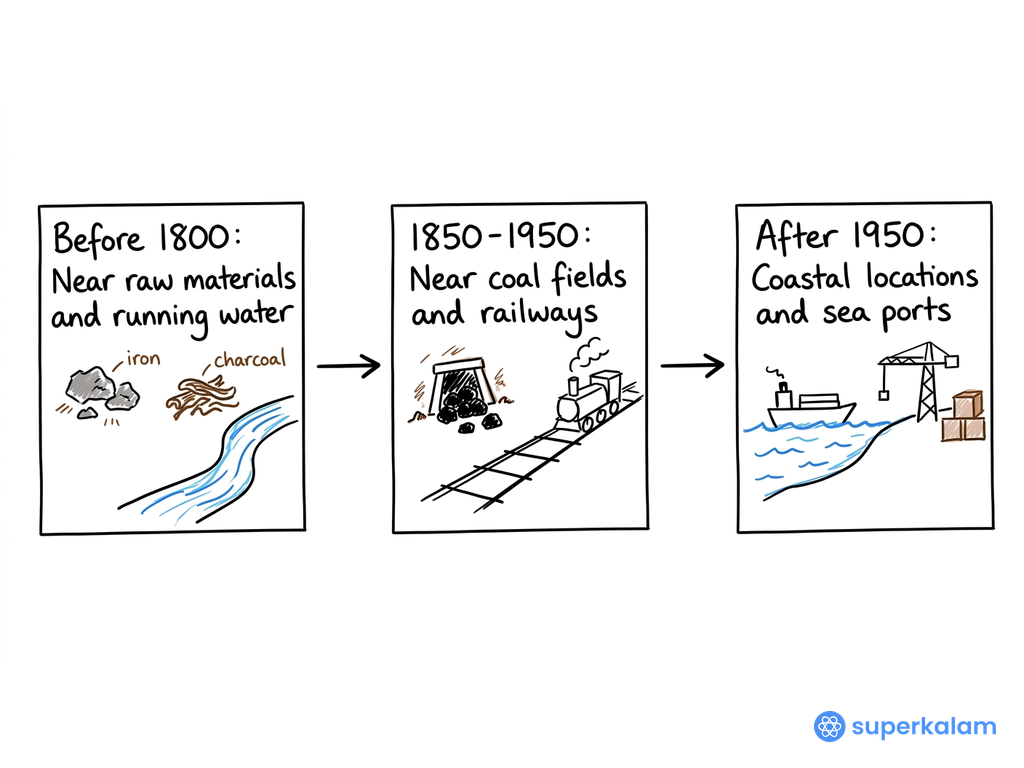
Iron and steel industry location changes
Historical Pattern and Traditional Centers
Early Development (1800s-1950s):
- Europe and North America dominated global production due to abundant coal deposits and early industrialization
- Major centers in Pittsburgh (USA), Ruhr Valley (Germany), and Birmingham (UK) leveraged proximity to coal and iron ore
- Technology transfer from Britain established steel production in colonies and dominions
- Transport infrastructure like railways connected raw materials to production centers
- Limited production capacity concentrated in developed Western economies
Contemporary Spatial Distribution
| Region | Leading Producers | Annual Production (Million Tonnes) | Market Share |
|---|---|---|---|
| Asia-Pacific | China, India, Japan | 1,300+ | 75% |
| Europe | Germany, Italy, Turkey | 160 | 10% |
| North America | USA, Canada, Mexico | 120 | 8% |
| Others | Russia, Brazil, Iran | 110 | 7% |
Factors Driving Spatial Change
-
Raw Material Access:
- Australia and Brazil emerged as iron ore exporters, enabling coastal steel plants
- Development of pelletization technology allowing efficient transport of low-grade ores
- Natural gas availability in Middle East enabling Direct Reduced Iron (DRI) production
-
Market Proximity:
- Rapid urbanization in Asia creating massive steel demand for infrastructure
- China's Belt and Road Initiative driving regional steel consumption
- Proximity to automobile and shipbuilding industries in South Korea and Japan
-
Technology and Investment:
- Electric Arc Furnace (EAF) technology reducing location constraints
- Foreign Direct Investment in developing countries establishing modern facilities
- Scrap steel availability in developed economies supporting mini-mills
Current Production Leaders and Trends
- China: Dominates with 1.01 billion tonnes (54% global share), though implementing capacity controls under 14th Five-Year Plan
- India: Second-largest producer with 140 million tonnes, targeting 300 million tonnes by 2030 under National Steel Policy
- Coastal Integration: Modern plants like POSCO (South Korea) and JFE (Japan) utilize imported raw materials
The spatial transformation reflects the industry's evolution from resource-based to market-oriented location strategy, with Asia's manufacturing boom and sustainable steel initiatives like India's hydrogen-based green steel projects shaping future geographical patterns.
Answer Length
Model answers may exceed the word limit for better clarity and depth. Use them as a guide, but always frame your final answer within the exam’s prescribed limit.
Evaluate this PYQ now
Write your answer & evaluate in just 60 seconds




500+ students evaluated
Model Answers from
- 2014World Geography10 MarksView Answer
How does India see its place in the economic space of rising natural resource-rich Africa?
- 2014World Geography10 MarksView Answer
Tropical cyclones are largely confined to the South China Sea, the Bay of Bengal and the Gulf of Mexico. Why?
- 2014World Geography10 MarksView Answer
Explain the formation of thousands of islands in the Indonesian and Philippines archipelagos.
Model Answers by Subject


Crack UPSC with your
Personal AI Mentor
An AI-powered ecosystem to learn, practice, and evaluate with discipline