In 2012, the longitudinal marking for high-risk areas for piracy was moved from 65 degrees east to 78 degrees east in the Arabian Sea by the International Maritime Organisation. What impact does this have on India’s maritime security concerns?
In 2012, the longitudinal marking for high-risk areas for piracy was moved from 65 degrees east to 78 degrees east in the Arabian Sea by the International Maritime Organisation. What impact does this have on India’s maritime security concerns?
The IMO's 2012 decision to extend the piracy high-risk zone from 65°E to 78°E significantly expanded maritime security challenges for India, bringing critical sea lanes closer to Indian territorial waters under threat assessment.
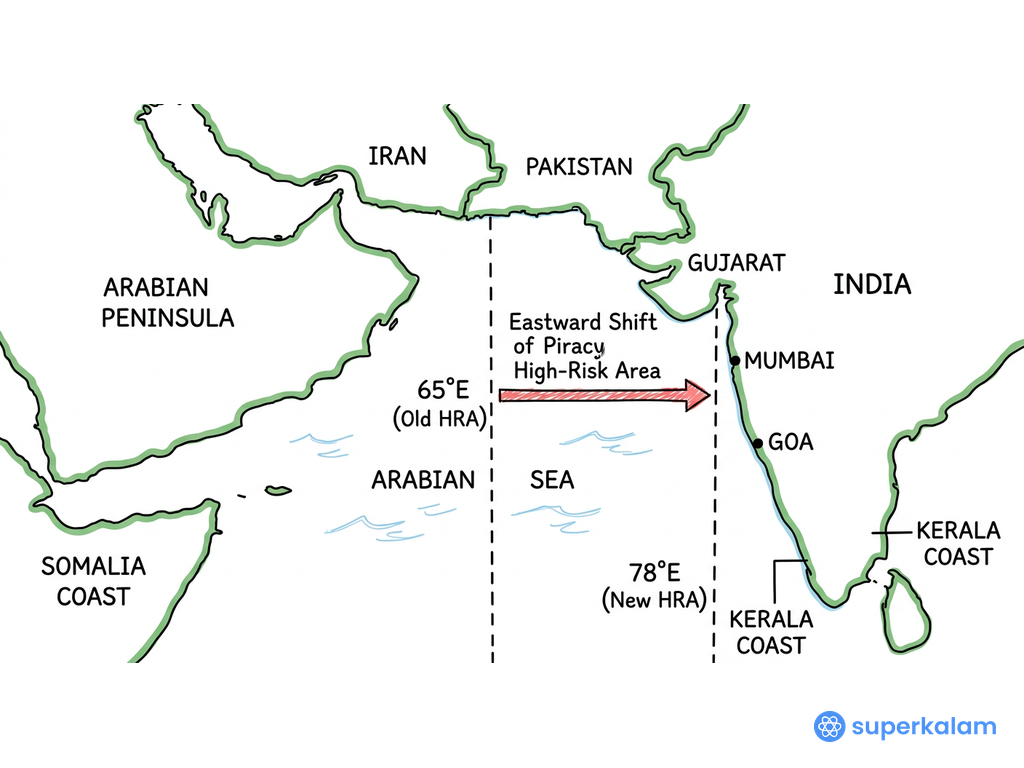
Arabian Sea and Western India Map
Enhanced Maritime Security Obligations
- Expanded Patrol Areas: Indian Navy and Coast Guard now monitor larger Arabian Sea expanse, requiring deployment of over 21 warships and 5,000 personnel for continuous surveillance
- Operation Sankalp: Launched comprehensive maritime security operations covering the extended high-risk zone with increased operational costs
- Surveillance Infrastructure: Enhanced requirement for radar coverage and AIS monitoring systems along western coast
- Coastal Security Network: Strengthened coordination between Marine Police, Coastal Police, and Central Marine Police Force
- Air Surveillance: Increased patrol flights exceeding 900 hours annually for maritime domain awareness
Strategic Trade Route Implications
- Economic Impact: Higher insurance premiums and security costs for vessels transiting India's major trade corridor
- SLOC Protection: Critical Sea Lines of Communication now fall within designated high-risk areas, affecting 60% of India's maritime trade
- Port Security: Enhanced security protocols at major ports like Mumbai, JNPT, and Kandla handling increased threat levels
- Commercial Shipping: Implementation of Best Management Practices (BMP-5) mandatory for merchant vessels
- Energy Security: Heightened protection needed for LNG/crude oil tankers serving India's energy requirements
Regional Security Architecture
- Information Fusion Centre-IOR: Established in 2018 for enhanced maritime domain awareness and regional cooperation
- Quad Maritime Security: Strengthened cooperation through Malabar exercises and intelligence sharing
- Regional Partnerships: Enhanced coordination with Gulf Cooperation Council nations and Combined Maritime Forces
- Technology Integration: Deployment of satellite-based surveillance and AI-powered threat detection systems
- Capacity Building: Training programs for regional navies through Indian Ocean Naval Symposium
The longitudinal shift transformed India from a coastal security provider to a comprehensive "net security provider" in the Indian Ocean Region, necessitating significant resource allocation while strengthening India's position as the region's "first responder" for maritime security challenges.
Answer Length
Model answers may exceed the word limit for better clarity and depth. Use them as a guide, but always frame your final answer within the exam’s prescribed limit.
Evaluate this PYQ now
Write your answer & evaluate in just 60 seconds




500+ students evaluated
Model Answers from
- 2014Internal Security12.5 MarksView Answer
China and Pakistan have entered into an agreement for development of an economic corridor. What threat does this pose for India’s security? Critically examine
- 2014Internal Security12.5 MarksView Answer
How does illegal trans-border migration pose a threat to India’s security? Discuss the strategies to curb this, bringing out the factors which give impetus to such migration
- 2014Internal Security12.5 MarksView Answer
The diverse nature of India as a multi-religious and multi-ethnic society is not immune to the impact of radicalism which is seen in her neighbourhood? Discuss along with strategies to be adopted to counter this environment
Model Answers by Subject


Crack UPSC with your
Personal AI Mentor
An AI-powered ecosystem to learn, practice, and evaluate with discipline



