Drought has been recognized as a disaster in view of its spatial expanse, temporal duration, slow onset and lasting effects on vulnerable sections. With a focus on the September 2010 guidelines from the National Disaster Management Authority (NDMA), discuss the mechanisms for preparedness to deal with likely El Nino and La Nina fallouts in India
Drought has been recognized as a disaster in view of its spatial expanse, temporal duration, slow onset and lasting effects on vulnerable sections. With a focus on the September 2010 guidelines from the National Disaster Management Authority (NDMA), discuss the mechanisms for preparedness to deal with likely El Nino and La Nina fallouts in India
Drought's recognition as a disaster reflects its extensive spatial coverage, prolonged duration, and severe impacts on vulnerable populations. The NDMA's September 2010 guidelines provide a comprehensive framework for drought preparedness, particularly addressing El Niño and La Niña impacts.
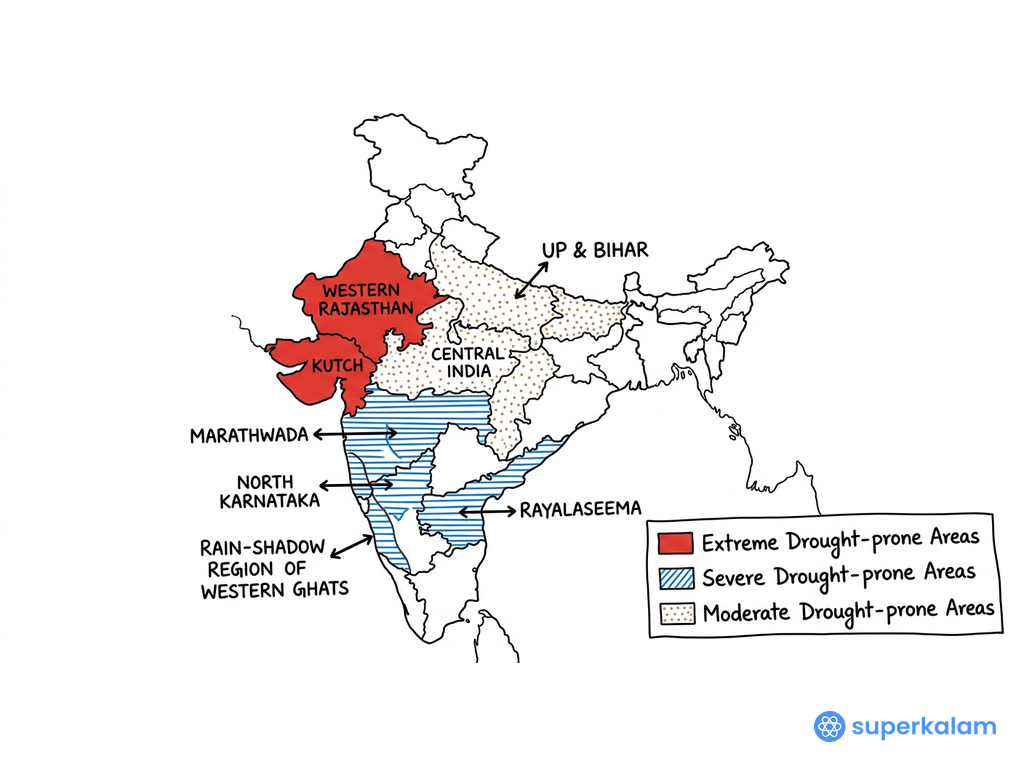
India drought prone areas zone demarcation
NDMA Institutional Framework for Drought Management
Early Warning and Monitoring Systems
- Drought Monitoring Cells (DMCs) at state and district levels for continuous assessment and real-time data collection
- Integrated Drought Information System using satellite imagery, meteorological data, and ground observations
- Real-time monitoring through National Agricultural Drought Assessment and Monitoring System (NADAMS)
- Development of vulnerability maps identifying drought-prone areas and at-risk populations
- Strengthened control rooms for coordinated response and information dissemination
El Niño Preparedness Mechanisms
- IMD seasonal forecasting integration with drought early warning systems for timely alerts
- Contingency planning based on El Niño Southern Oscillation (ENSO) patterns and historical data analysis
- Pre-positioning of relief materials and water resources in anticipated drought-affected regions
- Implementation of crop insurance schemes and alternative livelihood programs during El Niño years
- Water conservation measures and rationing protocols activated in advance
La Niña Management Strategies
Excess Rainfall Preparedness
- Flood management protocols during La Niña-induced heavy rainfall periods
- Rainwater harvesting infrastructure development to capture excess precipitation for drought years
- Soil moisture conservation techniques and watershed management programs
- Crop diversification strategies to manage both drought and flood scenarios
- Enhanced storage capacity through check dams and community ponds construction
Community-Based Preparedness
- Training programs for farmers through Krishi Vigyan Kendras on climate-resilient agricultural practices
- Self-Help Groups strengthening for alternative income generation during climate stress
- Promotion of drought-resistant crop varieties like millets and improved irrigation efficiency
- Fodder banks establishment and livestock management during extreme weather events
- Community participation in water resource management and conservation initiatives
The NDMA guidelines emphasize proactive preparedness over reactive response, integrating meteorological forecasting with ground-level implementation through state disaster management authorities and local institutions for effective drought resilience.
Answer Length
Model answers may exceed the word limit for better clarity and depth. Use them as a guide, but always frame your final answer within the exam’s prescribed limit.
Evaluate this PYQ now
Write your answer & evaluate in just 60 seconds




500+ students evaluated
Model Answers from
- 2014Economy12.5 MarksView Answer
International civil aviation laws provide all countries complete and exclusive sovereignty over the airspace above their territory. What do you understand by ‘airspace’ What are the implications of these laws on the space above this airspace? Discuss the challenges which this poses and suggest ways to contain the threat
- 2014Economy12.5 MarksView Answer
In a globalised world, Intellectual Property Rights assume significance and are a source of litigation. Broadly distinguish between the terms—Copyrights, Patents and Trade Secrets.
- 2014Economy12.5 MarksView Answer
Foreign Direct Investment (FDI) in the defence sector is now set to be liberalized: What influence this is expected to have on Indian defence and economy in the short and long run?
- 2014Economy12.5 MarksView Answer
National Urban Transport Policy emphasises ‘moving people’ instead of ‘moving vehicles’. Discuss critically the success of the various strategies of the Government in this regard.
- 2014Economy12.5 MarksView Answer
Explain how Private Public Partnership arrangements, in long gestation infrastructure projects, can transfer unsustainable liabilities to the future. What arrangements need to be put in place to ensure that successive generations’ capacities are not compromised?
- 2014Economy12.5 MarksView Answer
Capitalism has guided the world economy to unprecedented prosperity. However, it often encourages short-sightedness and contributes to wide disparities between the rich and the poor. In this light, would it be correct to believe and adopt capitalism to bring inclusive growth in India? Discuss.
Model Answers by Subject


Crack UPSC with your
Personal AI Mentor
An AI-powered ecosystem to learn, practice, and evaluate with discipline