What is meant by the Gujral doctrine? Does it have any relevance today? Discuss.
What is meant by the Gujral doctrine? Does it have any relevance today? Discuss.
India's foreign policy framework includes several doctrines, with the Gujral Doctrine representing a significant approach toward regional diplomacy in the post-Cold War era.
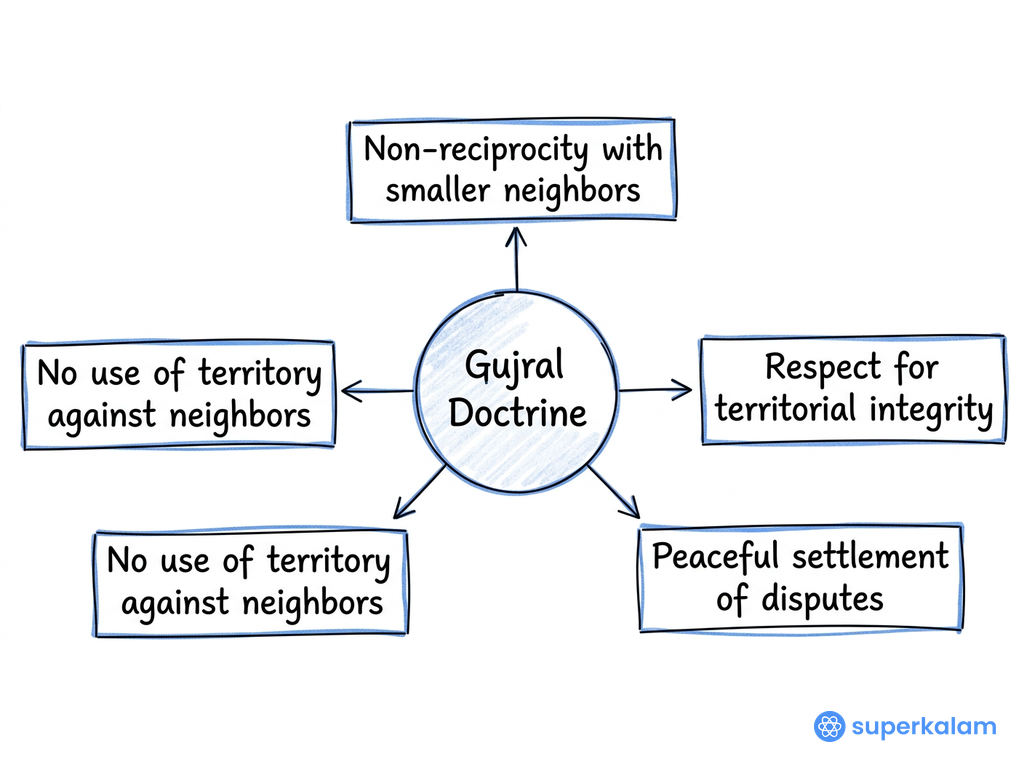
Gujral Doctrine Five Arrows Radial Diagram
Understanding the Gujral Doctrine
Core Principles
- Non-Reciprocity: India should offer unilateral concessions to smaller neighbors without expecting immediate reciprocity, acknowledging its position as South Asia's largest nation
- Non-Interference: Strict respect for sovereignty and non-interference in internal affairs of neighboring countries
- Peaceful Bilateral Engagement: Resolution of all disputes through dialogue and diplomatic negotiations rather than confrontation
- Regional Primacy with Responsibility: India's leadership role coupled with greater responsibility toward regional stability and development
- Trust Building: Emphasis on confidence-building measures to overcome historical mistrust in South Asian relations
Contemporary Relevance and Applications
Positive Relevance
- Neighborhood First Policy: Current government's approach mirrors Gujral principles through initiatives like India-Myanmar-Thailand Trilateral Highway and BBIN Motor Vehicle Agreement
- Counter-China Strategy: Soft power diplomacy helps counter China's Belt and Road Initiative influence in countries like Sri Lanka, Nepal, and Maldives
- Economic Integration: Facilitates regional connectivity through South Asian Free Trade Agreement and cross-border infrastructure projects
- Development Partnership: $1 billion Line of Credit to Sri Lanka (2022) and COVID-19 vaccine diplomacy demonstrate continued relevance
- Disaster Response: Operation Ganga (2022) and cyclone relief efforts showcase regional leadership responsibility
Contemporary Challenges
- Security Dilemmas: Cross-border terrorism from Pakistan and China's military presence in Doklam test non-reciprocity limits
- Strategic Competition: Chinese debt-trap diplomacy in South Asia requires more assertive responses than traditional Gujral approach
- Domestic Politics: Internal political changes in neighbors (e.g., Taliban in Afghanistan, political instability in Sri Lanka) complicate implementation
- Economic Asymmetries: Growing economic disparities make pure non-reciprocal approach potentially unsustainable
The Gujral Doctrine remains fundamentally relevant but requires calibrated adaptation to contemporary realities. While its emphasis on peaceful engagement and regional responsibility aligns with India's Vishwaguru aspirations, modern challenges demand balanced application of both soft power diplomacy and strategic assertiveness to maintain regional stability and counter emerging security threats.
Answer Length
Model answers may exceed the word limit for better clarity and depth. Use them as a guide, but always frame your final answer within the exam’s prescribed limit.
Evaluate this PYQ now
Write your answer & evaluate in just 60 seconds




500+ students evaluated
Model Answers from
- 2013International Relations10 MarksView Answer
The World Bank and the IMF, collectively known as the Bretton Woods Institutions, are the two inter-governmental pillars supporting the structure of the world’s economic and financial order. Superficially, the World Bank and the IMF exhibit many common characteristics, yet their role, functions, and mandate are distinctly different. Elucidate.
- 2013International Relations10 MarksView Answer
In respect of India — Sri Lanka relations, discuss how domestic factors influence foreign policy.
- 2013International Relations10 MarksView Answer
Discuss the political developments in Maldives in the last two years. Should they be of any cause of concern to India?
- 2013International Relations10 MarksView Answer
The protests in Shahbag Square in Dhaka in Bangladesh reveal a fundamental split in society between the nationalists and Islamic forces. What is its significance for India?
- 2013International Relations10 MarksView Answer
Economic ties between India and Japan while growing in recent years are still far below their potential. Elucidate the policy constraints that are inhibiting this growth
- 2013International Relations10 MarksView Answer
What do you understand by ‘The String of Pearls’? How does it impact India? Briefly outline the steps taken by India to counter this.
Model Answers by Subject


Crack UPSC with your
Personal AI Mentor
An AI-powered ecosystem to learn, practice, and evaluate with discipline



