Economic ties between India and Japan while growing in recent years are still far below their potential. Elucidate the policy constraints that are inhibiting this growth
Economic ties between India and Japan while growing in recent years are still far below their potential. Elucidate the policy constraints that are inhibiting this growth
India-Japan economic partnership, despite reaching $22.85 billion bilateral trade in FY 2023-24, remains significantly underutilized compared to its strategic potential.
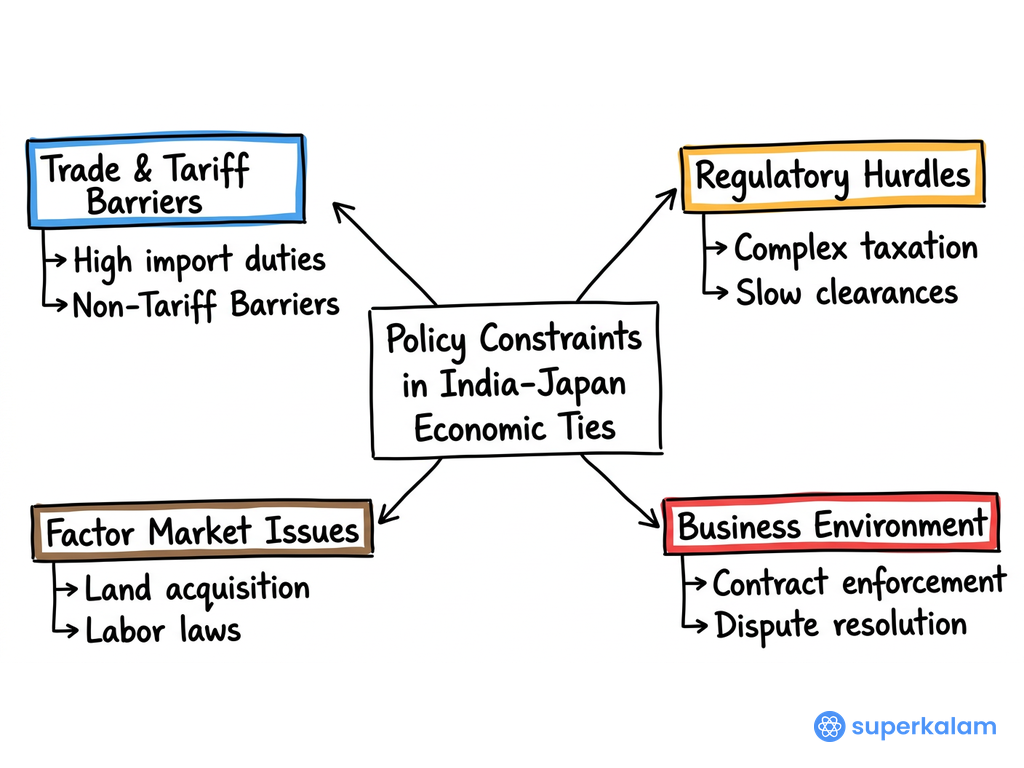
Policy Constraints in India and Japan
Regulatory and Administrative Constraints
- Multi-layered approval mechanisms causing project delays in Japanese investments
- Inconsistent policy implementation across Indian states creating investor uncertainty
- Lengthy environmental and forest clearances affecting infrastructure projects like Delhi-Mumbai Industrial Corridor
- Land acquisition challenges hindering establishment of Japanese industrial parks
- Lack of single-window clearance systems for foreign investments
Trade and Market Access Barriers
- High import duties on Japanese automobiles and electronics limiting market penetration
- Technical barriers to trade due to different quality standards and certification processes
- Limited mutual recognition agreements for professional services
- Restrictive e-commerce policies affecting Japanese digital companies
- Complex GST structure creating compliance challenges for Japanese businesses
Infrastructure and Connectivity Issues
- Inadequate port infrastructure despite Japanese funding in projects like Chennai-Bengaluru Industrial Corridor
- Poor last-mile connectivity affecting supply chain efficiency
- High logistics costs (12-13% of GDP) compared to global average of 8%
- Limited cold storage facilities affecting agri-trade potential
- Insufficient digital infrastructure in tier-2 and tier-3 cities
| Constraint Category | Impact on Trade | Key Examples |
|---|---|---|
| Regulatory Barriers | Project delays, increased costs | Land acquisition for bullet train project |
| Market Access | Limited penetration | Auto sector tariffs |
| Infrastructure | Supply chain inefficiency | Port connectivity issues |
Financial and Investment Challenges
- Exchange rate volatility affecting long-term investment planning
- Limited availability of yen-denominated financing for Indian companies
- Restrictions on foreign direct investment in certain sensitive sectors
- Inadequate insurance mechanisms for Japanese investments in India
- Limited banking presence of Japanese financial institutions
Technological and Innovation Barriers
- Intellectual property protection concerns limiting technology sharing
- Skill gaps in advanced manufacturing and automation
- Limited R&D collaboration despite agreements like India-Japan Science & Technology Cooperation
- Regulatory uncertainty in emerging sectors like AI and biotechnology
- Different technical standards hindering seamless technology integration
Enhanced cooperation through initiatives like the India-Japan Industrial Competitiveness Partnership and streamlined regulatory frameworks will unlock the partnership's true economic potential, targeting the ambitious $42 billion bilateral trade by 2025.
Answer Length
Model answers may exceed the word limit for better clarity and depth. Use them as a guide, but always frame your final answer within the exam’s prescribed limit.
Evaluate this PYQ now
Write your answer & evaluate in just 60 seconds




500+ students evaluated
Model Answers from
- 2013International Relations10 MarksView Answer
The World Bank and the IMF, collectively known as the Bretton Woods Institutions, are the two inter-governmental pillars supporting the structure of the world’s economic and financial order. Superficially, the World Bank and the IMF exhibit many common characteristics, yet their role, functions, and mandate are distinctly different. Elucidate.
- 2013International Relations10 MarksView Answer
What is meant by the Gujral doctrine? Does it have any relevance today? Discuss.
- 2013International Relations10 MarksView Answer
In respect of India — Sri Lanka relations, discuss how domestic factors influence foreign policy.
- 2013International Relations10 MarksView Answer
Discuss the political developments in Maldives in the last two years. Should they be of any cause of concern to India?
- 2013International Relations10 MarksView Answer
The protests in Shahbag Square in Dhaka in Bangladesh reveal a fundamental split in society between the nationalists and Islamic forces. What is its significance for India?
- 2013International Relations10 MarksView Answer
What do you understand by ‘The String of Pearls’? How does it impact India? Briefly outline the steps taken by India to counter this.
Model Answers by Subject


Crack UPSC with your
Personal AI Mentor
An AI-powered ecosystem to learn, practice, and evaluate with discipline



