What do you understand by the theory of continental drift? Discuss the prominent evidence in its support.
What do you understand by the theory of continental drift? Discuss the prominent evidence in its support.
The theory of continental drift, proposed by Alfred Wegener in 1912, suggests that continents were once united in a supercontinent called Pangaea and have since drifted to their present positions. This revolutionary concept transformed our understanding of Earth's dynamic crustal movements.
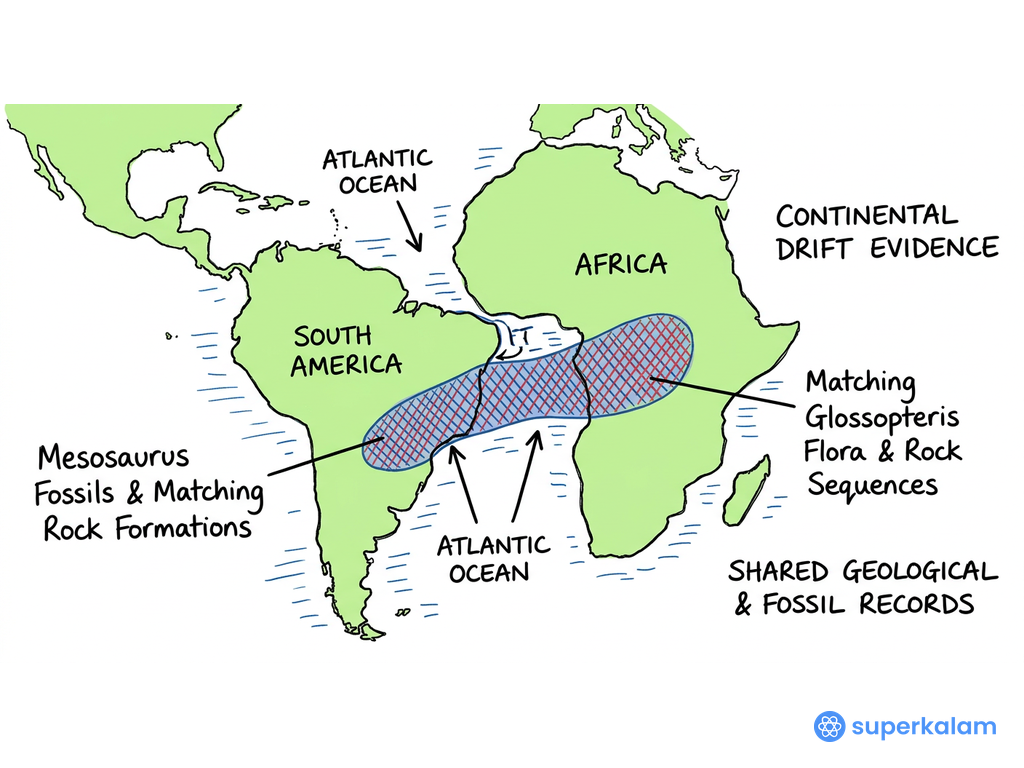
South America and Africa coastline fitting
Fundamental Concepts of Continental Drift Theory
- Pangaea Formation: All continents were joined as a single landmass approximately 200-250 million years ago
- Continental Movement: Lighter continental crust floats and drifts on denser oceanic crust through geological time
- Gradual Separation: Continents gradually moved to current positions over millions of years
- Dynamic Earth: Earth's surface is constantly changing rather than being static
- Crustal Mobility: Continental blocks can move horizontally across Earth's surface
Evidence Supporting Continental Drift Theory
Geological Evidence
- Gondwana System: Similar rock formations and sedimentary sequences found across India, Antarctica, Africa, Australia, and South America
- Mountain Continuity: Appalachian Mountains of North America align with Caledonian Mountains of Scotland when continents are fitted together
- Rock Age Correlation: Identical Precambrian rocks of similar age found on opposite sides of Atlantic Ocean
- Structural Matching: Cape Mountains of South Africa align with Sierra de la Ventana in Argentina
- Mineral Deposits: Similar coal and iron ore deposits across now-separated continents
Paleontological Evidence
- Glossopteris Flora: Fossil remains of this ancient fern found across India, Antarctica, Australia, and South America
- Mesosaurus Reptile: Freshwater reptile fossils found only in Brazil and South Africa, indicating land connection
- Cynognathus: Triassic period reptile fossils discovered in both Africa and South America
- Lystrosaurus: Mammal-like reptile fossils found in Antarctica, India, and South Africa
- Species Distribution: Similar fossil assemblages across southern continents suggesting common origin
Paleoclimatic Evidence
- Glacial Deposits: Permian-Carboniferous glaciation evidence found in tropical regions like India and Australia
- Striations Pattern: Glacial scratches and grooves show ice movement from ocean toward land in southern continents
- Tillite Deposits: Glacial sediments found in now-tropical regions indicating past polar conditions
- Climate Zones: Coal deposits in Antarctica suggest past tropical climate
- Desert Indicators: Ancient desert sandstones in regions that were never suitable for desert formation
Jigsaw Fit Evidence
- Continental Margins: Atlantic coastlines of Africa and South America fit together like puzzle pieces
- Continental Shelves: Better fit achieved when considering continental shelf boundaries rather than coastlines
- Bathymetric Matching: Ocean floor features align when continents are repositioned
- Geometric Correspondence: Statistical analysis shows 96% fit accuracy between Atlantic margins
- Modern Technology: GPS measurements confirm continuing continental drift at rates of 2-10 cm per year
Despite providing substantial evidence, Wegener's theory lacked explanation for the driving mechanism, which was later provided by plate tectonic theory incorporating mantle convection and seafloor spreading processes.
Answer Length
Model answers may exceed the word limit for better clarity and depth. Use them as a guide, but always frame your final answer within the exam’s prescribed limit.
Evaluate this PYQ now
Write your answer & evaluate in just 60 seconds




500+ students evaluated
Model Answers from
- 2013Physical Geography10 MarksView Answer
Major hot deserts in the northern hemisphere are located between 20-30 degrees north and on the western side of the continents. Why?
- 2013Physical Geography5 MarksView Answer
What do you understand by the phenomenon of temperature inversion in meteorology? How does it affect the weather and the inhabitants of the place?
Model Answers by Subject


Crack UPSC with your
Personal AI Mentor
An AI-powered ecosystem to learn, practice, and evaluate with discipline



