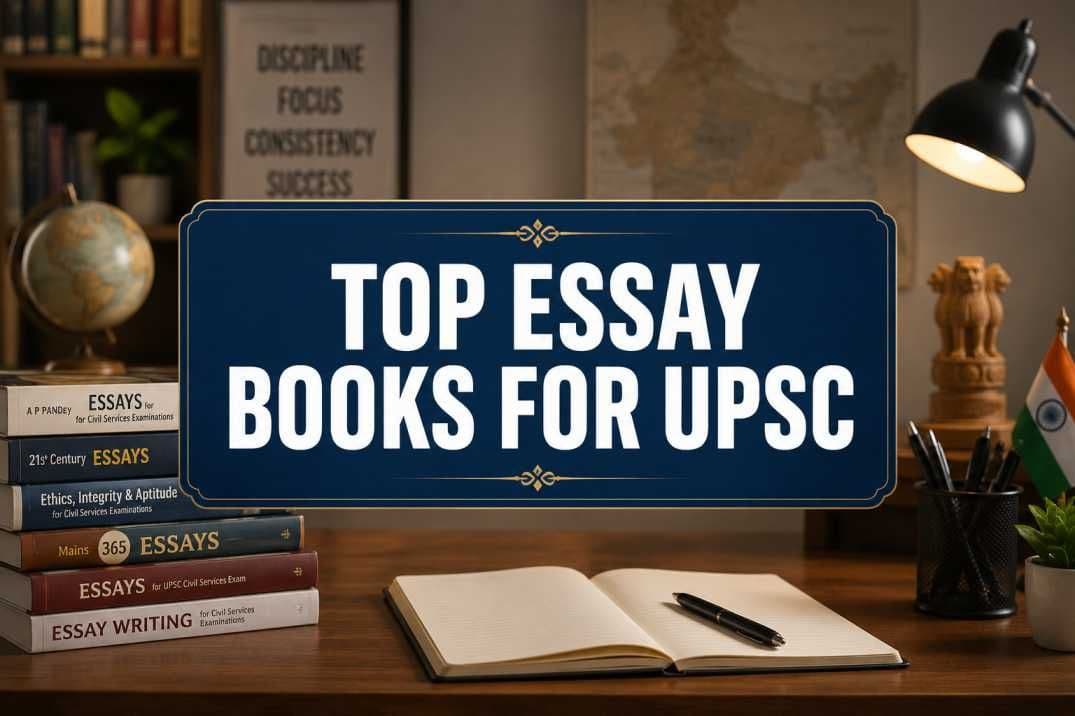
Best Ethics Books for UPSC Mains (GS Paper IV)
Get the list of best Ethics books for UPSC Mains GS Paper IV. Follow topper-recommended sources, strategy, PYQs, and answer evaluation to score higher. Click now!
May, 2026
•6 min read
Ethics (GS Paper IV) in UPSC Mains quietly decides your rank. In this paper, the examiner analyses how you think, how you judge situations, and how balanced your approach is as a future civil servant.
Many aspirants either ignore it in the beginning or keep collecting too many notes and sources. That usually creates confusion. Ethics does not need volume. It needs clarity, examples, and honest understanding. If your concepts are simple and your answers feel real, you are already ahead of many.
This is why choosing the right Ethics books for UPSC Mains is utmost important. A few good sources, revised properly, can help you build strong fundamentals. Here you will find the topper's recommended best Ethics books for the UPSC Mains exam.
Why is Selecting the Right Books for Ethics Important?
If you look at how the UPSC toppers approach Ethics, one thing is common. They do not run after too many sources. They pick a few good books from the beginning and focus on understanding and applying what they read.
The books you choose will shape that clarity. They will guide your understanding, while too many sources can leave you confused and inconsistent. Here is why selecting the right Ethics books matters:
- Builds Clear and Usable Concepts: Ethics terms can feel abstract at first. The right books simplify ideas like integrity, empathy, and accountability so that you can apply them in answers.
- Strengthens Answer Writing Skills: Good sources show you how to structure answers, add relevant examples, and maintain a balanced tone. This makes average answers into high-scoring ones.
- Develops a Practical Approach for Case Studies: Case studies test your judgement. The right books train you to identify stakeholders, ethical dilemmas, and realistic solutions, which improves both clarity and speed.
- Keeps Your Preparation Focused: Using too many sources creates confusion and inconsistency. A limited set of good books helps you revise better and keeps your preparation on track.
- Adds Depth Through Real-Life Examples: Ethics answers stand out when they feel grounded. The right books provide examples from administration and daily life, making your answers more relatable and convincing.
- Saves Time and Builds Confidence: When your resources are clear and limited, you spend less time searching and more time practising.
UPSC Mains GS Paper IV Official Syllabus
General Studies- IV: Ethics, Integrity and Aptitude
This paper will include questions to test the candidates’ attitude and approach to issues relating to integrity, probity in public life and their problem-solving approach to various issues and conflicts faced by them in dealing with society. Questions may utilise the case study approach to determine these aspects. The following broad areas will be covered:
- Ethics and Human Interface: Essence, determinants and consequences of Ethics in human actions; dimensions of ethics; ethics in private and public relationships. Human Values - lessons from the lives and teachings of great leaders, reformers and administrators; role of family, society and educational institutions in inculcating values.
- Attitude: content, structure, function; its influence and relation with thought and behaviour; moral and political attitudes; social influence and persuasion.
- Aptitude and foundational values for Civil Service, integrity, impartiality and non-partisanship, objectivity, dedication to public service, empathy, tolerance and compassion towards the weaker sections.
- Emotional intelligence concepts, their utilities and application in administration and governance.
- Contributions of moral thinkers and philosophers from India and the world.
- Public/Civil service values and Ethics in Public administration: Status and problems; ethical concerns and dilemmas in government and private institutions; laws, rules, regulations and conscience as sources of ethical guidance; accountability and ethical governance; strengthening of ethical and moral values in governance; ethical issues in international relations and funding; corporate governance.
- Probity in Governance: Concept of public service; Philosophical basis of governance and probity; Information sharing and transparency in government, Right to Information, Codes of Ethics, Codes of Conduct, Citizens’ Charters, Work culture, Quality of service delivery, Utilisation of public funds, challenges of corruption.
- Case Studies on the above issues.
Also see: UPSC Mains General Studies 4 Ethics Syllabus Analysis
Understanding the Pattern of GS Paper IV
Ethics (GS Paper IV) tests your moral clarity, honesty in judgment, and ability to handle real-life administrative dilemmas with balance and responsibility. Here is how the paper is structured:
- Total Marks: 250
- Duration: 3 hours
The syllabus broadly revolves around three pillars: Ethics, Integrity, and Aptitude, combining both theory and application.
- Number of Questions: Usually 12–14 questions, divided into two sections
- Section A (Theory – 125 marks): Focuses on concepts like values, ethics in public administration, emotional intelligence, and thinkers. These questions test your understanding and clarity.
- Section B (Case Studies – 125 marks): Based on real-life situations where you are expected to apply ethical principles, identify stakeholders, and suggest practical solutions.
- Marks and Word Limit: Questions are typically of 10 marks (150 words) and 20 marks (250 words), so clarity and precision matter as much as content.
With this structure in mind, it becomes much easier to choose the right resources and study in a focused way. Now, let’s move to the most reliable books for Ethics preparation.
List of Best Ethics Books for UPSC Mains
If you keep your sources limited and standard, Ethics becomes much more manageable. These are the books most consistently recommended by toppers and mentors for GS Paper IV, covering both theory and application.
| Book Name | Author | What It Covers / Why It Matters |
|---|---|---|
| NCERT Psychology (Class XI & XII) | NCERT | Helps in understanding attitude, emotional intelligence, and human behaviour—important for GS4 basics. |
| Ethics, Integrity & Aptitude | G. Subba Rao & P.N. Roy Chowdhury | Complete coverage of GS Paper IV syllabus including ethical theories, values, governance, and case studies; strong conceptual clarity with practice questions. |
| Lexicon for Ethics, Integrity & Aptitude | Niraj Kumar | Crisp definitions of key terms, thinkers, and examples; best for quick revision and building answer content. |
| Ethics, Integrity & Aptitude | Santosh Ajmera & Nanda Kishore Reddy | Detailed explanation of ethical theories and administrative dilemmas; useful for conceptual depth and examples. |
Additional Resources to Strengthen Ethics (GS Paper IV) Preparation
The best book list above will give you the base. With them, you need some additional resources for answer writing and develop an understanding of the questions asked in the exam.
1. SuperKalam: Your Personal AI Mentor
SuperKalam acts as your personalised guide to mastering answer writing for UPSC Mains. Most aspirants struggle to find someone to evaluate their answers or experience long delays of 4-5 weeks from coaching centres. SuperKalam solves this by offering instant feedback, making preparation less daunting and more efficient.
- Instant Feedback: Get quick and detailed evaluation of your Ethics answers without long delays.
- Model Answers for Comparison: See how a well-structured answer looks and where you can improve.
- Exam-Oriented Evaluation: Feedback is aligned with UPSC standards, so you understand what needs to be improved to make your answers UPSC-standard.
- Based on PYQ Trends: Insights are drawn from previous year questions, helping you match the UPSC pattern.
- Flexible Practice: You can evaluate answers anytime, on any topic, without dependency on coaching schedules.
Evaluate your first answer now: SuperKalam Mains Answer Evaluation
2. ARC Reports: Real Administrative Insight
The Second Administrative Reforms Commission report on Ethics in Governance is one of the most valuable resources for this paper. It connects ethical concepts with real governance practices. Even if you do not read it fully, going through summaries can help you pick up strong content and examples.
Key values you should focus on:
- Integrity and accountability in public life
- Impartiality and non-partisanship
- Objectivity in decision-making
- Dedication to public service
- Empathy, compassion, and sensitivity towards the weaker sections
Quoting these ideas in answers makes them more practical and credible.
Read here: 2nd ARC Report UPSC Mains: Key Recommendations & Summary
3. Previous Year Questions (PYQs): Understand What UPSC Asks
If you want to understand Ethics properly, PYQs are non-negotiable. They show you how UPSC frames questions, what kind of examples work, and how case studies are structured.
- Helps you identify recurring themes
- Improves your ability to think under exam conditions
- Guides your preparation in the right direction
- Regular practice will make your answers more relevant and less theoretical.
Practice Previous Year Questions on SuperKalam with their Model Answers: GS Paper IV PYQ with Model Answers
4. Model Answers of PYQs: Learn How to Present
Just reading questions is not enough. You need to see how good answers are written.
- Understand the answer structure and flow
- Learn how to balance theory with examples
- Observe how solutions are framed in case studies
This gradually improves your presentation, which is a key factor in scoring well in Ethics.
Ethics preparation improves when you combine the BEST BOOKS + LIMITED RESOURCES.+ ANSWER WRITING PRACTICE.
Start Writing Ethics Case Studies for UPSC Mains GS Paper 4 with our guide.
Conclusion
Ethics (GS Paper IV) can become one of your highest-scoring papers in UPSC Mains if approached with clarity and consistency. You do not need too many sources. A few of the best Ethics books for UPSC, supported with PYQs, case study practice, and answer writing, are enough to build strong fundamentals.
Focus on understanding concepts, using real-life examples, and writing balanced answers. With the right resources and approach, UPSC Ethics preparation becomes simple, practical, and scoring.
Start your UPSC Preparation 2026/2027 with SuperKalam
SuperKalam is your personal mentor for UPSC preparation, guiding you at every step of the exam journey. Practice, revise, and evaluate– all in one place.
Download Now