GS 3: EconomyGS 3: Science & TechnologyGS 3: Environment & Ecology
Why is India pushing for coal gasification?, Pg13
India boosts coal gasification with ₹37,500-crore incentive, aiming to cut ₹3 lakh crore imports and gasify 100 million tonnes by 2030.
Practice MCQs
796 Students attempted
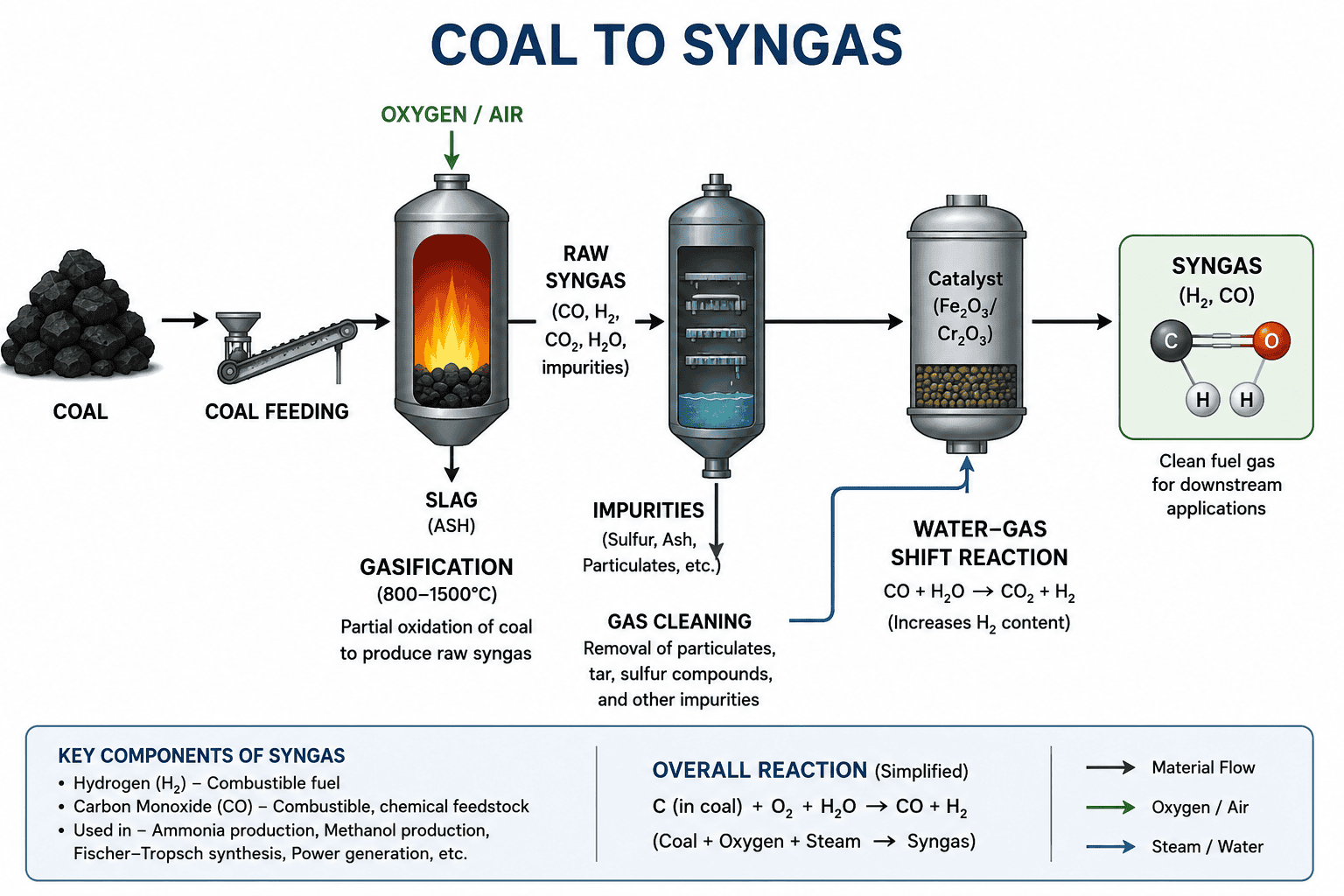
Syngas.png
The Development
- The Union Cabinet has approved a ₹37,500-crore incentive scheme to accelerate coal gasification projects.
- The government aims to gasify 100 million tonnes of coal by 2030, with 75 million tonnes supported under the scheme.
- The initiative follows an earlier ₹8,500-crore package approved in 2024, under which eight projects have already received support.
- The upcoming Talcher coal-to-urea complex is expected to be commissioned in FY2027-28.
Why It Matters
- Coal gasification can reduce India's dependence on imports of urea, methanol and ammonia, potentially substituting imports worth ₹3 lakh crore.
- India possesses around 401 billion tonnes of coal and 47 billion tonnes of lignite reserves, providing a large domestic resource base.
- The technology converts coal into syngas, which serves as a feedstock for fertilizers, chemicals and synthetic fuels.
- The initiative seeks to improve India's energy security and industrial self-reliance.
The Core Challenge
- Indian coal has high ash content and variable calorific value, making gasification technically challenging.
- Coal gasification projects are highly capital-intensive and involve long gestation periods.
- Financial viability remains critical, as capital costs account for a major share of syngas production expenses.
- Environmental concerns persist regarding the continued reliance on coal-based technologies despite cleaner conversion methods.
Strategic Significance
- BHEL has developed a pressurised fluidized-bed gasifier suited to Indian coal characteristics.
- According to NITI Aayog, India already has multiple facilities capable of manufacturing gasification equipment.
- Companies such as Jindal Steel and Greta Energy have achieved 80–90% indigenisation, reducing project costs significantly.
- The initiative aligns with broader goals of Atmanirbhar Bharat and domestic industrial capability building.
- Successful deployment could create a new ecosystem around coal-based chemicals, fertilizers and synthetic fuels.
Key Concepts
- Coal Gasification → Conversion of coal into synthetic gas (syngas) through controlled chemical reactions.
- Syngas → Mixture primarily consisting of hydrogen and carbon monoxide used as an industrial feedstock.
- Fluidized-Bed Gasification → Technology that efficiently gasifies high-ash coal by suspending coal particles in a gas stream.
- Energy Security → Reliable access to affordable energy resources with reduced dependence on imports.
The Takeaway
Coal gasification represents India's attempt to transform abundant domestic coal reserves into strategic industrial inputs, though its success will depend on overcoming technological, financial and environmental challenges.

SuperKalam is your personal mentor for UPSC preparation, guiding you at every step of the exam journey.
Download the App


STUDY RESOURCES
CONTACT US
ⓒ Snapstack Technologies Private Limited