GS 3: Environment & EcologyGS 1: Indian GeographyPrelims
New cascade frog species recorded in Nagaland’s hill-stream habitats, Pg10
New cascade frog species, Amolops kamal, discovered in Nagaland's hill streams, highlighting Northeast's unmapped biodiversity and need for conservation.
Practice MCQs
796 Students attempted
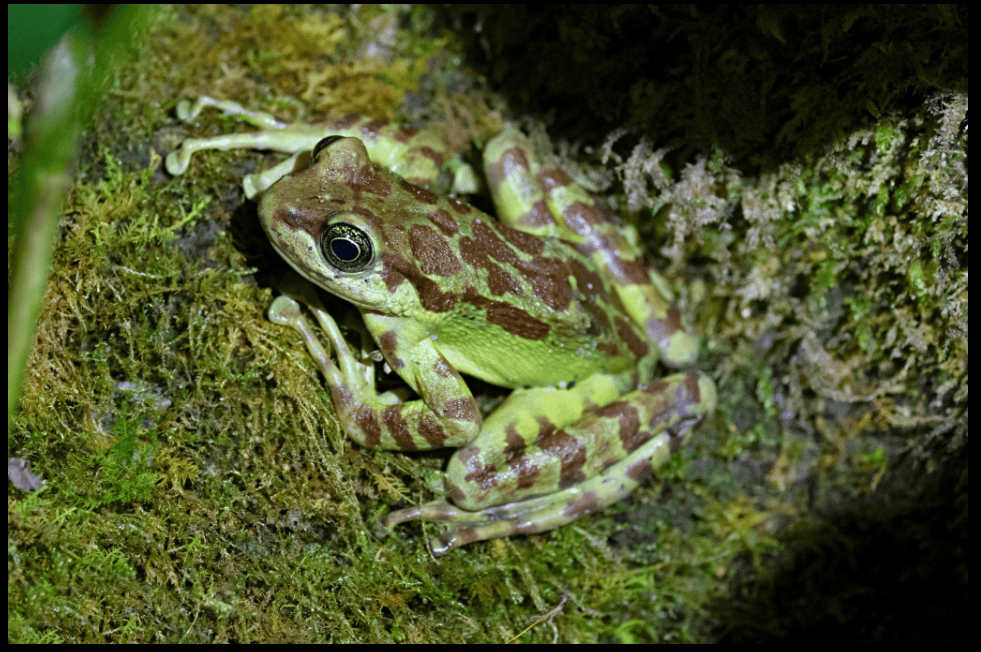
Amolops kamal.png
The Discovery
- Scientists from the Zoological Survey of India (ZSI) discovered a new frog species, Amolops kamal, in Nagaland.
- The species was found in hill-stream habitats near Singrep village in Kiphire district, close to the Myanmar border.
- It has been named after Kamal Choudhury, a former teacher of the lead researcher.
- The frog is commonly referred to as the Nagaland cascade frog.
Why It Matters
- The discovery highlights the rich yet understudied biodiversity of Northeast India.
- It reinforces the ecological significance of the region as a biodiversity hotspot.
- Such findings strengthen the case for greater investment in scientific surveys and conservation research.
The Scientific Significance
- Integrative taxonomy combining morphological and genetic evidence confirmed the frog as a distinct species.
- Molecular phylogenetic studies established it as a separate evolutionary lineage within the Amolops indoburmanensis complex.
- The findings suggest that Amolops indoburmanensis, once considered a single widespread species, may contain multiple hidden lineages.
- The study demonstrates the importance of molecular tools in identifying cryptic amphibian diversity.
- Isolated stream ecosystems in the Northeast continue to harbour poorly understood amphibian populations.
Broader Implications
- The discovery underscores the conservation value of fragile freshwater ecosystems in Northeast India.
- It highlights the role of taxonomy in informing biodiversity conservation and environmental policymaking.
- Undiscovered species may still exist in remote landscapes of the Eastern Himalayas and Indo-Myanmar region.
- The finding strengthens India's contribution to global knowledge on amphibian diversity and evolution.
Key Concepts
- Integrative Taxonomy → Method of species identification using morphological, genetic and ecological evidence.
- Molecular Phylogenetics → Study of evolutionary relationships using genetic data.
- Cryptic Species Complex → Group of genetically distinct species that appear morphologically similar.
- Evolutionary Lineage → Sequence of populations connected through common ancestry over time.
The Takeaway
The discovery of Amolops kamal demonstrates that Northeast India remains a frontier for biodiversity exploration, where modern genetic tools are reshaping our understanding of species diversity.

SuperKalam is your personal mentor for UPSC preparation, guiding you at every step of the exam journey.
Download the App


STUDY RESOURCES
CONTACT US
ⓒ Snapstack Technologies Private Limited