GS 2: PolityGS 2: GovernanceGS 2: Social JusticeGS 3: EconomyPrelims
Why are States opposing VB-G RAM G, Pg14
States oppose new VB-G RAM G rural employment scheme replacing MGNREGA, citing 40% financial burden and centralisation of power, sparking federalism concerns.
Practice MCQs
796 Students attempted
Key Highlights:
- The Viksit Bharat-Guarantee for Rozgar and Ajeevika Mission (Gramin) (VB-G RAM G) is set to replace the Mahatma Gandhi National Rural Employment Guarantee Act (MGNREGA) from July 1.
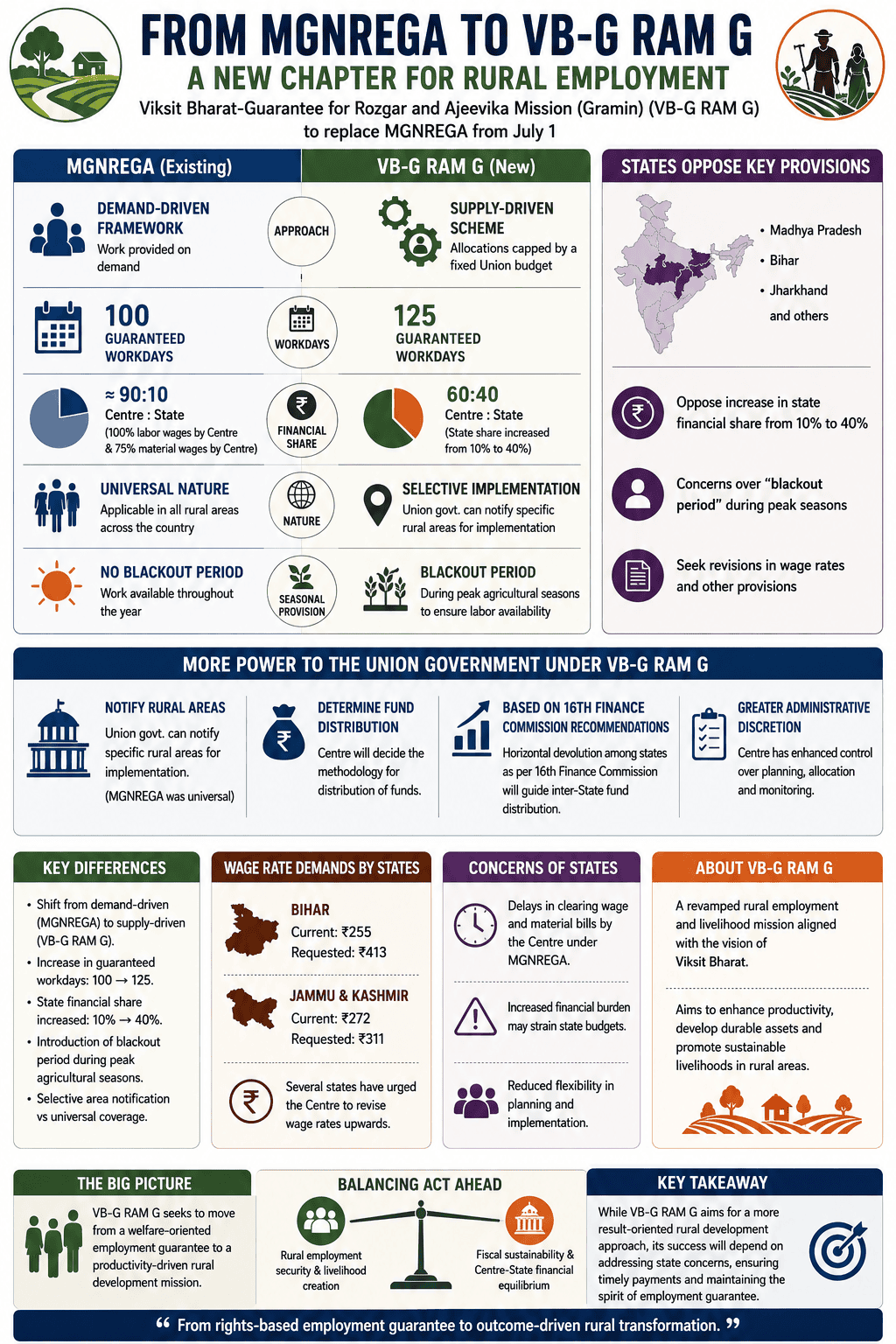
- The new scheme shifts from a "demand-driven framework" to a "supply-driven scheme" with allocations capped by a fixed Union government budget.
- VB-G RAM G increases guaranteed workdays from 100 to 125 but raises the financial burden on states from 10% to 40% of total expenditure.
- States like Madhya Pradesh, Bihar, and Jharkhand have opposed the increased financial share and other provisions.
- The Union government gains more power, including notifying rural areas for scheme implementation and determining fund distribution methodology based on 16th Finance Commission recommendations.
VBGRAMG.png
Detailed Insights:
- Under MGNREGA, the Union government covered 100% of labor wages and 75% of material wages, resulting in an approximate 90:10 Centre-State cost share.
- The VB-G RAM G introduces a "blackout period" during peak agricultural seasons to ensure labor availability, a departure from the universal nature of MGNREGA.
- Several states have requested revisions to wage rates, with Bihar seeking an increase from ₹255 to ₹413 and Jammu & Kashmir from ₹272 to ₹311.
- Concerns have been raised by states regarding delays in clearing wage and material bills by the Centre under the previous scheme.
- The draft rules for VB-G RAM G allow the Union government to notify specific rural areas for implementation, unlike the universal application of MGNREGA.
- The 16th Finance Commission's recommendations for horizontal devolution among states will guide the inter-State distribution of funds under the new scheme.
Key Concepts Involved:
- Viksit Bharat-Guarantee for Rozgar and Ajeevika Mission (Gramin) (VB-G RAM G): A new central scheme replacing MGNREGA, aiming to provide 125 days of guaranteed rural employment with a revised funding pattern.
- Mahatma Gandhi National Rural Employment Guarantee Act (MGNREGA): A social welfare legislation enacted in 2005 guaranteeing 100 days of wage employment to rural households on demand.
- Demand-driven framework: A system where work is provided based on the demand from eligible households, ensuring a legal right to employment.
- Supply-driven scheme: A system where employment is provided based on a pre-determined budget and allocation, rather than immediate demand.
- 16th Finance Commission: A constitutional body that recommends the distribution of tax revenues between the Union and states, and among states.

SuperKalam is your personal mentor for UPSC preparation, guiding you at every step of the exam journey.
Download the App


STUDY RESOURCES
CONTACT US
ⓒ Snapstack Technologies Private Limited