GS 2: International RelationsGS 3: Science & TechnologyGS 2: GovernancePrelims
What India’s 12 ‘operationally deployed’ nuclear warheads really mean, Pg11
SIPRI reveals 12 Indian nuclear warheads are now operationally deployed, bolstering 'no first use' doctrine and second-strike capability amid escalating global nuclear tensions.
Practice MCQs
796 Students attempted
Key Highlights:
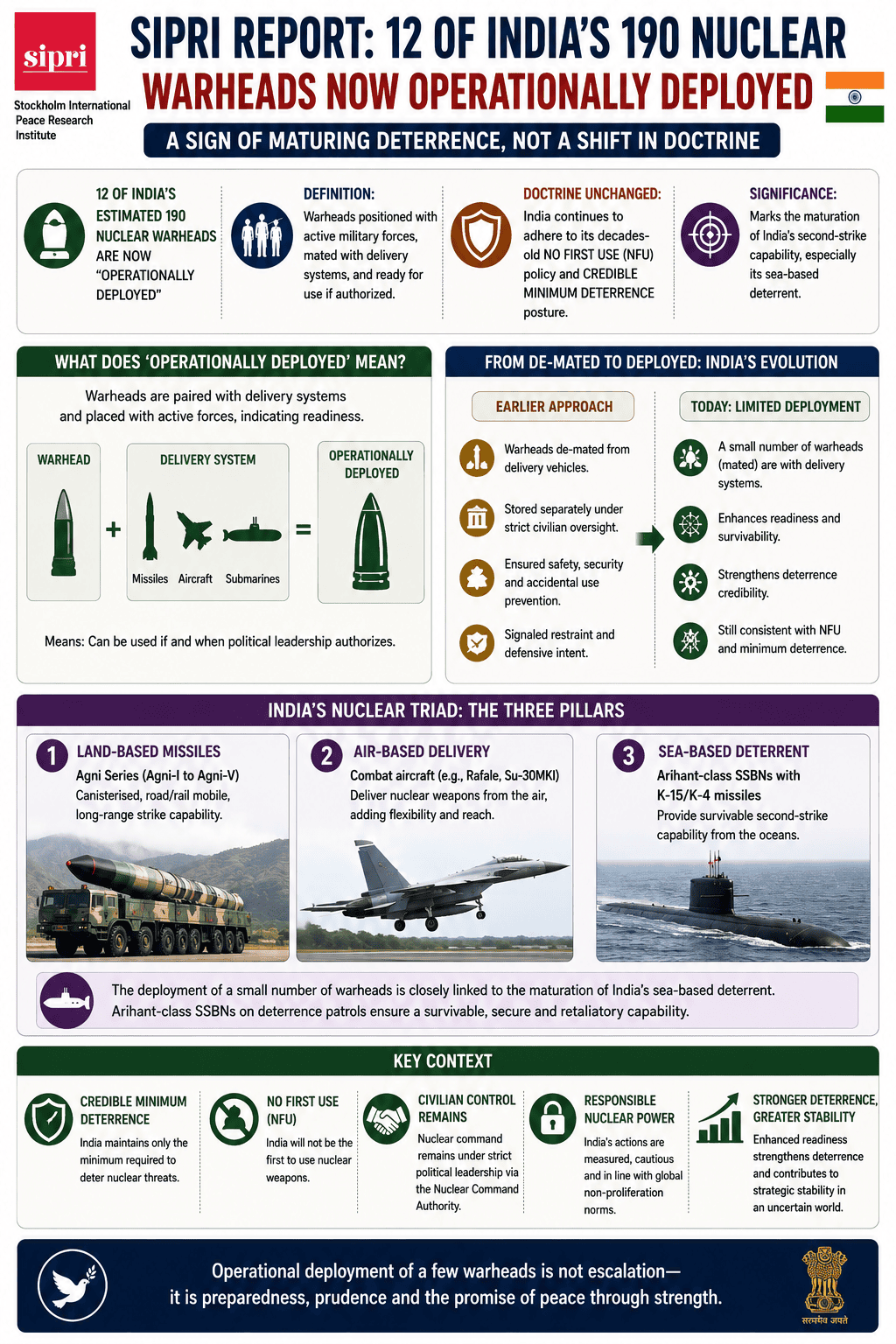
- The Stockholm International Peace Research Institute (SIPRI) reported that 12 of India’s estimated 190 nuclear warheads are now "operationally deployed".
- This classification means these warheads are positioned with active military forces, mated with delivery systems, and ready for use.
- India continues to adhere to its decades-old No First Use (NFU) policy and credible minimum deterrence posture.
- The deployment signifies the maturation of India's second-strike capability, particularly its sea-based deterrent.
SIPRI.png
Detailed Insights:
- "Operationally deployed" warheads are paired with delivery systems like missiles, aircraft, or submarines, indicating readiness if authorized.
- Historically, India kept warheads de-mated from delivery vehicles, stored separately under strict civilian oversight to ensure safety and signal restraint.
- The deployment is linked to the maturation of India’s nuclear triad, especially its Arihant-class submarines (SSBNs) conducting deterrence patrols.
- Canisterized Agni-series missiles, kept ready with fuel in sealed cylinders for direct firing, also contribute to increased operational readiness.
- A robust sea-based deterrent, like SSBNs, is crucial for NFU doctrine as it ensures survivability against a potential first strike.
- This development occurs amidst a global trend where states are increasingly relying on nuclear weapons, with China's arsenal expanding significantly.
- India's modernization, including long-range delivery systems, aims to maintain credible deterrence against both China and Pakistan.
Key Concepts Involved:
- No First Use (NFU): A nuclear doctrine where a state commits to not being the first to use nuclear weapons in a conflict.
- Credible Minimum Deterrence: A nuclear strategy aiming to maintain a nuclear arsenal just large enough to deter an adversary from attacking, ensuring assured retaliation.
- Second-Strike Capability: The ability of a nuclear power to retaliate with nuclear weapons even after absorbing a nuclear first strike from an adversary.
- Nuclear Triad: A nuclear arsenal consisting of three components: strategic bombers, intercontinental ballistic missiles (ICBMs), and submarine-launched ballistic missiles (SLBMs).
- SSBN (Nuclear Ballistic Missile Submarine): A submarine powered by a nuclear reactor and capable of launching ballistic missiles with nuclear warheads.
- Canisterization: A method of storing and launching missiles within a sealed container, allowing for quicker deployment and enhanced protection.

SuperKalam is your personal mentor for UPSC preparation, guiding you at every step of the exam journey.
Download the App


STUDY RESOURCES
CONTACT US
ⓒ Snapstack Technologies Private Limited