GS 3: Science & TechnologyGS 3: EconomyGS 2: GovernancePrelims
Reforms 3.0 — towards the Bharat rate of growth, Pg8
India must launch a National AI Token Policy, making AI access free like data, to achieve an 8%+ 'Bharat rate of growth' and global AI leadership.
Practice MCQs
796 Students attempted
Key Highlights:
- India aims to achieve an 8% or higher GDP growth rate, termed the "Bharat rate of growth," by leveraging Artificial Intelligence (AI) as a transformative force.
- The strategy proposes making AI tokens free, similar to how mobile data became accessible, to foster widespread adoption and innovation.
- India plans to diversify its AI compute hardware, moving away from a single vendor dominance, by adopting a 40:30:30 mix of different providers.
- A National AI Token Policy is suggested for implementation over 24 months, involving public-private partnerships with hyperscalers.
- The initiative is estimated to cost around $2 billion annually, a fraction of India's existing subsidies, and aims to boost R&D spending from 0.65% of GDP.
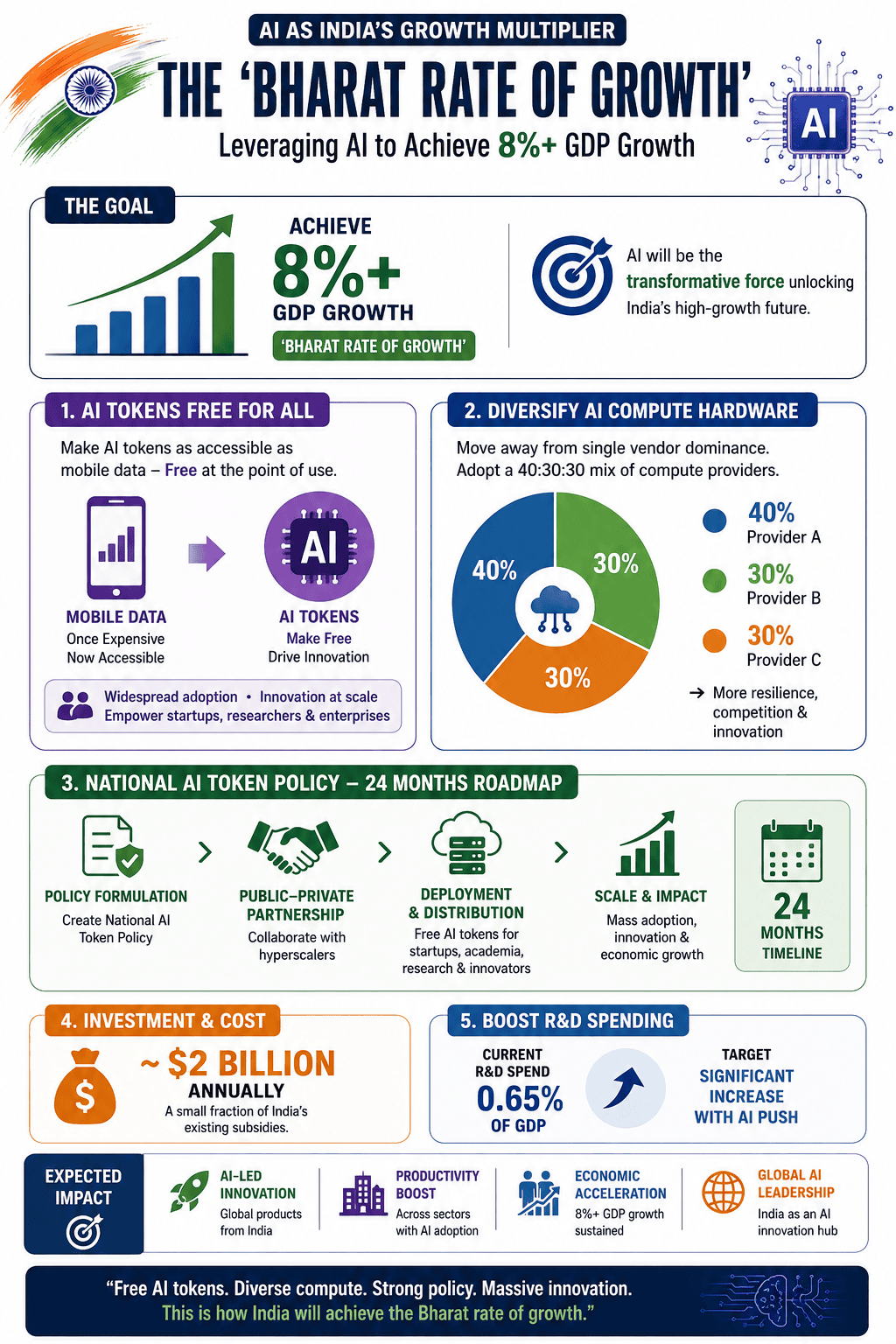
Bharat Rate of Growth.png
Detailed Insights:
- The article draws a parallel between the potential of AI and the economic liberalization reforms of 1991, which moved India beyond the "Hindu rate of growth" (around 3%).
- India has a proven track record of scaling digital infrastructure, exemplified by Aadhaar (biometric identity), UPI (digital payments), and Reliance Jio (affordable mobile data).
- The proposed funding for AI tokens could be achieved by freezing subsidy growth for a year, rather than cutting existing welfare programs.
- Public-private partnerships with major cloud providers like AWS, Google, and Microsoft are envisioned to secure free inference capacity in exchange for data center land and power subsidies.
- Hosting AI models on sovereign infrastructure is deemed crucial for national security and avoiding dependence on foreign APIs, with Sarvam being an example of an Indian-trained model.
- Open-source AI models offer advantages such as sovereignty, lower costs, customization for Indic languages, and transparency through auditable model weights.
- The strategy emphasizes building deep expertise in managing AI infrastructure for high availability, low latency, efficiency, and robust security.
- Diversifying hardware to include AWS Trainium, AMD, and Google TPUs alongside NVIDIA is seen as economically viable and strategically essential to prevent vendor lock-in.
- The implementation timeline includes piloting unlimited research tokens for top IITs and IISc, expanding access to startups and universities, and launching an AI literacy program in high schools.
Key Concepts Involved:
- Hindu Rate of Growth: A term used to describe India's historically low annual economic growth rate of about 3.5% from the 1950s to the 1980s.
- Digital Public Infrastructure (DPI): Open, interoperable digital systems and platforms, like Aadhaar and UPI, that enable public and private services at scale.
- AI Tokens: The fundamental units of data or computation processed by Artificial Intelligence models, often representing words or sub-word units.
- Hyperscalers: Large cloud computing service providers such as Amazon Web Services (AWS), Google Cloud, and Microsoft Azure, offering extensive infrastructure and services.

SuperKalam is your personal mentor for UPSC preparation, guiding you at every step of the exam journey.
Download the App


STUDY RESOURCES
CONTACT US
ⓒ Snapstack Technologies Private Limited