GS 2: PolityGS 2: GovernanceGS 1: Indian GeographyPrelims
Pact to implement Yamuna water accord inked, Pg1
Union Home Minister Amit Shah brokers landmark Yamuna Water Project accord between Haryana and Rajasthan, ensuring vital water resource implementation.
Practice MCQs
796 Students attempted
Key Highlights:
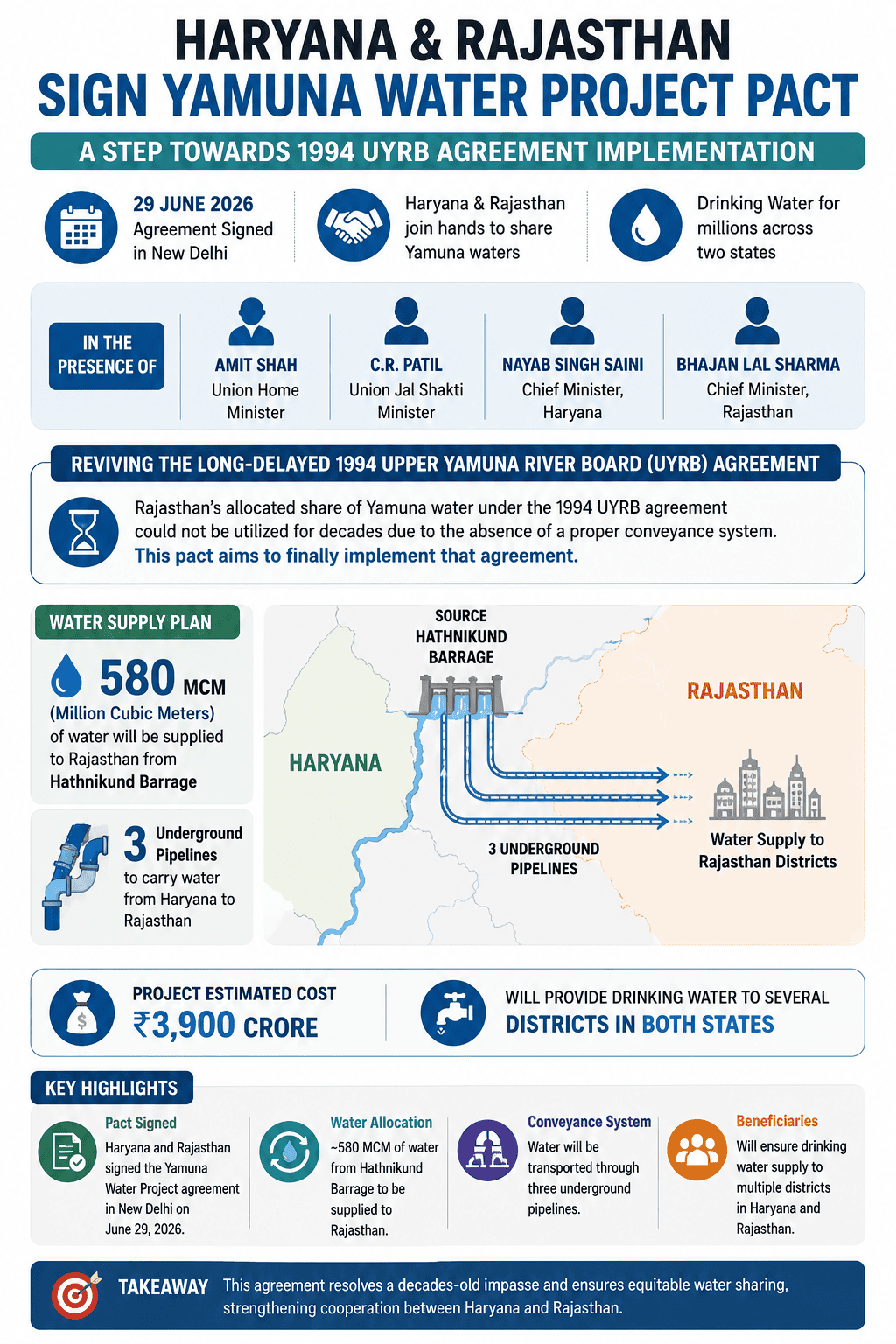
- Haryana and Rajasthan signed an agreement for the Yamuna Water Project in New Delhi on June 29, 2026.
- The pact aims to implement the long-delayed 1994 Upper Yamuna River Board (UYRB) agreement for Yamuna water sharing.
- Approximately 580 Million Cubic Meters (MCM) of water will be supplied from the Hathnikund Barrage to Rajasthan through three underground pipelines.
- The project, estimated at ₹3,900 crore, will provide drinking water to several districts in both states.
Yamuna.png
Detailed Insights:
- The agreement was signed in the presence of Union Home Minister Amit Shah and Union Jal Shakti Minister C.R. Patil, along with the Chief Ministers of both states.
- Rajasthan's allocated share of Yamuna water under the 1994 UYRB agreement could not be utilized for decades due to the absence of a proper conveyance system.
- The three underground pipelines, each over 3.6 meters in diameter, will facilitate water transfer during the monsoon months, from July to October.
- Districts such as Sikar, Churu, and Jhunjhunu in Rajasthan, and Bhiwani and Fatehabad in Haryana, are expected to benefit from improved drinking water supply.
- The 1994 UYRB agreement originally involved Himachal Pradesh, Haryana, Uttar Pradesh, Rajasthan, and Delhi, with Uttarakhand joining in 2001.
- This resolution is highlighted as an example of Cooperative Federalism, demonstrating how long-standing inter-state issues can be resolved through dialogue.
- The implementation of this project is also expected to accelerate other crucial storage projects in the Yamuna basin, including the Renukaji Dam Project, Kishau Multipurpose Dam Project, and Lakhwar-Vyasi Project.
Key Concepts Involved:
- Inter-state Water Dispute: Conflicts between states over the sharing and management of river waters, often requiring central government intervention.
- Cooperative Federalism: A principle in which the central government and state governments collaborate to achieve common goals and resolve shared challenges.
- Memorandum of Understanding (MoU): A formal agreement between two or more parties outlining their intentions and areas of cooperation, though often not legally binding.
- Barrage: A type of low-head dam with a series of gates that regulate water flow, primarily used for irrigation or diverting water into canals.

SuperKalam is your personal mentor for UPSC preparation, guiding you at every step of the exam journey.
Download the App


STUDY RESOURCES
CONTACT US
ⓒ Snapstack Technologies Private Limited