GS 3: Environment & EcologyGS 1: Physical GeographyGS 2: International RelationsPrelims
Overheated Europe, Underprepared world, Pg12
Europe reels from unprecedented 40°C+ heatwaves, exposing global warming's planetary emergency and demanding urgent climate action and commitments.
Practice MCQs
796 Students attempted
Key Highlights:
- Europe experienced severe heatwaves in 2023, with temperatures exceeding 40 degrees Celsius in several countries.
- This follows record-breaking hot summers in Europe in 2019 and 2022.
- The United Kingdom recorded its hottest June day on record, while Spain, Portugal, Belgium, the Netherlands, and Germany also faced unusual conditions.
- The crisis led to red alerts, school closures, transport disruptions, and strain on health services across the continent.
- Europe is identified as the fastest-warming continent globally.
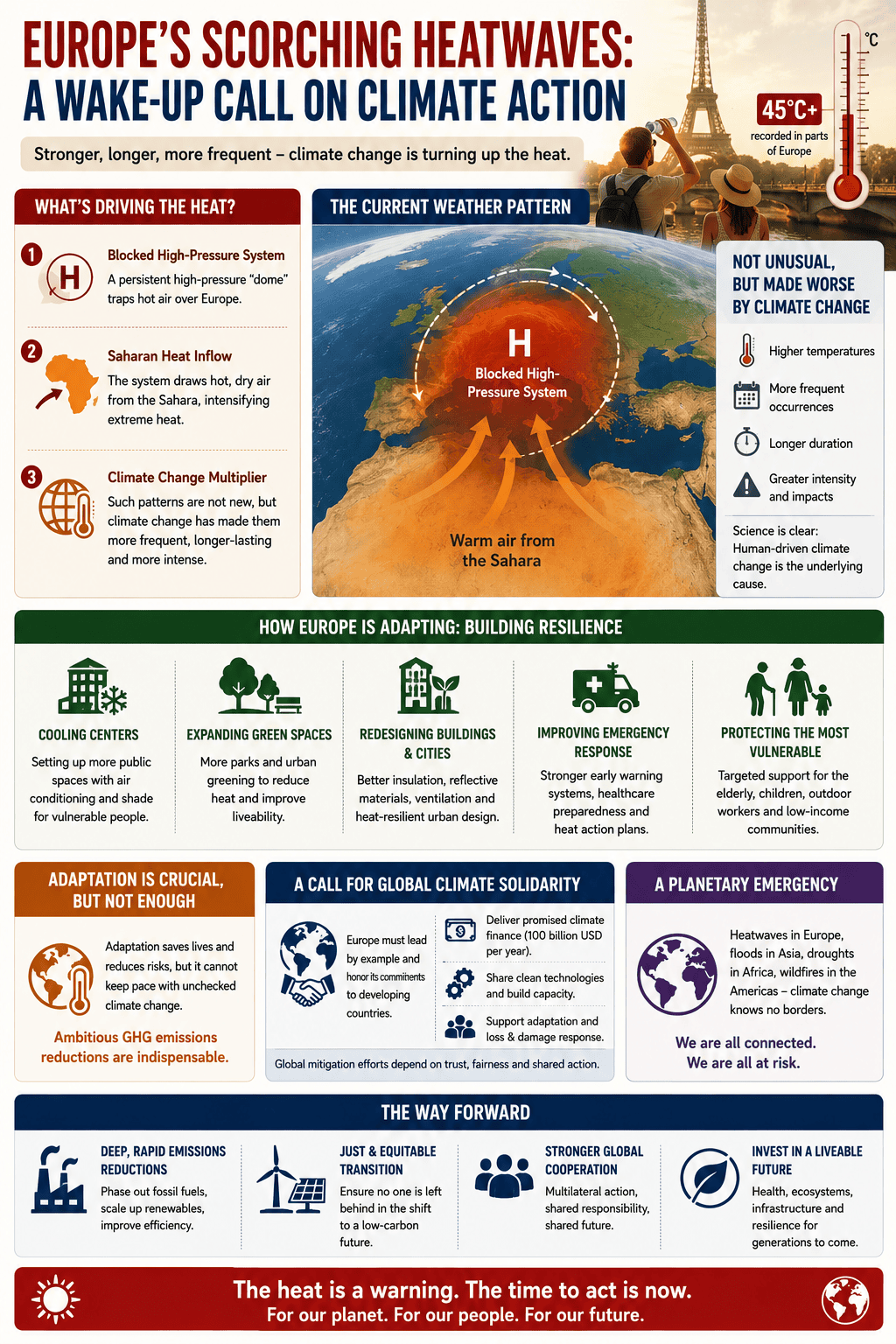
Europe Heatwave.png
Detailed Insights:
- The current weather pattern involves a blocked high-pressure system trapping hot air over Europe and drawing warm air from the Sahara.
- While such patterns are not unusual, climate change has made these occurrences more frequent and intense.
- European municipalities are considering measures like cooling centers, expanding green spaces, redesigning buildings, and improving emergency response systems.
- Adaptation strategies are crucial, but the article emphasizes the indispensable need for ambitious greenhouse gas (GHG) emissions reductions.
- There is a call for Europe to honor its financial and technological commitments to developing countries to aid global climate mitigation efforts.
- The heatwaves highlight the interconnected nature of climate change as a planetary emergency.
Key Concepts Involved:
- Climate Change: Long-term shifts in temperatures and weather patterns, primarily caused by human activities, especially the burning of fossil fuels.
- Greenhouse Gas (GHG) Emissions: Gases that trap heat in the atmosphere, contributing to global warming, such as carbon dioxide, methane, and nitrous oxide.
- Mitigation: Actions taken to reduce or prevent the emission of greenhouse gases and enhance their removal from the atmosphere.
- Adaptation: Adjustments in natural or human systems in response to actual or expected climatic stimuli or their effects, which moderates harm or exploits beneficial opportunities.

SuperKalam is your personal mentor for UPSC preparation, guiding you at every step of the exam journey.
Download the App


STUDY RESOURCES
CONTACT US
ⓒ Snapstack Technologies Private Limited