GS 2: International RelationsGS 1: World GeographyPrelims
Iran to charge fee for using the Strait of Hormuz: What international law says, Pg22
Iran defies international law, imposing transit fees on ships in the strategic Strait of Hormuz, sparking global concerns over navigation rights and UNCLOS principles.
Practice MCQs
796 Students attempted
Key Highlights:
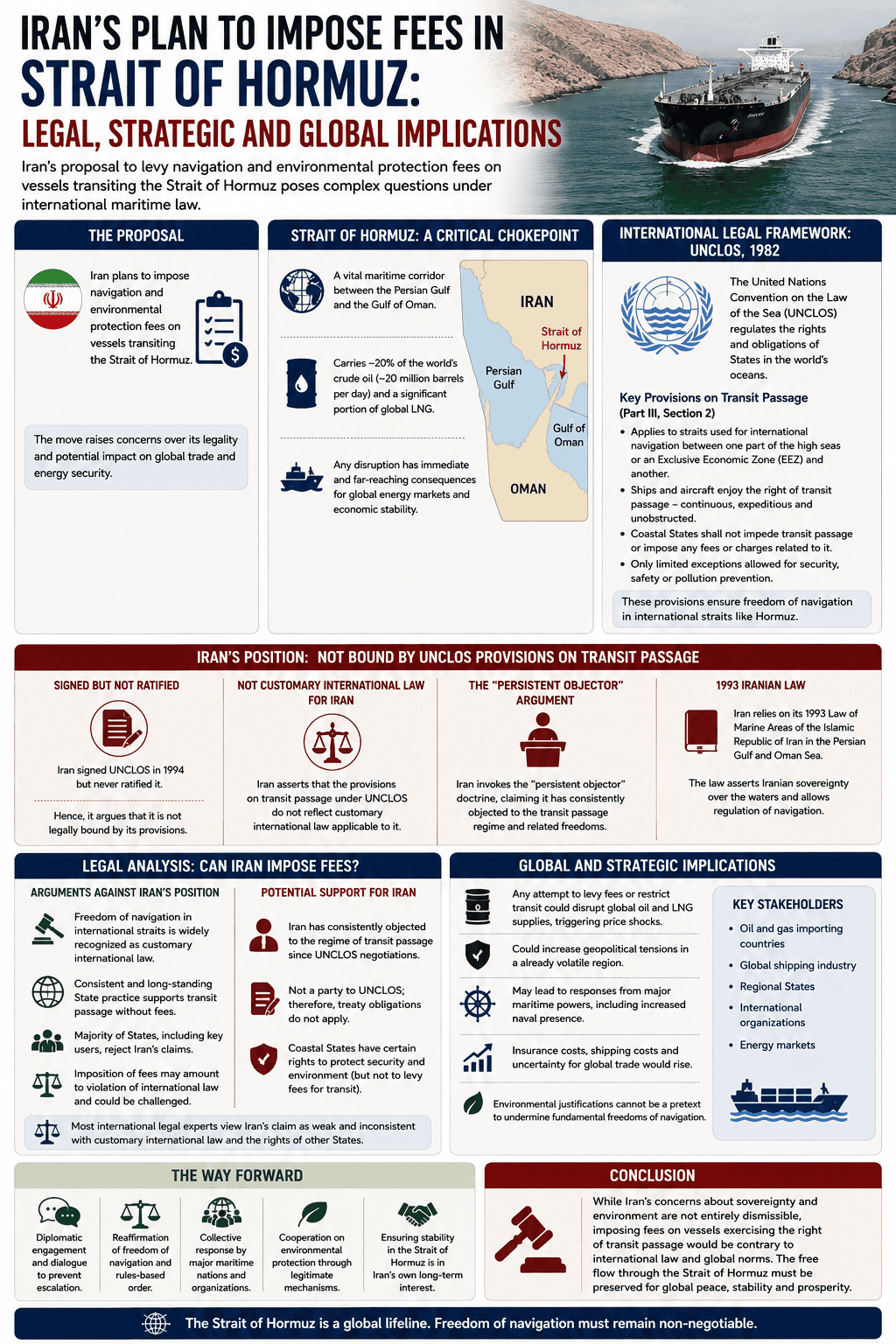
- Iran plans to impose navigation and environmental protection fees for vessels transiting the Strait of Hormuz.
- This action raises questions regarding its compliance with international maritime law, particularly the 1982 United Nations Convention on the Law of the Sea (UNCLOS).
- The Strait of Hormuz is a critical global chokepoint, with approximately 20% of the world's crude oil and a significant portion of liquefied natural gas passing through it.
- Iran, which signed but never ratified UNCLOS, asserts that the convention's provisions on transit passage do not constitute customary international law for it.
- Iran invokes the "persistent objector" argument, citing its 1993 Law of Marine areas of the Islamic Republic of Iran in the Persian Gulf and Oman Sea.
Strait of Hormuz.png
Detailed Insights:
- The Strait of Hormuz connects the Persian Gulf with the Gulf of Oman and the Arabian Sea, making it vital for global energy security.
- UNCLOS Articles 37 to 44 establish the "right of transit passage" for international straits, ensuring continuous and unimpeded navigation.
- The Corfu Channel case (1949) affirmed that ships have unrestricted passage through international straits during peacetime, provided it does not threaten coastal state security.
- Iran argues that the "right of innocent passage" applies, which allows coastal states to deny passage if it prejudices their peace, good order, or security.
- Unlike the Suez and Panama canals, which are artificial and governed by specific treaties, the Strait of Hormuz is a natural waterway.
- Iran's 1993 legislation requires prior authorization for warships and vessels carrying harmful substances, which could include commercial oil tankers.
- The "persistent objector" rule allows a state to be exempt from a norm of customary international law if it consistently objected to it during its formation.
Key Concepts Involved:
- Strait of Hormuz: A narrow, strategically vital waterway connecting the Persian Gulf to the Arabian Sea, crucial for global oil and gas transit.
- United Nations Convention on the Law of the Sea (UNCLOS): An international treaty establishing a legal framework for all marine and maritime activities.
- Right of Transit Passage: The right of all ships and aircraft to unimpeded navigation and overflight through international straits for continuous and expeditious transit.
- Right of Innocent Passage: The right of foreign vessels to navigate through a coastal state's territorial sea, provided it is not prejudicial to the peace, good order, or security of that state.
- Customary International Law: International legal obligations arising from established state practices followed out of a sense of legal obligation, binding on all states.
- Persistent Objector: A doctrine in international law allowing a state to be exempt from a norm of customary international law if it consistently objected to it from its inception.
Previous18/18

SuperKalam is your personal mentor for UPSC preparation, guiding you at every step of the exam journey.
Download the App


STUDY RESOURCES
CONTACT US
ⓒ Snapstack Technologies Private Limited