GS 3: Internal SecurityPrelimsGS 2: International Relations
Army set to establish, operationalise first Integrated Battle Groups next month, Pg1
Indian Army to operationalize first Integrated Battle Groups next month from XVII Corps, enhancing agile deployment in mountainous areas facing China.
Practice MCQs
789 Students attempted
Key Highlights:
- The Indian Army is set to operationalize its first Integrated Battle Groups (IBGs) by next month, specifically July 1.
- These IBGs will be agile, self-contained, brigade-sized fighting units, initially carved out of the Panagarh-based XVII Corps.
- The XVII Corps is the Mountain Strike Corps (MSC), primarily tasked with operations along the China border.
- Each IBG will comprise over 5,000 troops, including infantry, artillery, engineers, and support elements, commanded by a Major General.
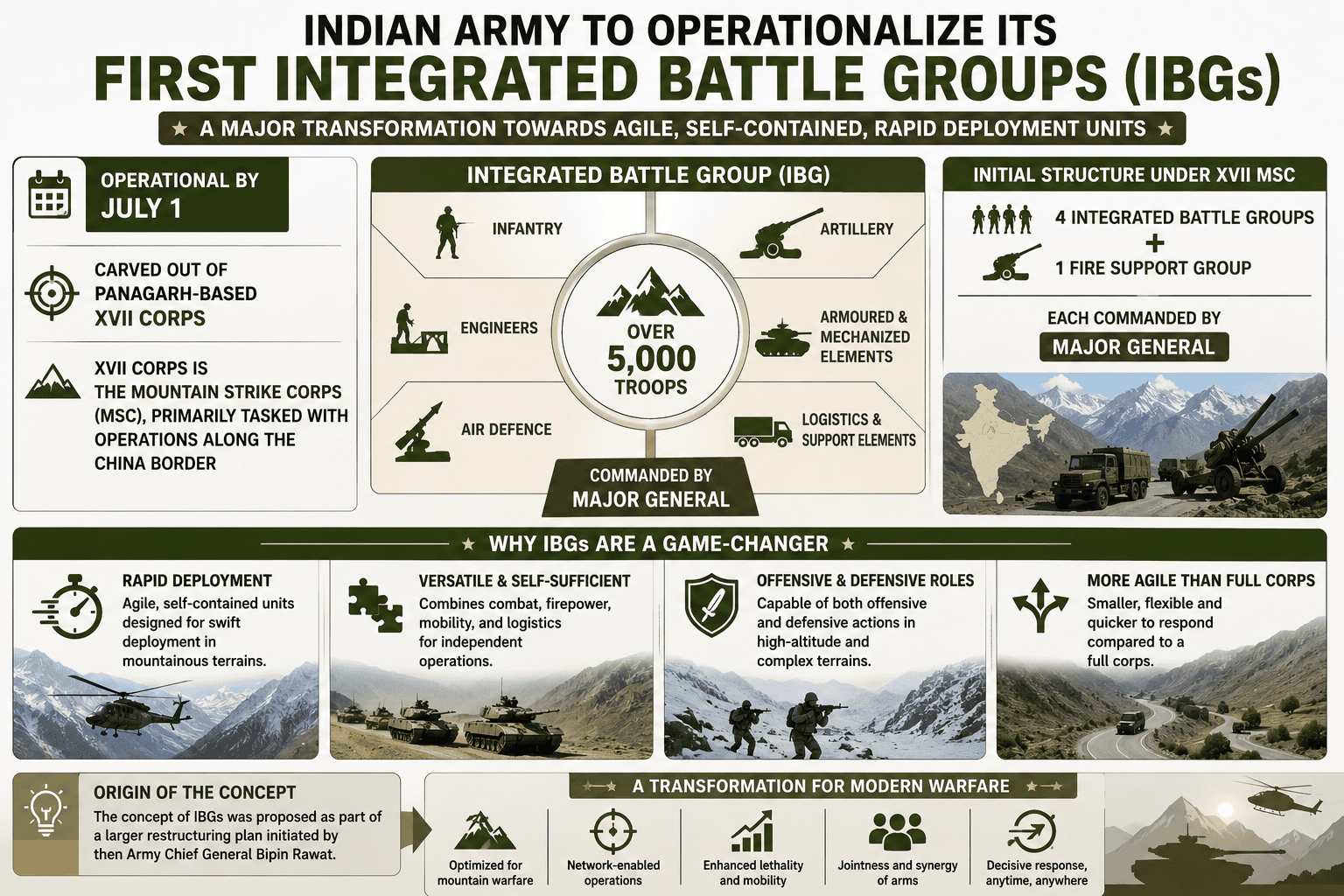
IBG.png
Detailed Insights:
- The establishment of IBGs is a significant transformation aimed at enabling rapid deployment in mountainous terrains.
- The initial plan involves creating four IBGs and a fire support group under the XVII MSC, each commanded by a Major General.
- The concept of IBGs was proposed as part of a larger restructuring plan initiated by then Army Chief General Bipin Rawat.
- IBGs are designed for both offensive and defensive roles, offering swift application and flexible operations compared to a full corps.
- The concept was test-bedded at the IX Corps on the western border around 2019 and experimented with in the eastern theatre during Exercise Him Vijay in 2019.
- This restructuring aligns with global trends, as China has also transitioned to smaller, more versatile Combined Arms Brigades (CABs).
Key Concepts Involved:
- Integrated Battle Groups (IBGs): Self-contained, brigade-sized military formations designed for rapid deployment and flexible operations.
- Mountain Strike Corps (MSC): A specialized military formation equipped and trained for offensive operations in mountainous and high-altitude regions.
- Combined Arms Operations: Military tactics that integrate different combat arms, such as infantry, artillery, and engineers, to achieve synergistic effects.

SuperKalam is your personal mentor for UPSC preparation, guiding you at every step of the exam journey.
Download the App


STUDY RESOURCES
CONTACT US
ⓒ Snapstack Technologies Private Limited