GS 3: Science & TechnologyPrelims
Chandrayaan-2 finds ‘possible presence’ of ice in lunar south pole, Pg12
Chandrayaan-2 discovers potential sub-surface ice deposits in Lunar South Pole's shadowed craters, crucial for future exploration missions.
Practice MCQs
782 Students attempted
Key Highlights:
- Chandrayaan-2 found possible sub-surface ice in the Lunar South Polar Region using its Dual Frequency Synthetic Aperture Radar (DFSAR).
- Scientists focused on doubly shadowed craters within permanently shadowed regions (PSRs).
- These PSRs maintain extremely cold temperatures (around -25K) favorable for preserving water-ice.
- Radar analysis identified signatures suggesting sub-surface ice in four doubly shadowed craters.
Detailed Insights:
- Chandrayaan-2, launched nearly six years ago, continues to deliver valuable data about the moon.
- Doubly shadowed craters are unique due to their continuous shielding from sunlight and thermal radiation.
- The extremely low temperatures in PSRs allow water-ice to be preserved over extended geological periods.
- The discovery has significant implications for planning and executing future lunar exploration missions.
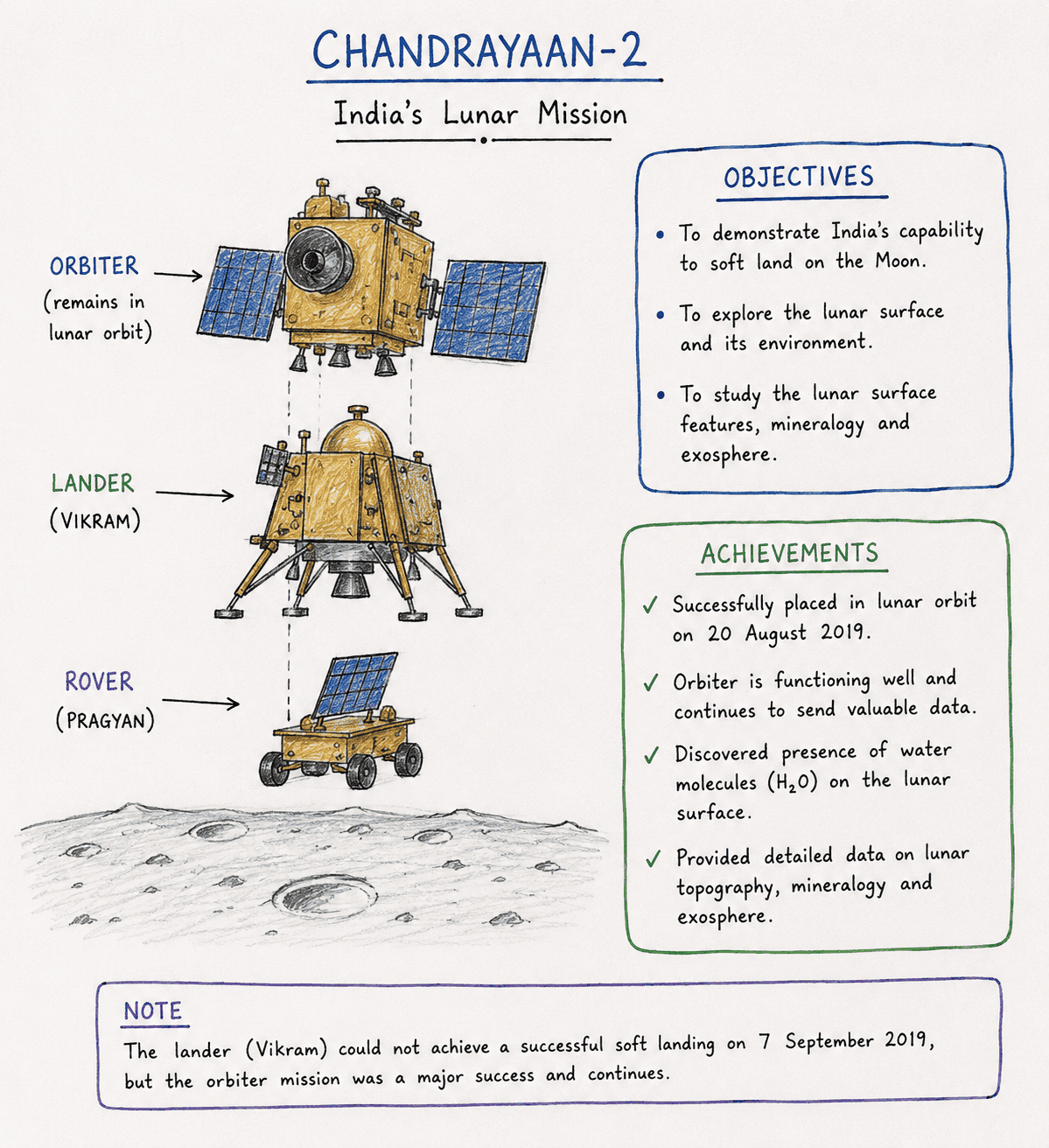
C2.png
Scientific/Technical Concepts Involved:
- Dual Frequency Synthetic Aperture Radar (DFSAR): An advanced radar system used for high-resolution imaging of surfaces.
- Permanently Shadowed Regions (PSRs): Lunar areas that never receive direct sunlight, maintaining extremely low temperatures.
- Radar Polarimetric Analysis: A technique used to analyze the properties of radar waves to infer characteristics of a surface.

SuperKalam is your personal mentor for UPSC preparation, guiding you at every step of the exam journey.
Download the App


STUDY RESOURCES
CONTACT US
ⓒ Snapstack Technologies Private Limited