GS 2: Social JusticeGS 2: PolityPrelims
The RTE Act and the idea of social inclusion, Pg6
Supreme Court reaffirms RTE Act's Section 12(1)(c), emphasizing social inclusion through 25% private school reservation for disadvantaged students.
Practice MCQs
775 Students attempted
Key Highlights:
- In January 2026, the Supreme Court reaffirmed the purpose of Section 12(1)(c) of the RTE Act, 2009, which reserves 25% of seats in private schools for disadvantaged students.
- The Court emphasized that this provision aims to create shared learning spaces, fostering equality of status among children from diverse backgrounds.
- Over five million children have gained access to private schools through this provision, with retention rates averaging over 90%.
- Research indicates that mixed classrooms lead to increased generosity, reduced discrimination, and stronger pro-social behavior, without adverse academic impacts.
Detailed Insights:
- Section 12(1)(c) is a constitutional strategy to integrate students from diverse socioeconomic backgrounds, not a tool to promote private schooling or outsource public education duties.
- The shift towards private schooling predates the RTE Act, driven by concerns about infrastructure, teacher presence, and perceived quality in government schools.
- Blended classrooms are becoming the norm in cities like Delhi and Ahmedabad, providing disadvantaged children access to social capital, peer networks, and broader worldviews.
- Challenges in implementation persist, including resistance from some private schools, hidden costs for families, and uneven implementation across states.
- State-driven digital admission systems and improved monitoring mechanisms in states like Rajasthan, Gujarat, and Delhi have strengthened access and accountability.
- States must ensure timely reimbursements, remove hidden costs, strengthen grievance redress, and enforce inclusion norms to fully realize the promise of social integration.
Key Concepts Involved:
- Right to Education (RTE) Act, 2009: Indian legislation ensuring free and compulsory education for children aged 6-14 years.
- Social Inclusion: The process of improving the terms for individuals and groups to take part in society.
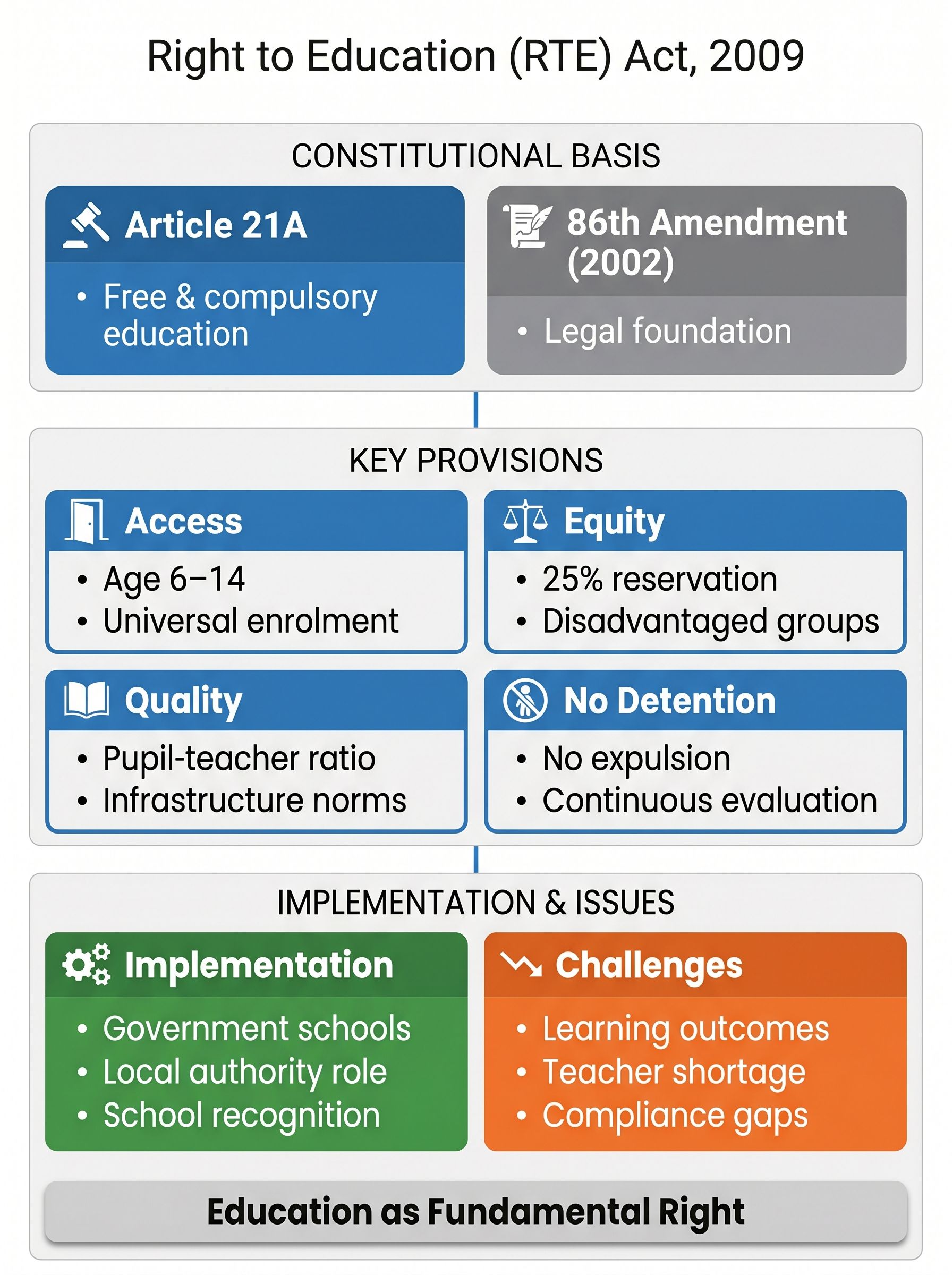
RTE ACT

SuperKalam is your personal mentor for UPSC preparation, guiding you at every step of the exam journey.
Download the App


STUDY RESOURCES
CONTACT US
ⓒ Snapstack Technologies Private Limited