GS 2: PolityPrelimsGS 2: Governance
Which document proves Indian citizenship?, Pg11
MEA official clarifies passports, Aadhaar, and voter IDs are not conclusive proof of Indian citizenship, exposing complex legal framework and lack of universal document.
Practice MCQs
782 Students attempted
Key Highlights:
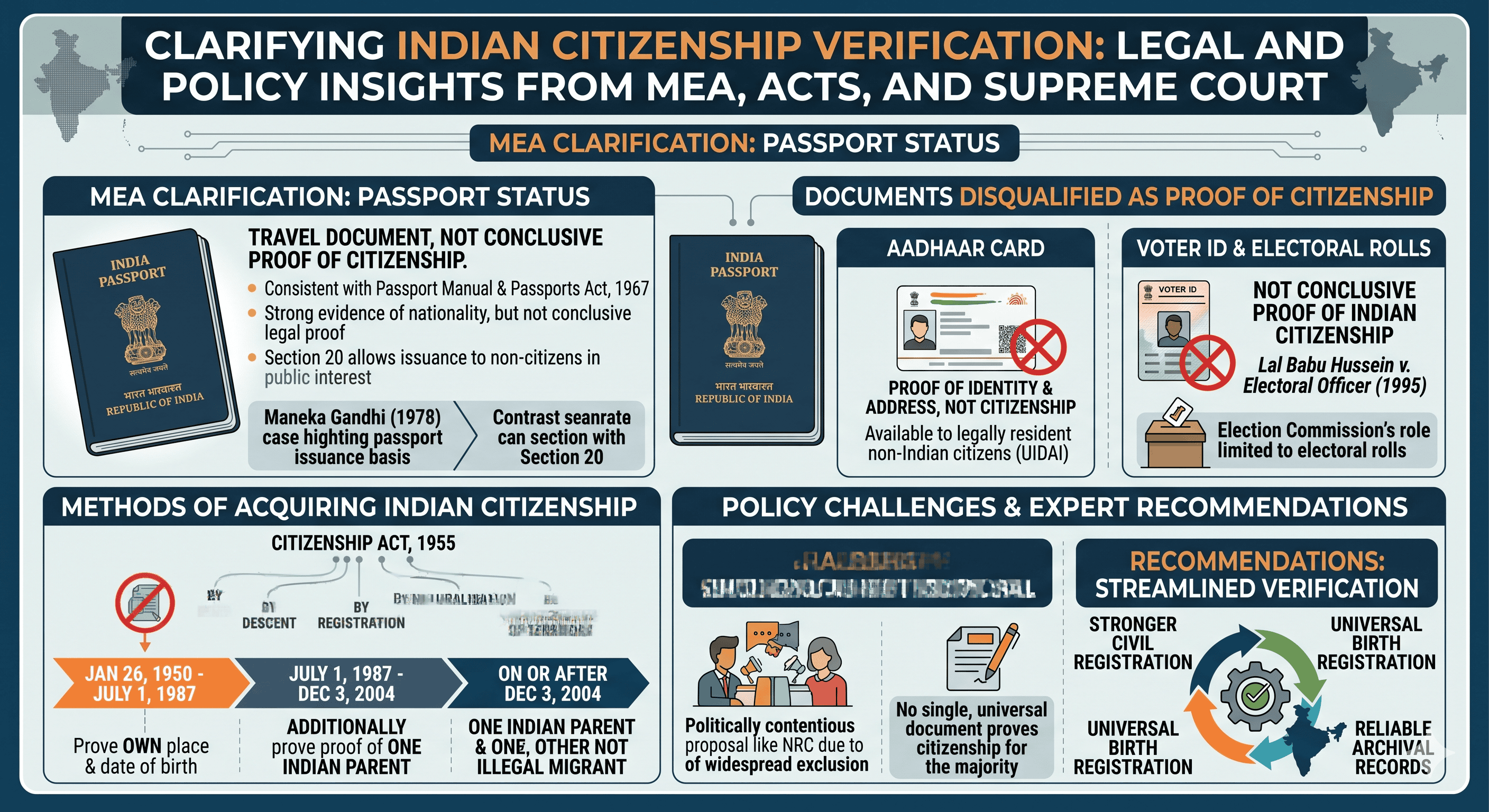
- The Ministry of External Affairs (MEA) clarified that an Indian passport is a travel document and not conclusive proof of citizenship.
- This stance is consistent with the Passport Manual and the Passports Act, 1967, which allows refusal of a passport if the applicant is not a citizen.
- The Supreme Court recently affirmed that Aadhaar cards serve as proof of identity and address, but not as proof of citizenship.
- Voter IDs or presence on electoral rolls do not conclusively prove Indian citizenship, as established by the Supreme Court in Lal Babu Hussein v. Electoral Registration Officer (1995).
- Indian citizenship is governed by the Citizenship Act, 1955, and can be acquired by birth, descent, registration, naturalisation, or incorporation of territory.
- There is no single, universal document that conclusively proves Indian citizenship for the majority of citizens, who are citizens by birth or descent.
Citizenship.png
Detailed Insights:
- The Passport Manual categorizes a passport as strong evidence of nationality, but not as conclusive legal proof of citizenship.
- The Maneka Gandhi v Union Of India (1978) case highlighted that passport issuance is based on conclusive proof of Indian nationality.
- Section 20 of the Passports Act, 1967, permits the Union government to issue passports to non-citizens in the public interest.
- Aadhaar is issued by the Unique Identification Authority of India (UIDAI) and is available to legally resident non-Indian citizens as well.
- The Election Commission's role is limited to determining eligibility for electoral rolls and does not extend to adjudicating citizenship.
- Citizenship by birth rules vary significantly based on the date of birth, requiring different documentary proofs for each period.
- Individuals born between January 26, 1950, and July 1, 1987, need to prove their own place and date of birth for citizenship.
- For those born between July 1, 1987, and December 3, 2004, proof of one Indian parent is additionally required.
- For those born on or after December 3, 2004, one parent must be Indian, and the other must not be an illegal migrant.
- The proposal for a single document like the National Register of Citizens (NRC) became politically contentious due to fears of widespread exclusion.
- Experts advocate for stronger civil registration, universal birth registration, and reliable archival records to streamline citizenship verification.
Key Concepts Involved:
- Citizenship Act, 1955: The primary legislation governing the acquisition, determination, and termination of Indian citizenship.
- Passports Act, 1967: The law that regulates the issuance of passports and travel documents to Indian citizens.
- Aadhaar: A 12-digit unique identification number issued by the Unique Identification Authority of India (UIDAI), serving as proof of identity and address.
- National Register of Citizens (NRC): An official record of legal Indian citizens, intended to identify and document all genuine citizens.

SuperKalam is your personal mentor for UPSC preparation, guiding you at every step of the exam journey.
Download the App


STUDY RESOURCES
CONTACT US
ⓒ Snapstack Technologies Private Limited