GS 3: Science & TechnologyPrelims
Why does gold never rust? Its surface may have the clue, Pg2
Study reveals gold's resistance to rust is due to surface reconstruction hindering oxygen molecule dissociation, impacting catalyst design.
Practice MCQs
775 Students attempted
Key Highlights:
- Gold's resistance to rust and tarnish is attributed to its low reactivity.
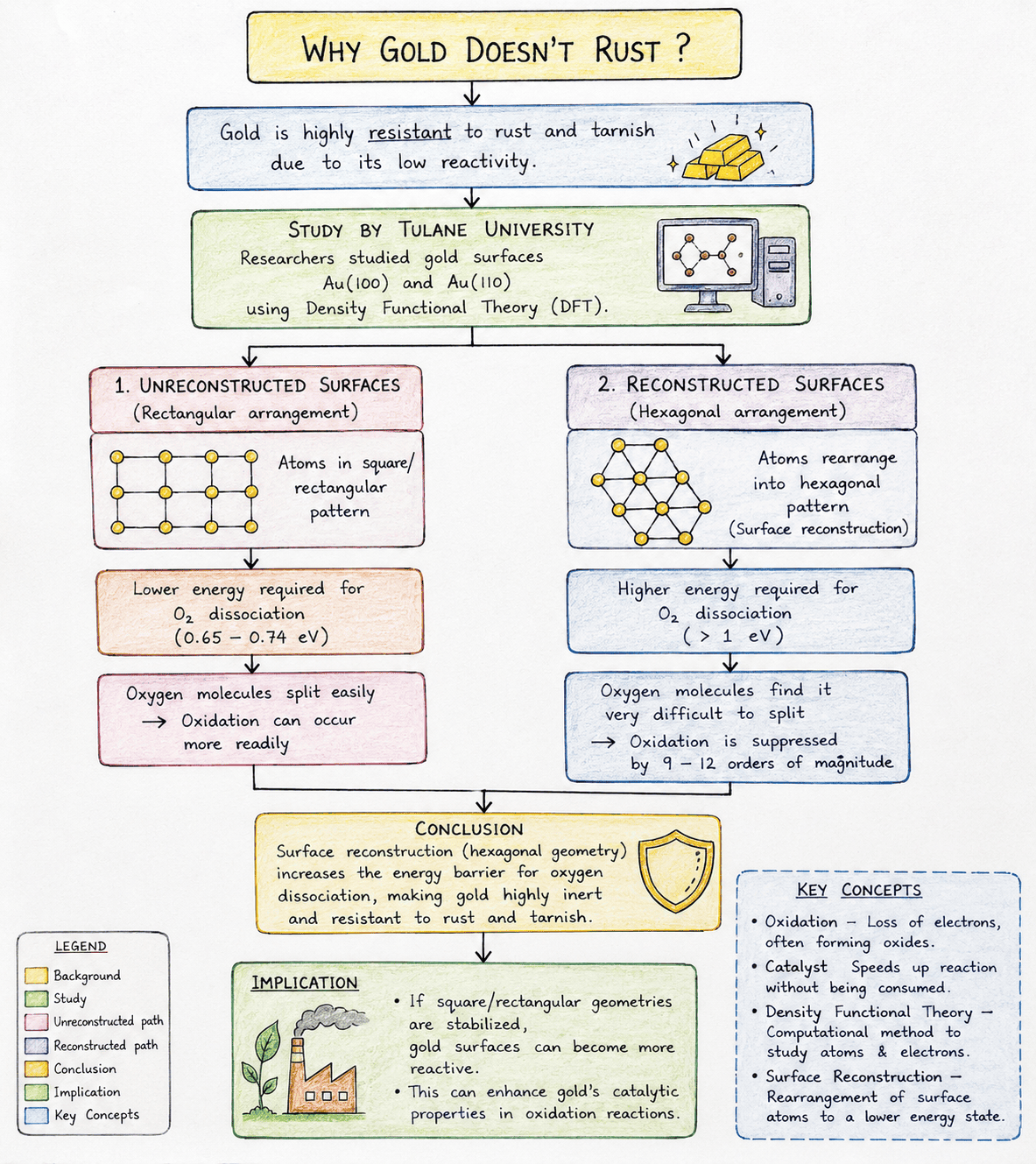
- Researchers at Tulane University studied gold surfaces, Au(100) and Au(110), to understand this property.
- Surface reconstruction, where gold atoms rearrange into hexagonal patterns, increases the energy required for oxygen molecules to split.
- Reconstruction suppresses oxidation by nine to twelve orders of magnitude due to atomic geometry.
Detailed Insights:
- Gold's inertness makes it a symbol of permanence, but it's also used as a catalyst in oxidation reactions.
- The study used density functional theory to compare reconstructed and unreconstructed gold surfaces, estimating the energy needed for oxygen dissociation.
- Unreconstructed gold surfaces have a rectangular arrangement of atoms and lower dissociation energy (0.65-0.74 eV).
- Reconstructed surfaces require more than 1 eV for oxygen molecule dissociation, hindering oxidation.
- Stabilizing square or rectangular surface geometries could make gold more reactive in oxidation reactions, potentially improving its catalytic properties.
Gold.png
Scientific/Technical Concepts Involved:
- Oxidation: A chemical reaction involving the loss of electrons, often resulting in the formation of oxides.
- Catalyst: A substance that speeds up a chemical reaction without being consumed in the process.
- Density Functional Theory: A computational method used to simulate the behavior of atoms and electrons in materials.
- Surface Reconstruction: The rearrangement of atoms on a material's surface to achieve a lower energy state.

SuperKalam is your personal mentor for UPSC preparation, guiding you at every step of the exam journey.
Download the App


STUDY RESOURCES
CONTACT US
ⓒ Snapstack Technologies Private Limited