GS 3: Science & TechnologyPrelims
To make sense of cosmic rays, CERN team tracks a fragile nucleus, PgII
CERN's ALICE experiment reveals deuteron formation mechanism in high-energy collisions, impacting cosmic ray and dark matter research.
Practice MCQs
746 Students attempted
Key Highlights:
- The ALICE collaboration at the Large Hadron Collider (LHC) has discovered that most deuterons are formed through coalescence after particle decays, not directly at the initial collision.
- The study used femtoscopy to analyze the correlation between pions and deuterons, identifying a signal indicating that deuterons form after the decay of a Δ(1232) resonance.
- Approximately 62% of deuterons are produced following decays, and this figure could rise to 80% when including other short-lived resonances.
- The findings impact the modeling of high-energy particulate reactions, such as those induced by cosmic rays, and could aid in the search for dark matter signals.
Detailed Insights:
- Deuterons, the nuclei of deuterium atoms, are composed of a proton and a neutron with a low binding energy, making them fragile in high-energy environments.
- The coalescence mechanism involves protons and neutrons sticking together after being produced, requiring a third particle like a pion to carry away excess energy.
- The Δ(1232) resonance is a short-lived excited version of a proton or neutron that decays into a pion and a proton or neutron, linking the pion and deuteron formation.
- The discovery suggests that deuterons are assembled slightly later and away from the most violent part of the collision, allowing them to survive the LHC's high-energy environment.
- Understanding the formation mechanisms of light nuclei and antinuclei is crucial for interpreting cosmic-ray data and searching for potential dark matter signals.
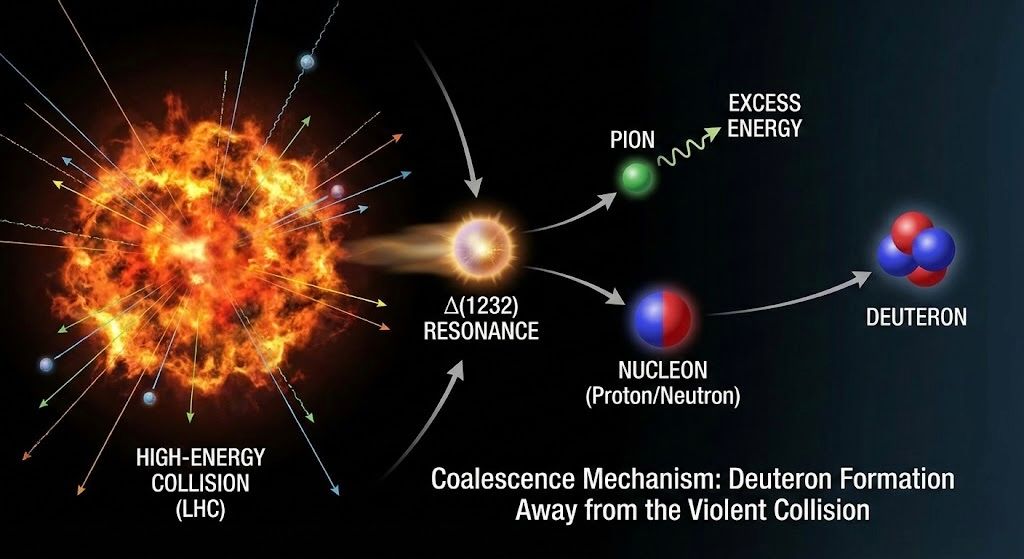
Deuteron
Scientific/Technical Concepts Involved:
- Deuteron: The nucleus of a deuterium atom, consisting of one proton and one neutron.
- Coalescence: A process where particles combine to form a new particle.
- Pion: A subatomic particle that acts as a catalyst in nuclear reactions.
- Δ(1232) resonance: A short-lived, excited state of a proton or neutron that decays into a pion.
Previous13/13

SuperKalam is your personal mentor for UPSC preparation, guiding you at every step of the exam journey.
Download the App


STUDY RESOURCES
CONTACT US
ⓒ Snapstack Technologies Private Limited