GS 2: International RelationsGS 3: EconomyGS 2: GovernancePrelims
‘China’s Bangladesh ties doesn’t target third party’, Pg12
China pledges 'trusted friend' status to Bangladesh, fast-tracking Teesta project and BRI cooperation amidst high-level talks.
Practice MCQs
775 Students attempted
Key Highlights:
- China affirmed that its relationship with Bangladesh does not "target" any third party.
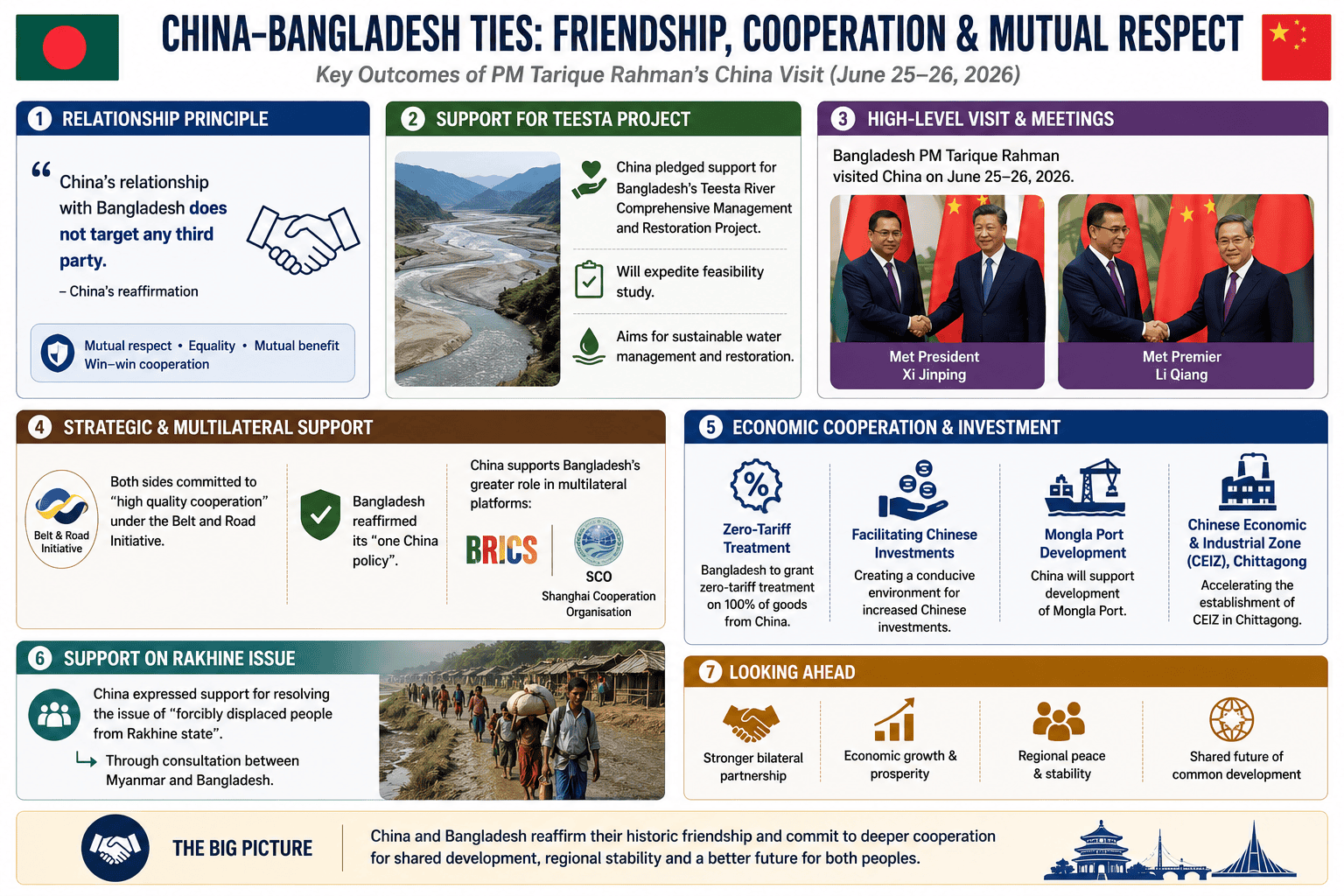
- China pledged support for Bangladesh's Teesta River Comprehensive Management and Restoration Project and will expedite its feasibility study.
- Bangladesh Prime Minister Tarique Rahman visited China from June 25-26, meeting President Xi Jinping and Premier Li Qiang.
- Both nations committed to "high quality cooperation" under the Belt and Road Initiative and Bangladesh reaffirmed its "one China policy".
- China supported Bangladesh's greater role in multilateral organizations like BRICS and the Shanghai Cooperation Organisation.
- Economic cooperation includes zero-tariff treatment, facilitating Chinese investments, and developing Mongla port and a Chinese Economic and Industrial Zone (CEIZ) in Chittagong.
- China expressed support for resolving the issue of "forcibly displaced people from Rakhine state" through consultation between Myanmar and Bangladesh.
China-Bangladesh.png
Detailed Insights:
- The Teesta River Comprehensive Management and Restoration Project is crucial for Bangladesh's water management and agricultural development, a project where India also has significant interests.
- China's support for the Teesta project is seen as a strategic move to enhance its influence in South Asia, potentially impacting regional geopolitical dynamics.
- The Belt and Road Initiative (BRI) is a global infrastructure development strategy by China aimed at fostering connectivity and economic cooperation across various regions.
- Bangladesh's commitment to the "one China policy" aligns with Beijing's diplomatic principles regarding Taiwan and Tibet.
- China's backing for Bangladesh's participation in BRICS and SCO aims to expand the reach and influence of these multilateral platforms.
- The zero-tariff treatment for 100% tariff lines significantly boosts Bangladesh's exports to China, strengthening bilateral trade relations.
- Development of Mongla port and the Chinese Economic and Industrial Zone (CEIZ) in Chittagong are key components of China's infrastructure investment, enhancing Bangladesh's connectivity and industrial capacity.
- China's diplomatic phrasing regarding "forcibly displaced people from Rakhine state" reflects a cautious approach to the Rohingya issue, avoiding direct reference to the term "Rohingya".
- The visit underscores China's growing economic and strategic engagement in Bangladesh, a country with significant geopolitical importance in the Bay of Bengal region.
- President Xi Jinping assured support for the development plans of the BNP government, highlighting the strengthened bilateral ties under the new administration.
Key Concepts Involved:
- Teesta River Comprehensive Management and Restoration Project: A major infrastructure initiative in Bangladesh focused on water resource management and flood control for the Teesta River.
- Belt and Road Initiative (BRI): China's global strategy to invest in infrastructure development and accelerate economic integration across Asia, Europe, and Africa.
- One China Policy: A diplomatic stance acknowledging the People's Republic of China's claim over Taiwan and other territories as integral parts of China.
- BRICS: An intergovernmental organization comprising Brazil, Russia, India, China, South Africa, and other members, promoting economic and political cooperation.
- Shanghai Cooperation Organisation (SCO): A Eurasian political, economic, and security alliance, primarily led by China and Russia.
- Zero-tariff treatment: An agreement between countries to eliminate customs duties on a specified range of goods, promoting free trade.
- Chinese Economic and Industrial Zone (CEIZ): Special economic zones established in foreign countries with Chinese investment to facilitate industrial development and trade.
- BNP government: Refers to the government formed by the Bangladesh Nationalist Party, which assumed power in Bangladesh in February 2026.

SuperKalam is your personal mentor for UPSC preparation, guiding you at every step of the exam journey.
Download the App


STUDY RESOURCES
CONTACT US
ⓒ Snapstack Technologies Private Limited