GS 3: Internal SecurityGS 2: GovernanceGS 2: International Relations
In PRAHAAR lies India's consolidated strategy for counterterrorism operations, Pg19
India unveils 'PRAHAAR', a comprehensive counter-terrorism strategy addressing cross-border threats, technology use, and international cooperation, marking a shift towards consolidated national policy.
Practice MCQs
746 Students attempted
Key Highlights:
- The Ministry of Home Affairs (MHA) has released PRAHAAR, India's first publicly articulated national counter-terrorism strategy document.
- PRAHAAR outlines a comprehensive framework for India's approach to terrorism, incorporating past measures and future plans.
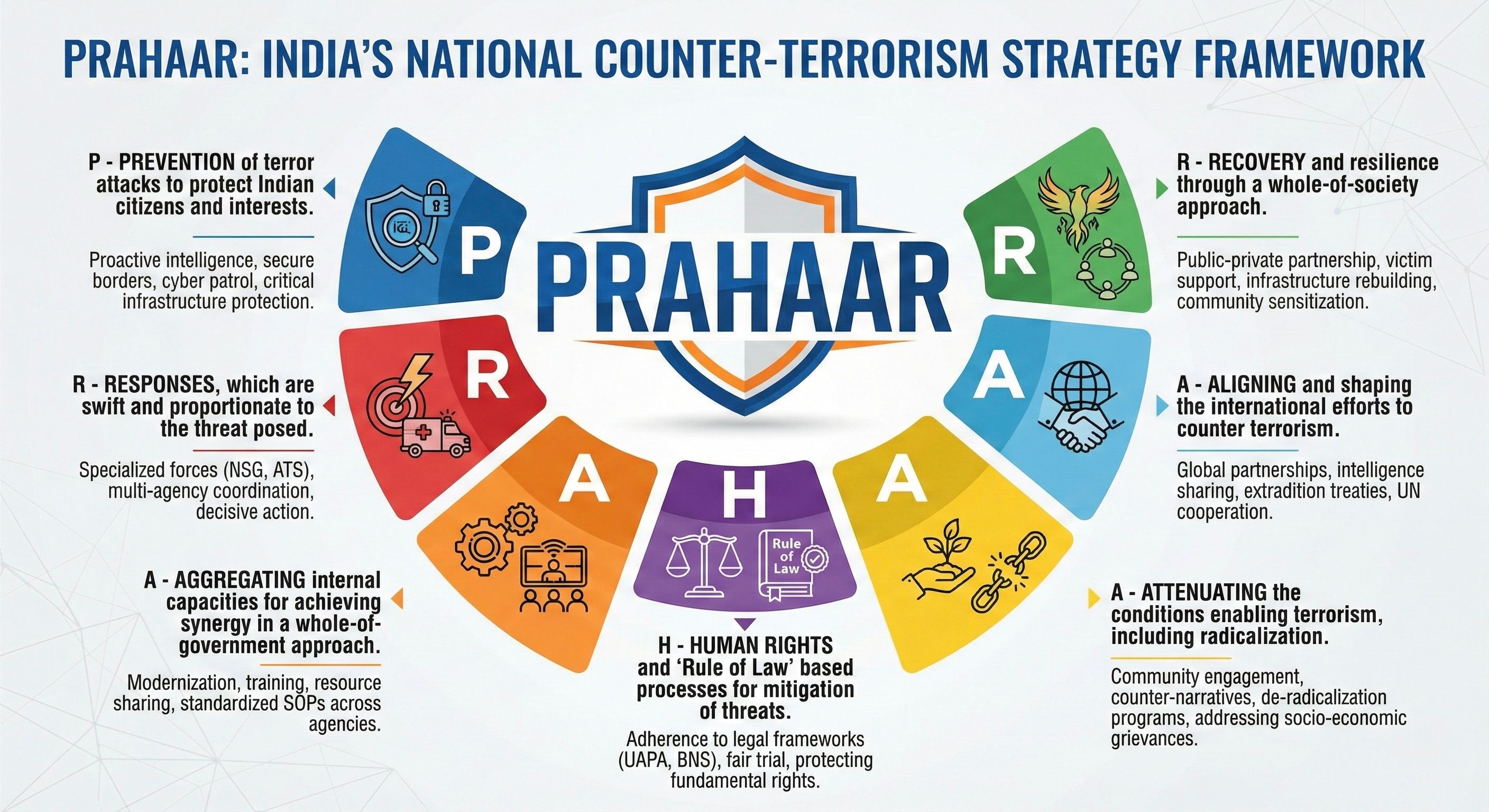
- The strategy emphasizes a seven-pillar response, including intelligence-led prevention, swift response, and international cooperation.
- Unlike the US and UK strategies, PRAHAAR is less detailed and does not include specific objectives, sub-programs, or agency-specific tasks.
Detailed Insights:
- PRAHAAR addresses India's terrorism challenges shaped by cross-border violence, global jihadi networks, and technological advancements like drones and cyber attacks.
- The seven-pillar response includes intelligence-led prevention, swift response by local police, aggregation of capacities through police modernization, and adherence to human rights.
- PRAHAAR also focuses on graded de-radicalization, community engagement, international cooperation, and recovery and resilience with a zero-tolerance stance on terrorism, irrespective of religion or identity.
- The strategy aims to consolidate India's counterterrorism architecture, which was previously scattered across various laws, SOPs, and state-level arrangements.
- For PRAHAAR to be effective, the MHA needs to develop clear guidelines, possibly state-wise, to translate the seven pillars into practical policing, intelligence sharing, and community engagement.
- Capacity building for state Anti-Terrorism Squads (ATS) and district police is crucial, along with defining the roles of each entity in the response mechanism.
- A national framework for de-radicalization is needed, building on the work done by states like Telangana and Maharashtra.
Key Concepts Involved:
- Counter-Terrorism: Strategies and actions taken to combat terrorism.
- De-radicalization: The process of persuading individuals to abandon extremist beliefs.
- Intelligence Sharing: Exchanging information between agencies to enhance security.
PRAHAAR
Previous13/13

SuperKalam is your personal mentor for UPSC preparation, guiding you at every step of the exam journey.
Download the App


STUDY RESOURCES
CONTACT US
ⓒ Snapstack Technologies Private Limited