GS 3: Science & TechnologyEthicsGS 2: GovernanceGS 1: Indian SocietyPrelims
Keeping humanity at the centre of the AI revolution, Pg8
Pope Leo XIV and global leaders demand urgent human-centric AI governance, fearing job displacement, misinformation, and threats to human dignity amidst the tech revolution.
Practice MCQs
767 Students attempted
Key Highlights:
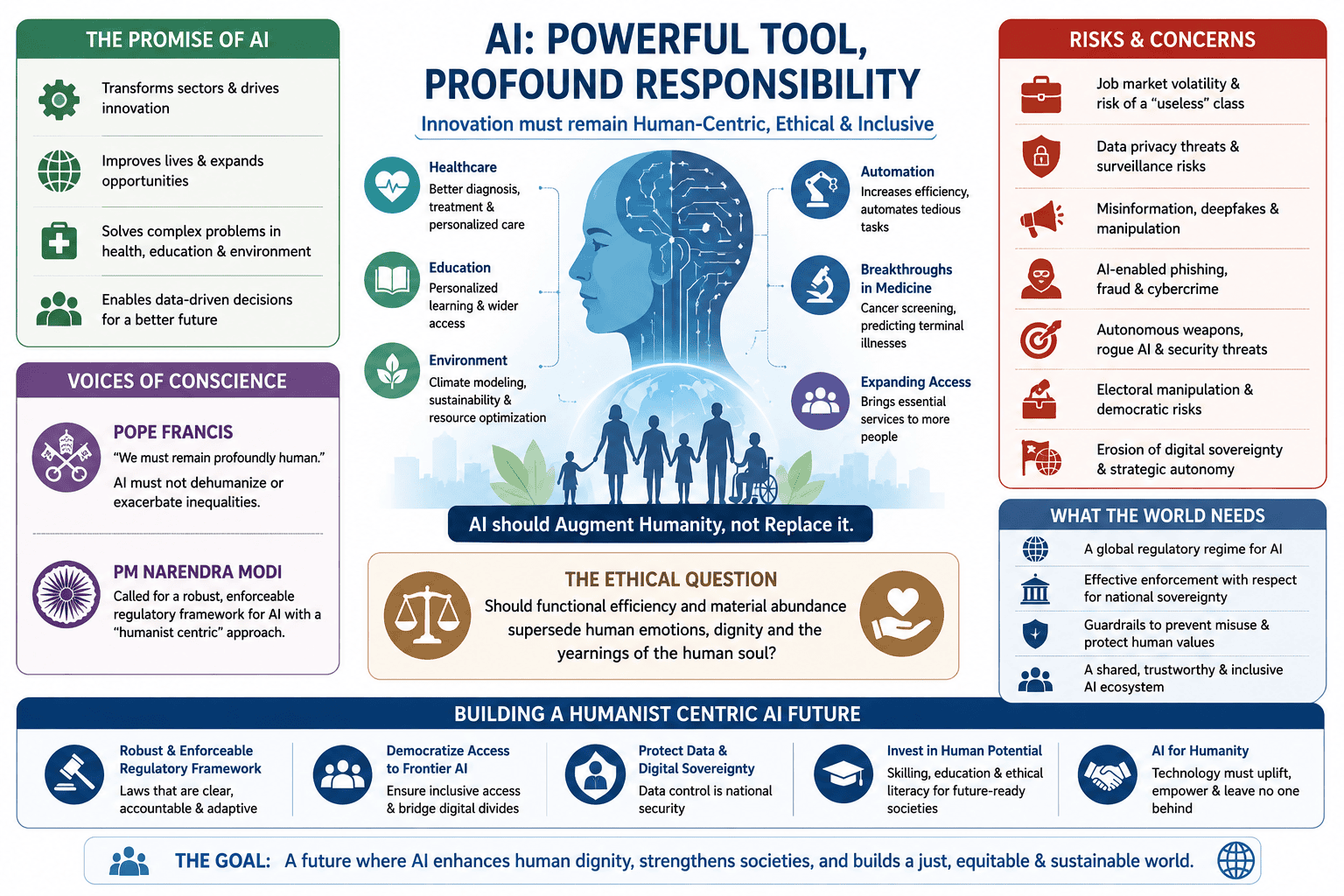
- Artificial Intelligence (AI) offers transformative potential across various sectors, including healthcare, education, and environmental sustainability.
- Concerns are raised regarding AI's impact on human values, job markets, data privacy, and the potential for misuse.
- Philosophers and technology leaders advocate for ethical guardrails and a pause in AI development to address humanitarian considerations.
- Pope Francis has emphasized the duty to remain "profoundly human" in the AI era, warning against dehumanization and progress that exacerbates inequalities.
- Prime Minister Narendra Modi has called for a robust and enforceable regulatory framework for AI, advocating a "humanist centric" approach.
AI Revolution.png
Detailed Insights:
- AI's contributions include automating tedious tasks, expanding access to essential services, and breakthroughs in medicine like cancer screening and prediction of terminal illnesses.
- The debate questions whether functional efficiency and material abundance should supersede human emotions, dignity, and the yearnings of the human soul.
- Potential negative impacts include job market volatility, the creation of a "useless" class, data privacy vulnerabilities, and the proliferation of misinformation.
- Ominous portents of unregulated AI include electoral manipulations, super-intelligent weapon systems going rogue, and AI-enabled phishing campaigns.
- Preserving digital sovereignty of nation-states is crucial, as control over data is intrinsically linked to national security and strategic autonomy.
- A global regulatory regime is deemed necessary to ensure effective enforcement and respect national sovereignty, rather than voluntary commitments.
- Pope Francis warns against the "illusion" of "self-assertion" and the "idolatry of profit" that sacrifices the weak, emphasizing human relational and spiritual capabilities.
- PM Modi stressed a "humanist centric" approach at both the VivaTech 2026 conference in Paris and the India-AI Impact Summit 2026 in New Delhi.
- This approach requires a robust and enforceable regulatory framework to democratize access to frontier AI and build a shared, trustworthy AI ecosystem.
Key Concepts Involved:
- Artificial Intelligence (AI): The simulation of human intelligence processes by machines, especially computer systems, for tasks like learning, problem-solving, and decision-making.
- Digital Sovereignty: A nation-state's ability to control its digital infrastructure, data, and online activities within its borders, crucial for national security.
- Ethical AI: The development and deployment of AI systems guided by moral principles and human values to ensure fairness, transparency, accountability, and human well-being.
- Human-centric AI: An approach to AI design and deployment that prioritizes human well-being, dignity, and control, ensuring technology serves humanity's best interests.

SuperKalam is your personal mentor for UPSC preparation, guiding you at every step of the exam journey.
Download the App


STUDY RESOURCES
CONTACT US
ⓒ Snapstack Technologies Private Limited