GS 1: Physical GeographyGS 3: Disaster ManagementPrelims
Behind Venezuela’s quake devastation: Rare ‘seismic doublet’, vulnerable location, Pg12
Rare 'seismic doublet' of 7.2 and 7.5 magnitude quakes devastates Venezuela, sparking fears of tens of thousands dead.
Practice MCQs
767 Students attempted
Key Highlights:
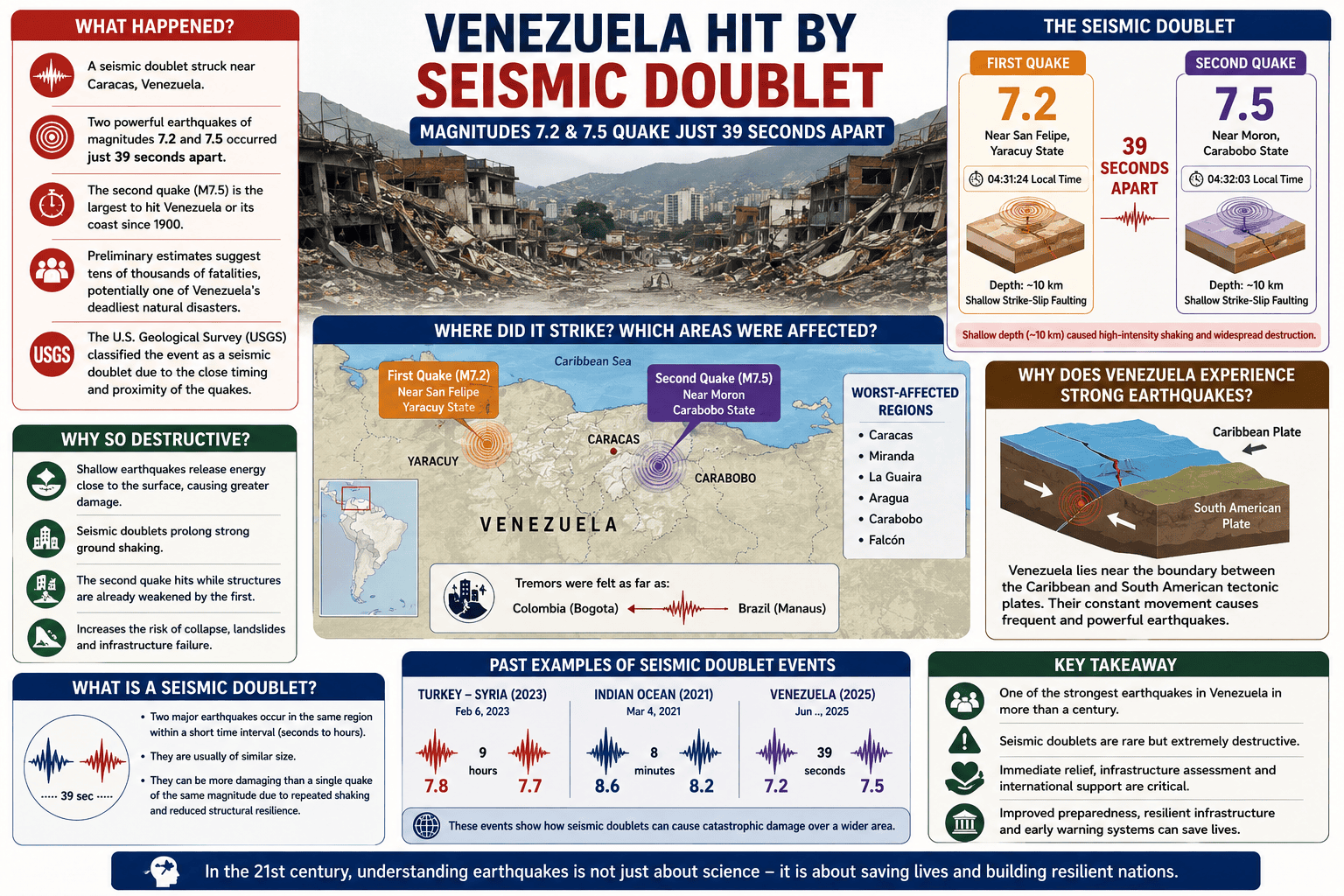
- A seismic doublet of earthquakes, with magnitudes 7.2 and 7.5, struck near Caracas, Venezuela.
- The two quakes occurred just 39 seconds apart, with the second being the largest to hit Venezuela or its coast since 1900.
- Preliminary estimates suggest tens of thousands of fatalities, potentially making it one of Venezuela's deadliest natural disasters.
- The U.S. Geological Survey (USGS) classified the event as a seismic doublet due to the close timing and proximity of the two major quakes.
Venezuala.png
Detailed Insights:
- The first earthquake struck near San Felipe in Yaracuy state, while the second hit near Moron in Carabobo state.
- Tremors from the disaster were felt as far away as neighboring Colombia and parts of Brazil, including Manaus and Bogota.
- Venezuela's President Delcy Rodriguez identified Caracas and the north-central states of Miranda, La Guaira, Aragua, Carabobo, and Falcón as the worst-affected regions.
- The earthquakes resulted from shallow strike-slip faulting near the boundary between the Caribbean and South American tectonic plates.
- The shallow depth of approximately 10 km meant that shockwaves reached the surface with high intensity, contributing to the widespread destruction.
- Seismic doublets are particularly destructive because they prolong strong ground shaking, increasing the risk of collapse for structures already weakened by the initial quake.
- Past examples of such events include a 2023 doublet in Turkey and Syria (magnitudes 7.8 and 7.7) and a 2021 event in the Indian Ocean (magnitudes 8.6 and 8.2).
- Venezuela is situated in one of the most seismically active regions in northern South America.
Key Concepts Involved:
- Seismic Doublet: Two earthquakes of similar magnitude that originate from distinct but closely related ruptures and occur in quick succession.
- Strike-slip fault: A type of fault where two blocks of the Earth's crust slide horizontally past each other.
- Tectonic Plates: Large, rigid slabs of the Earth's lithosphere that are constantly moving and interacting.
- Foreshock: A smaller earthquake that precedes a larger, main earthquake in a seismic sequence.
- Mainshock: The largest earthquake in a seismic sequence, often followed by aftershocks.

SuperKalam is your personal mentor for UPSC preparation, guiding you at every step of the exam journey.
Download the App


STUDY RESOURCES
CONTACT US
ⓒ Snapstack Technologies Private Limited