GS 3: Environment & EcologyGS 3: Science & TechnologyGS 3: EconomyPrelims
What are carbon capture and utilisation technologies?, Pg10
India advances Carbon Capture and Utilisation (CCU) technologies to achieve net-zero emissions by 2070, focusing on industrial decarbonization.
Practice MCQs
739 Students attempted
Key Highlights:
- Carbon Capture and Utilisation (CCU) involves capturing CO₂ emissions and converting them into valuable products like fuels and building materials.
- India, the world's third-largest CO₂ emitter, sees CCU as a way to decarbonize industries and achieve its net-zero target by 2070.
- The Department of Science and Technology is funding CCU research, and the Ministry of Petroleum and Natural Gas has drafted a 2030 roadmap for CCUS.
- Companies like Ambuja Cements, JK Cement, and Organic Recycling Systems Limited (ORSL) are piloting CCU projects in India.
Detailed Insights:
- CCU differs from Carbon Capture and Storage (CCS) because it utilizes captured carbon instead of permanently storing it underground.
- CCU can help reduce emissions from "hard-to-abate" sectors like power generation, cement, steel, and chemicals, fostering a circular, low-carbon economy.
- The EU Bioeconomy Strategy and Circular Economy Action Plan support CCU, while the U.S. uses tax credits and funding to scale CCU technologies.
- Key challenges for scaling CCU in India include cost competitiveness, infrastructure readiness, and the absence of clear standards and market signals.
- Widespread implementation of CCU technologies requires co-located industrial clusters and reliable CO₂ transport infrastructure.
Key Concepts Involved:
- Carbon Capture and Utilisation (CCU): Technologies that capture CO₂ emissions and convert them into useful products.
- Net-Zero Target: Achieving an overall balance between emissions produced and emissions taken out of the atmosphere.
- Circular Economy: An economic system aimed at minimizing waste and making the most of resources.
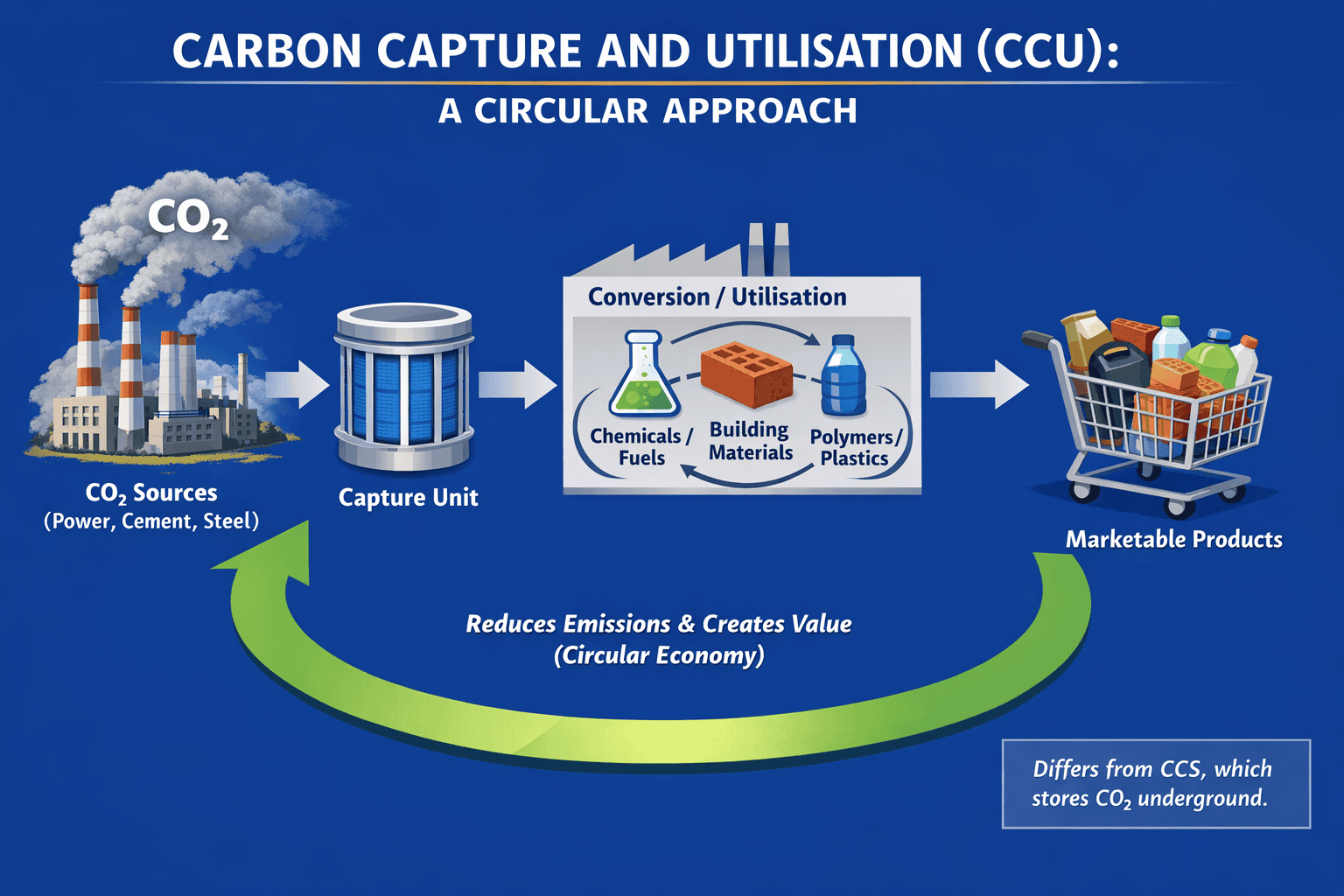
Carbon Capture and Utilisation

SuperKalam is your personal mentor for UPSC preparation, guiding you at every step of the exam journey.
Download the App


STUDY RESOURCES
CONTACT US
ⓒ Snapstack Technologies Private Limited