GS 3: Science & TechnologyPrelims
ExoMiner++: planet spotter, PgII
NASA's ExoMiner++ AI identifies 7,000 potential exoplanets from TESS data, enhancing planet detection with explainable AI and open-source access.
Practice MCQs
731 Students attempted
Key Highlights:
- NASA developed ExoMiner++, a deep-learning AI model, to identify exoplanets in telescope data.
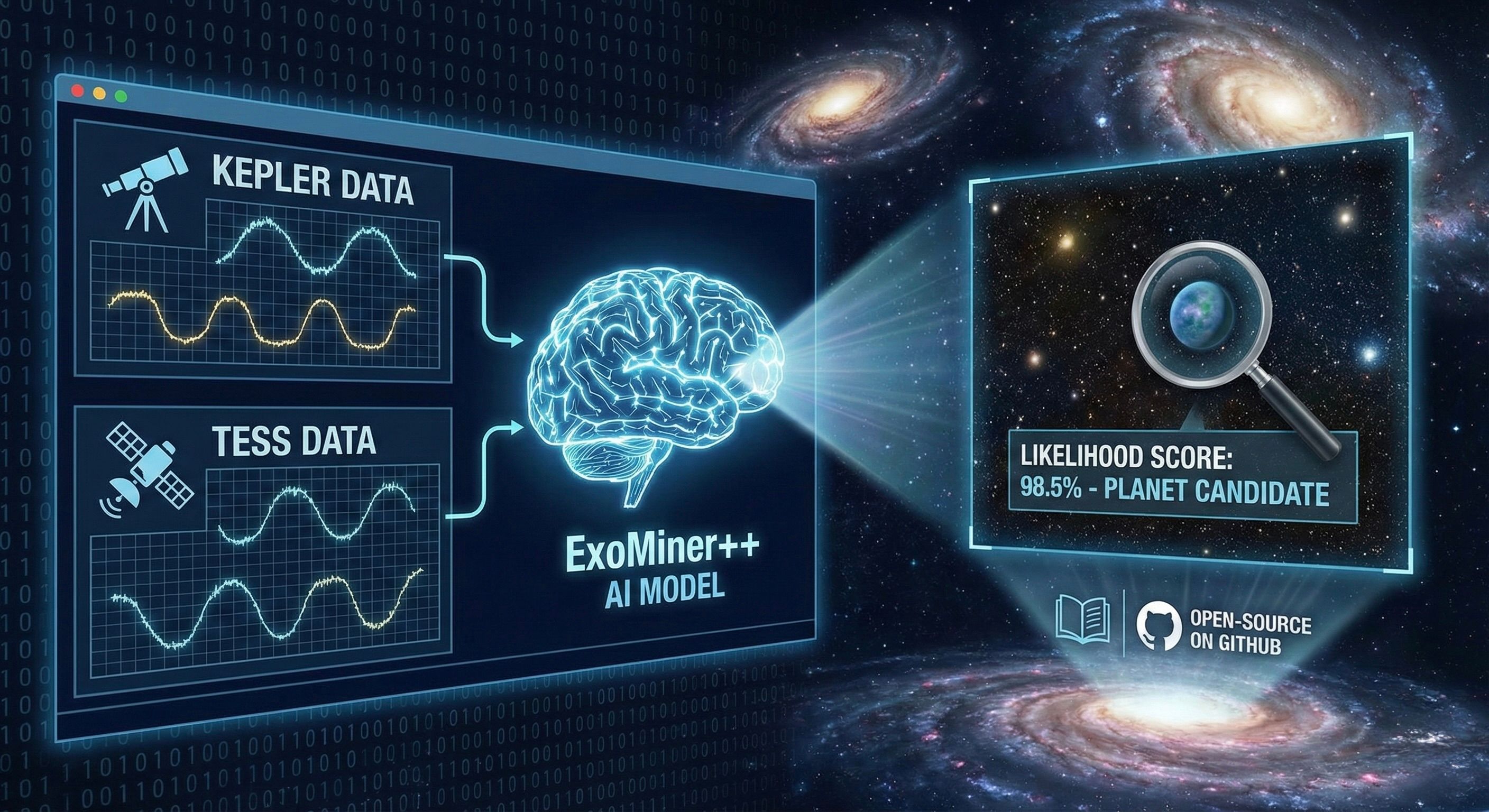
- ExoMiner++ analyzes data from the Transiting Exoplanet Survey Satellite (TESS), following up on the work of ExoMiner with Kepler telescope data.
- The AI model distinguishes true planetary signals from false positives by analyzing dips in a star's brightness caused by transiting planets.
- ExoMiner validated 370 new exoplanets from Kepler data.
- ExoMiner++ has identified approximately 7,000 potential exoplanet candidates in TESS data.
- NASA has released ExoMiner++ as open-source software on GitHub.
ExoMinor++
Detailed Insights:
- ExoMiner++ builds upon its predecessor by being trained on both Kepler and TESS data, enabling it to analyze a larger number of stars simultaneously.
- The AI model provides astronomers with a score indicating the likelihood of a signal being a planet, along with insights into its classification process, enhancing its explainability.
- The release of ExoMiner++ as open-source software encourages researchers to replicate results, apply the model to their datasets, and improve the algorithm for future missions like the Nancy Grace Roman Space Telescope.
- Identifying exoplanets is crucial for understanding the potential for life beyond Earth and the diversity of planetary systems in the galaxy.
Scientific/Technical Concepts Involved:
- Exoplanet: A planet that orbits a star outside of our solar system.
- Deep Learning: A type of artificial intelligence that uses artificial neural networks with multiple layers to analyze data.
- Transit: The passage of a planet across the face of its host star, causing a slight dimming of the star's light.
Previous12/12

SuperKalam is your personal mentor for UPSC preparation, guiding you at every step of the exam journey.
Download the App


STUDY RESOURCES
CONTACT US
ⓒ Snapstack Technologies Private Limited