GS 2: PolityGS 2: GovernancePrelims
SC to hear plea to stop cash donations to political parties, Pg1
Supreme Court examines plea seeking ban on cash donations to political parties, advocating transparency and complete donor details under income tax.
Practice MCQs
789 Students attempted
Key Highlights:
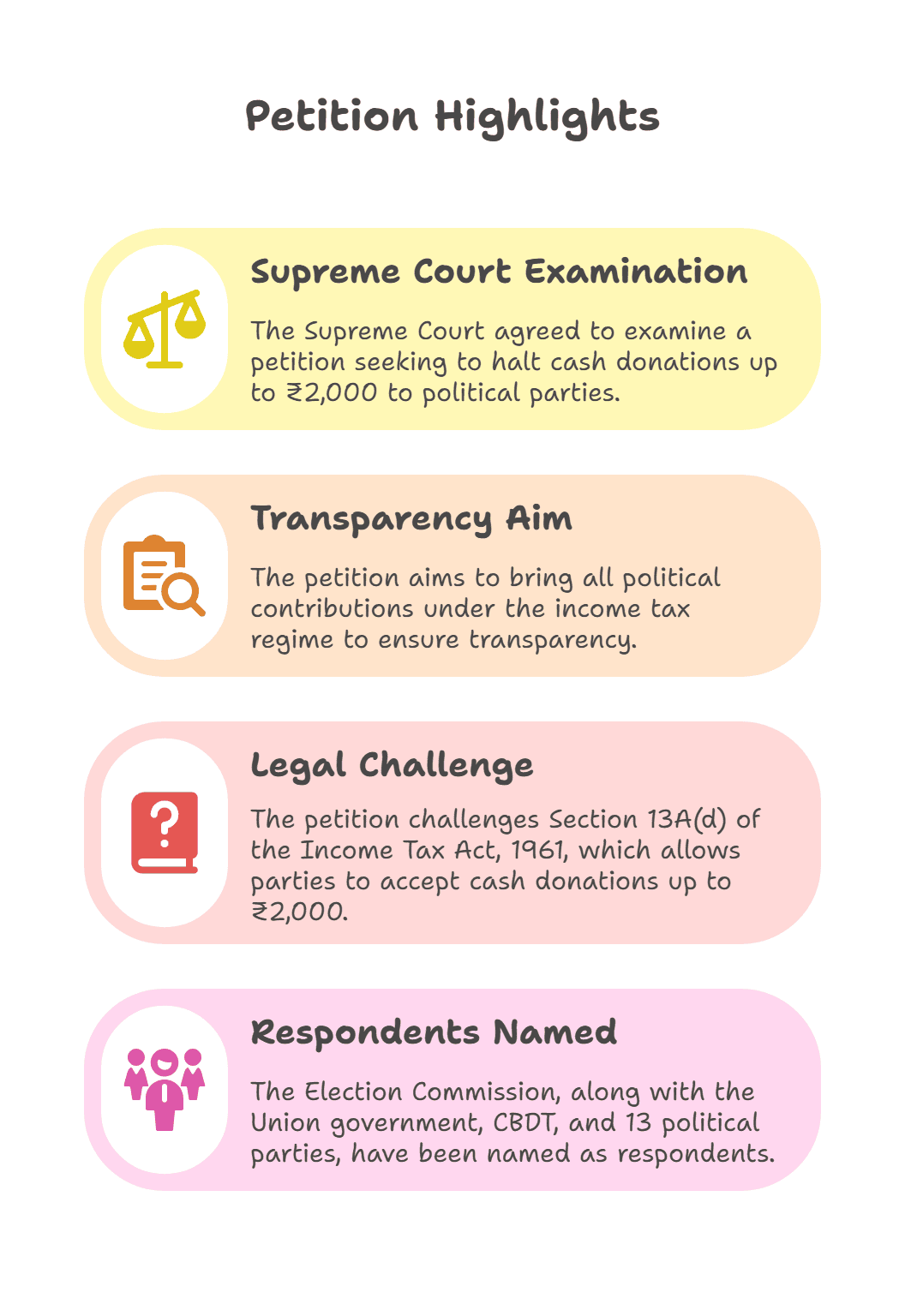
- The Supreme Court agreed to examine a petition seeking to halt cash donations up to ₹2,000 to political parties.
- The petition aims to bring all political contributions under the income tax regime to ensure transparency.
- The petition challenges Section 13A(d) of the Income Tax Act, 1961, which allows parties to accept cash donations up to ₹2,000.
- The Election Commission, along with the Union government, CBDT, and 13 political parties, have been named as respondents.
Petition Highlights.png
Detailed Insights:
- The petition argues that Section 13A(d) creates a loophole, enabling anonymous donors to bypass transparency requirements by dividing large donations into smaller cash amounts.
- The petitioner contends that the lack of transparency in political funding violates Article 19(1)(a) of the Constitution, infringing on voters' right to information about the sources of funds of political parties.
- The petitioner seeks a mandamus to the Election Commission to scrutinize contribution reports and require parties to deposit contributions received without proper address or PAN details.
- The plea emphasizes the need for political parties to disclose the names and particulars of all donors, regardless of the donation amount, to maintain transparency in political funding.
Key Concepts Involved:
- Article 19(1)(a): Guarantees freedom of speech and expression, which the petitioner argues includes the right to information about political funding.
- Section 13A of the Income Tax Act, 1961: A provision that grants tax exemptions to political parties under certain conditions, including accepting cash donations up to ₹2,000.
- Mandamus: A judicial writ ordering a government agency or body to fulfill a duty or obligation.

SuperKalam is your personal mentor for UPSC preparation, guiding you at every step of the exam journey.
Download the App


STUDY RESOURCES
CONTACT US
ⓒ Snapstack Technologies Private Limited