GS 1: Physical GeographyGS 3: Environment & EcologyGS 3: Disaster ManagementPrelims
What's driving Europe heatwave, and why is it struggling to cope?, Pg9
Europe reels under deadly heatwave, with 50 deaths, as Omega Block and rapid climate warming expose unprepared infrastructure and urban heat islands.
Practice MCQs
760 Students attempted
Key Highlights:
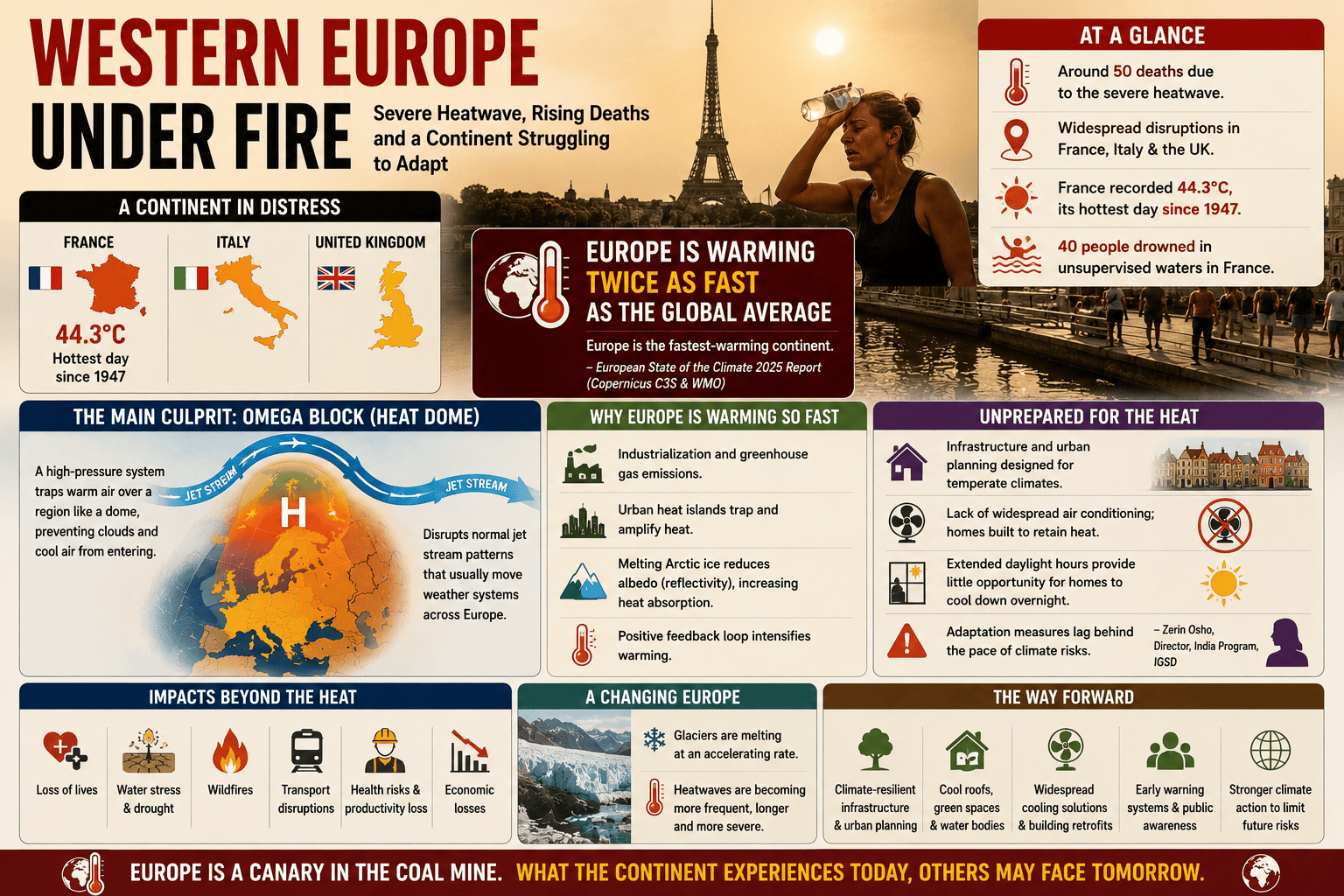
- Western Europe is experiencing a severe heatwave, leading to around 50 deaths and widespread disruptions in countries like France, Italy, and the UK.
- France recorded its hottest day since 1947, reaching 44.3 degrees Celsius, with 40 people drowning in unsupervised waters.
- The heatwave is primarily driven by an Omega Block or heat dome effect, a high-pressure system trapping warm air.
- Europe is warming at twice the global average rate, making it the fastest-warming continent, according to the European State of the Climate 2025 report by Copernicus Climate Change Service and the World Meteorological Organization.
- Europe's infrastructure and urban planning, historically designed for temperate climates, are struggling to cope with the increasing frequency and severity of heatwaves.
Europe heat.png
Detailed Insights:
- The Omega Block disrupts normal jet stream patterns, which typically move weather systems across Europe.
- The European State of the Climate 2025 report highlights that glaciers are melting, and heatwaves are becoming more frequent and severe across the continent.
- Factors contributing to Europe's rapid warming include industrialization, urban heat islands, and the albedo effect due to melting Arctic ice.
- The lack of widespread air conditioning and building designs optimized for heat retention exacerbate the impact of high temperatures in European homes.
- Zerin Osho, Director of the India Program at the Institute for Governance & Sustainable Development, notes that Europe's adaptation measures lag behind the pace of climate risks.
- The extended hours of sunlight in Western Europe provide little opportunity for homes to cool down overnight during heatwaves.
Scientific/Technical Concepts Involved:
- Omega Block/Heat Dome Effect: A high-pressure system shaped like the Greek letter Ω, trapping warm air near the surface and suppressing cloud formation.
- Jet Streams: Strong, narrow bands of wind blowing from west to east in the upper atmosphere, influencing weather patterns.
- Urban Heat Islands: Metropolitan areas that are significantly warmer than their surrounding rural areas due to human activities and infrastructure.
- Albedo Effect: The measure of the reflectivity of a surface; lighter surfaces reflect more sunlight, while darker surfaces absorb more, contributing to warming.

SuperKalam is your personal mentor for UPSC preparation, guiding you at every step of the exam journey.
Download the App


STUDY RESOURCES
CONTACT US
ⓒ Snapstack Technologies Private Limited