GS 1: Indian GeographyGS 3: Environment & EcologyGS 3: EconomyPrelims
In dry monsoon, a test of resilience, Pg9
India's monsoon faces 40% June deficit, MJO blamed over El Niño, testing national resilience and economic stability.
Practice MCQs
760 Students attempted
Key Highlights:
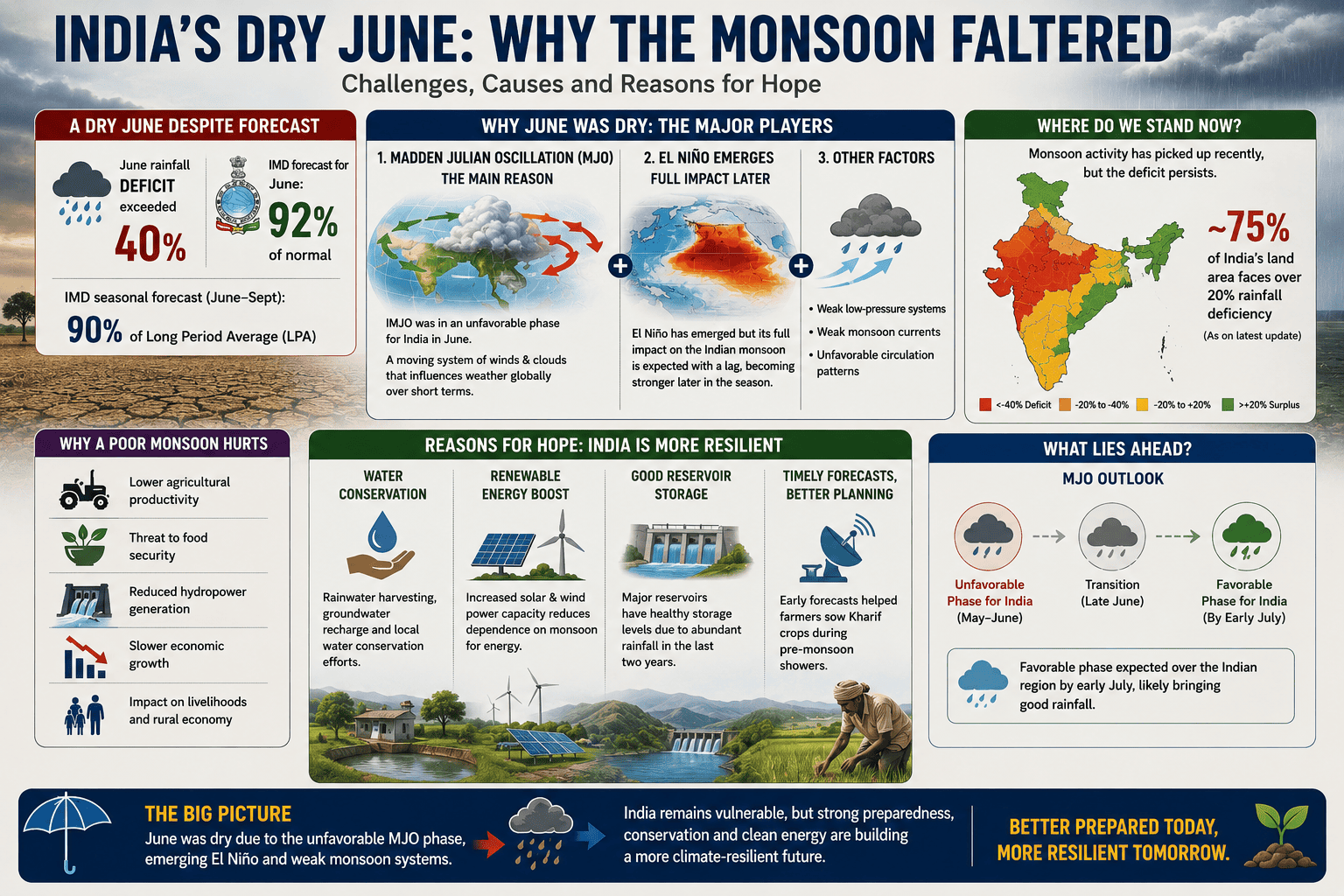
- June monsoon rainfall deficit exceeded 40%, despite the India Meteorological Department (IMD) forecasting 92% of normal for the month.
- The Madden Julian Oscillation (MJO) was identified as a primary reason for the dry June, being in an unfavorable phase for India.
- El Niño has emerged but its full impact on the Indian monsoon is expected with a lag, becoming stronger later in the season.
- Monsoon activity picked up recently, but around 75% of India's land area still faces over 20% rainfall deficiency.
- India's resilience to a dry monsoon has improved due to efforts in water conservation and increased renewable energy capacity.
Dry monsoon.png
Detailed Insights:
- The IMD had predicted 90% of the Long Period Average (LPA) for the entire monsoon season.
- Weak low-pressure systems and monsoon currents also contributed to the significant rainfall deficit in June.
- The MJO is a moving system of winds and clouds that influences weather globally over short terms, distinct from El Niño which operates in the Pacific.
- The favorable part of the MJO is expected to be over the Indian region by early July, potentially bringing good rainfall.
- A poor monsoon can severely impact agricultural productivity, food security, hydropower generation, and overall economic growth.
- Measures like rainwater harvesting, groundwater recharge, and increased solar/wind power capacity have reduced India's monsoon dependence.
- Major reservoirs currently maintain good storage levels due to abundant rainfall in the preceding two years.
- Timely forecasts allowed farmers to sow Kharif crops during pre-monsoon showers, mitigating some immediate risks.
Key Concepts Involved:
- El Niño: A climate pattern describing unusual warming of surface waters in the eastern equatorial Pacific Ocean.
- Madden Julian Oscillation (MJO): An eastward-moving pulse of clouds and rainfall that propagates around the global tropics on a 30-60 day cycle.
- Long Period Average (LPA): The average rainfall recorded over a specific region during a particular period, typically 50 years.
- Kharif Crops: Crops sown during the monsoon season (June-July) and harvested in autumn (September-October), like rice, maize, and cotton.

SuperKalam is your personal mentor for UPSC preparation, guiding you at every step of the exam journey.
Download the App


STUDY RESOURCES
CONTACT US
ⓒ Snapstack Technologies Private Limited