GS 3: EconomyGS 2: GovernancePrelims
Digital fraud: RBI revamps rules, widens framework, Pg13
RBI unveils revamped digital fraud compensation rules, offering 85% for losses up to Rs 50,000, effective January 2027, widening liability framework.
Practice MCQs
760 Students attempted
Key Highlights:
- The Reserve Bank of India (RBI) has revised its compensation mechanism for victims of digital payment frauds and expanded its framework for limiting customer liability.
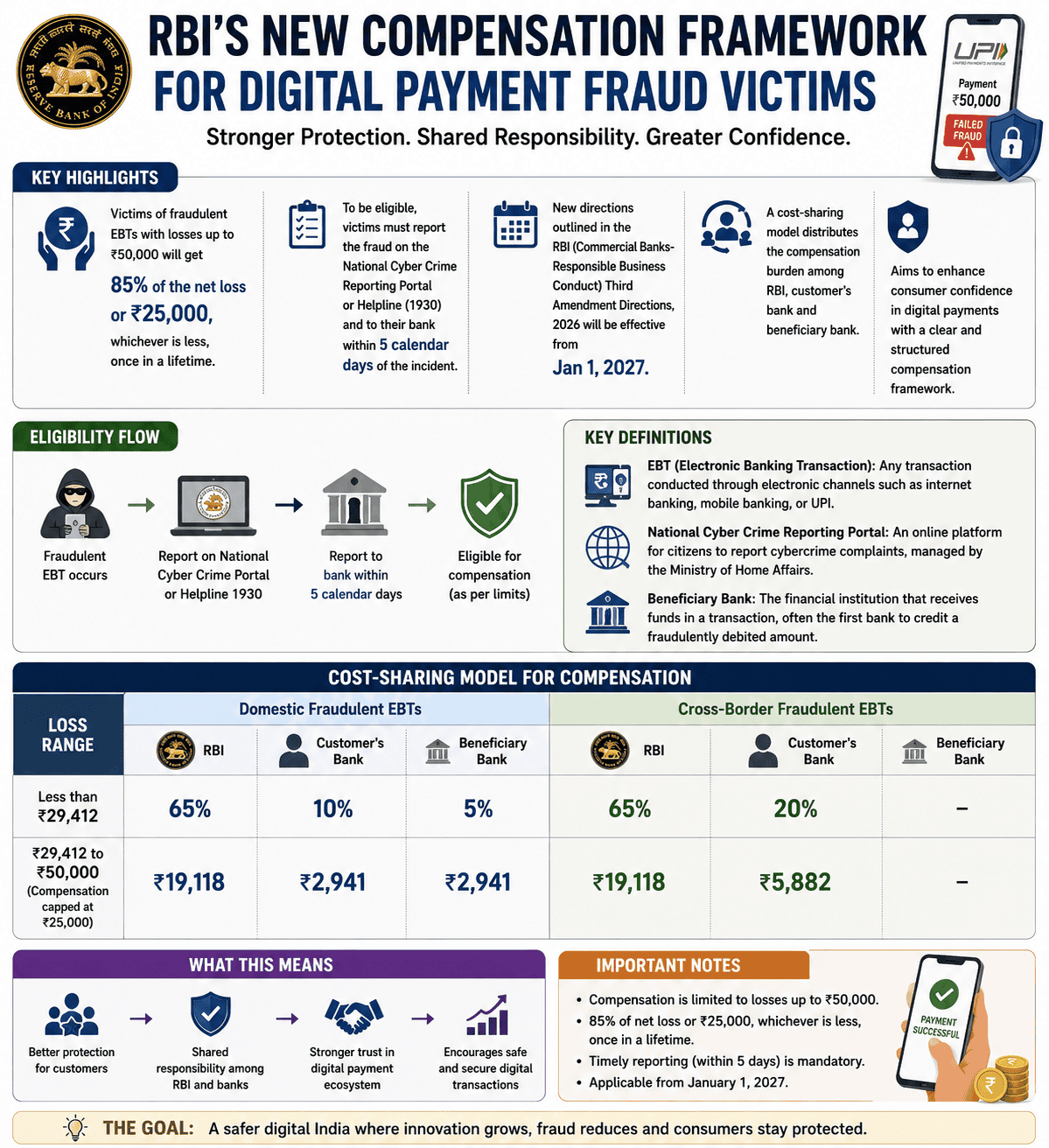
- Victims of fraudulent Electronic Banking Transactions (EBTs) with losses up to ₹50,000 will receive 85% of the net loss or ₹25,000, whichever is less, once in their lifetime.
- To be eligible, victims must report the fraud on the National Cyber Crime Reporting Portal or Helpline (1930) and to their bank within five calendar days of the incident.
- The new directions, outlined in the Reserve Bank of India (Commercial Banks-Responsible Business Conduct) Third Amendment Directions, 2026, will be effective from January 1, 2027.
- A cost-sharing model has been introduced, distributing the compensation burden among the RBI, the customer's bank, and the beneficiary bank.
RBI.png
Detailed Insights:
- For fraudulent EBTs involving losses less than ₹29,412, the RBI will bear 65% of the compensation, the customer's bank 10%, and the beneficiary bank 5%.
- In cases of cross-border fraudulent EBTs with losses less than ₹29,412, the RBI will cover 65% and the customer's bank 20%.
- For losses between ₹29,412 and ₹50,000, where compensation is capped at ₹25,000, the RBI will contribute ₹19,118, and both the customer's bank and beneficiary bank will contribute ₹2,941 each.
- In cross-border fraudulent EBTs within the ₹29,412 to ₹50,000 range, the RBI will contribute ₹19,118 and the customer's bank ₹5,882.
- A beneficiary bank is defined as the bank where the fraudulently debited amount is initially credited.
- This move aims to enhance consumer confidence in digital payment systems by providing a clearer and more structured compensation framework.
Key Concepts Involved:
- Electronic Banking Transaction (EBT): Any transaction conducted through electronic channels such as internet banking, mobile banking, or UPI.
- National Cyber Crime Reporting Portal: An online platform for citizens to report cybercrime complaints, managed by the Ministry of Home Affairs.
- Beneficiary Bank: The financial institution that receives funds in a transaction, often the first bank to credit a fraudulently debited amount.

SuperKalam is your personal mentor for UPSC preparation, guiding you at every step of the exam journey.
Download the App


STUDY RESOURCES
CONTACT US
ⓒ Snapstack Technologies Private Limited