GS 2: PolityGS 2: GovernancePrelims
Centre revises cadre allocation policy with new group structure, Pg9
Centre overhauls IAS cadre allocation policy, replacing zonal system with alphabetical groups for fair, transparent postings and national integration.
Practice MCQs
724 Students attempted
Key Highlights:
- The central government has revised the cadre allocation policy for IAS, IPS, and IFoS.
- A new grouping structure based on alphabetical order replaces the previous zonal arrangement.
- The new framework was notified by the Department of Personnel and Training (DoPT) after consulting with states.
- Vacancies will be determined annually by cadre-controlling authorities and distributed among categories like UR, SC, ST, and OBC.
- The policy aims for greater transparency and consistency in vacancy determination and cadre allocation.
- Vacancies for Economically Weaker Sections (EWS) will be part of the Unreserved category.
✅ Now ZONE removed and Group Introduced
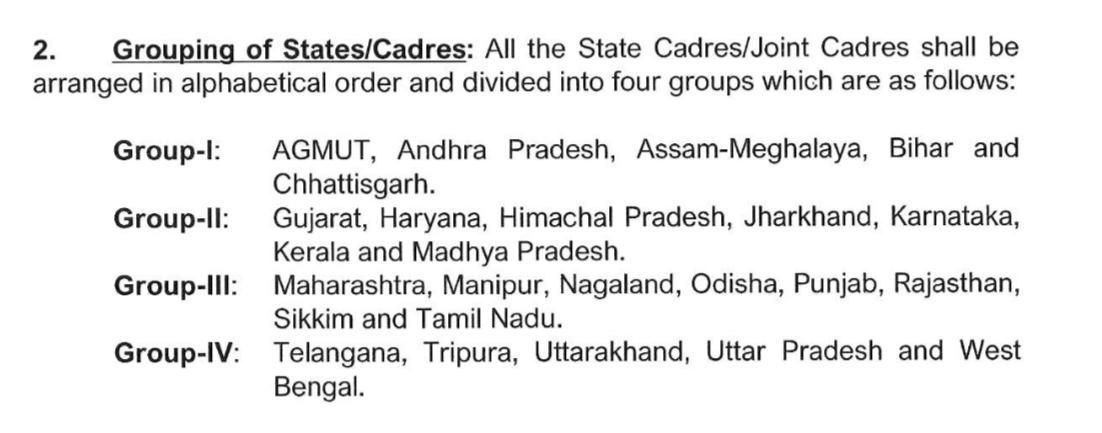
IMAGE 2026-01-25 06:47:20.jpg
Detailed Insights:
- The restructured framework aims to maintain national integration within the civil services and address concerns about uneven vacancy distribution.
- The new allocation model is expected to streamline administrative processes and enhance inter-state exposure for young officers.
- Cadre allocation will now proceed through a rotational cycle system, corresponding to the 25 states and joint cadres.
- Allocation priority within the same cycle will be given to the candidate with the higher rank.
- Allocation for outsider candidates will be done per the roster system in two stages: first for Persons with Benchmark Disabilities (PwBD) and then for others.
- States must submit their vacancy requisitions by January 31 of the year following the Civil Services Examination.
- A candidate’s willingness to serve in their home State is now a mandatory condition for eligibility against an insider vacancy.
Key Concepts Involved:
- Cadre Allocation Policy: Rules governing the assignment of officers to different state cadres.
- All-India Services: Civil services common to the Union and the States (IAS, IPS, IFoS).
- Roster System: A mechanism for reservation of posts for different categories.
Previous4/4

SuperKalam is your personal mentor for UPSC preparation, guiding you at every step of the exam journey.
Download the App


STUDY RESOURCES
CONTACT US
ⓒ Snapstack Technologies Private Limited