GS 2: International RelationsGS 1: Indian GeographyGS 1: Indian SocietyGS 3: EconomyPrelims
Via Lipulekh: At 17,000 Ft, A Trade door opens into China, Pg3
India reopens strategic Lipulekh Pass at 17,000 ft for cross-border trade with China after seven years, reviving traditional livelihoods amidst geopolitical complexities.
Practice MCQs
753 Students attempted
Key Highlights:
- The Lipulekh Pass, located at 17,000 feet in Uttarakhand, is set to reopen for cross-border trade with China after a seven-year closure.
- The Pass, a historical route for the Mansarovar Yatra and trade, was shut in 2019 due to the pandemic and subsequent India-China border skirmishes.
- It is situated at the trijunction of India, Nepal, and China's Tibet Autonomous Region, a region contested by Nepal based on the 1816 Treaty of Sugauli.
- The reopening holds significant strategic value and is crucial for the traditional livelihoods of local communities in villages like Gunji and Dharchula.
- The Ministry of External Affairs has issued 300 permits for traders this year, with a new road on the Indian side facilitating access to the Pass.
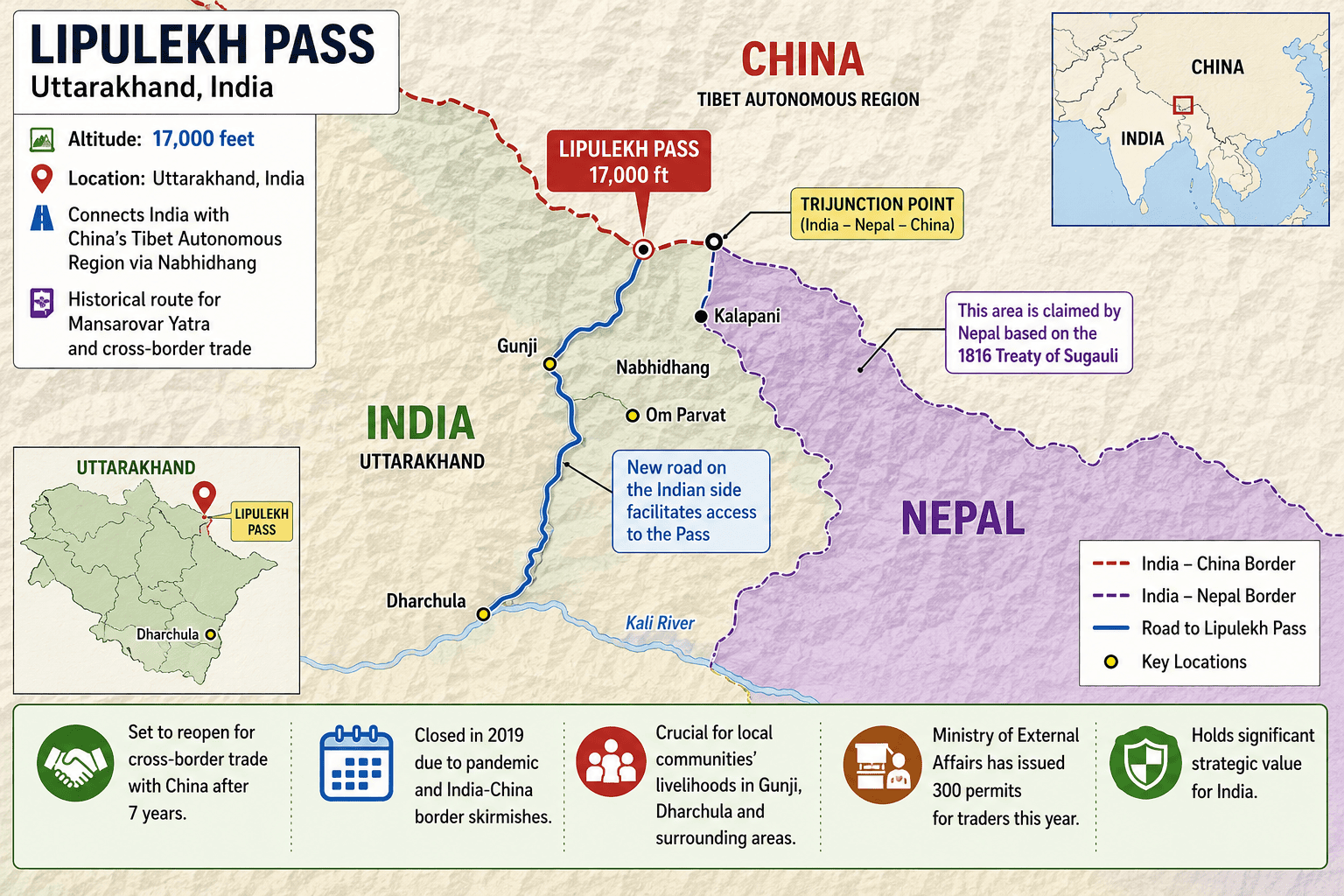
Lipulekh.png
Detailed Insights:
- The trade route has historical roots dating back to the 17th century, connecting Pithoragarh's Rang community with Tibet.
- The Panchsheel Agreement of 1954 formally allowed traders through the Lipulekh Pass with government-issued certificates.
- Trade was first suspended after the 1962 India-China war and reopened in 1992 under regulated conditions.
- Local traders traditionally exchanged Indian goods like jaggery and textiles for Tibetan products such as pashmina wool, rock salt, and borax.
- Despite its strategic importance, trade volumes had significantly declined by 2019, with imports at Rs 1.9 crore and exports at Rs 1.25 crore.
- The local economy in areas like Dharchula, once heavily reliant on this trade, has diversified into tourism for Adi Kailash and Om Parvat.
- The reopening is expected to revitalize the traditional barter and credit-based trade system, which operates outside modern commercial logic.
- Infrastructure improvements on the Indian side, including a new road, will reduce the trekking distance for traders and pilgrims.
Key Concepts Involved:
- Lipulekh Pass: A high-altitude Himalayan pass at the India-Nepal-China trijunction, historically significant for trade and pilgrimage.
- Treaty of Sugauli (1816): A treaty between the British East India Company and the Kingdom of Nepal, which Nepal cites in its territorial claims over Lipulekh, Kalapani, and Limpiyadhura.
- Panchsheel Agreement (1954): An agreement between India and China based on five principles of peaceful coexistence, which initially facilitated cross-border trade and pilgrimage through the Lipulekh Pass.

SuperKalam is your personal mentor for UPSC preparation, guiding you at every step of the exam journey.
Download the App


STUDY RESOURCES
CONTACT US
ⓒ Snapstack Technologies Private Limited