GS 3: Environment & EcologyGS 3: EconomyGS 2: GovernancePrelims
India’s patchy industrial climate strategy, Pg13
India's industrial climate strategy faces a critical gap, overlooking 40% of emissions from 'non-specific industries' and jeopardizing net-zero targets.
Practice MCQs
753 Students attempted
Key Highlights:
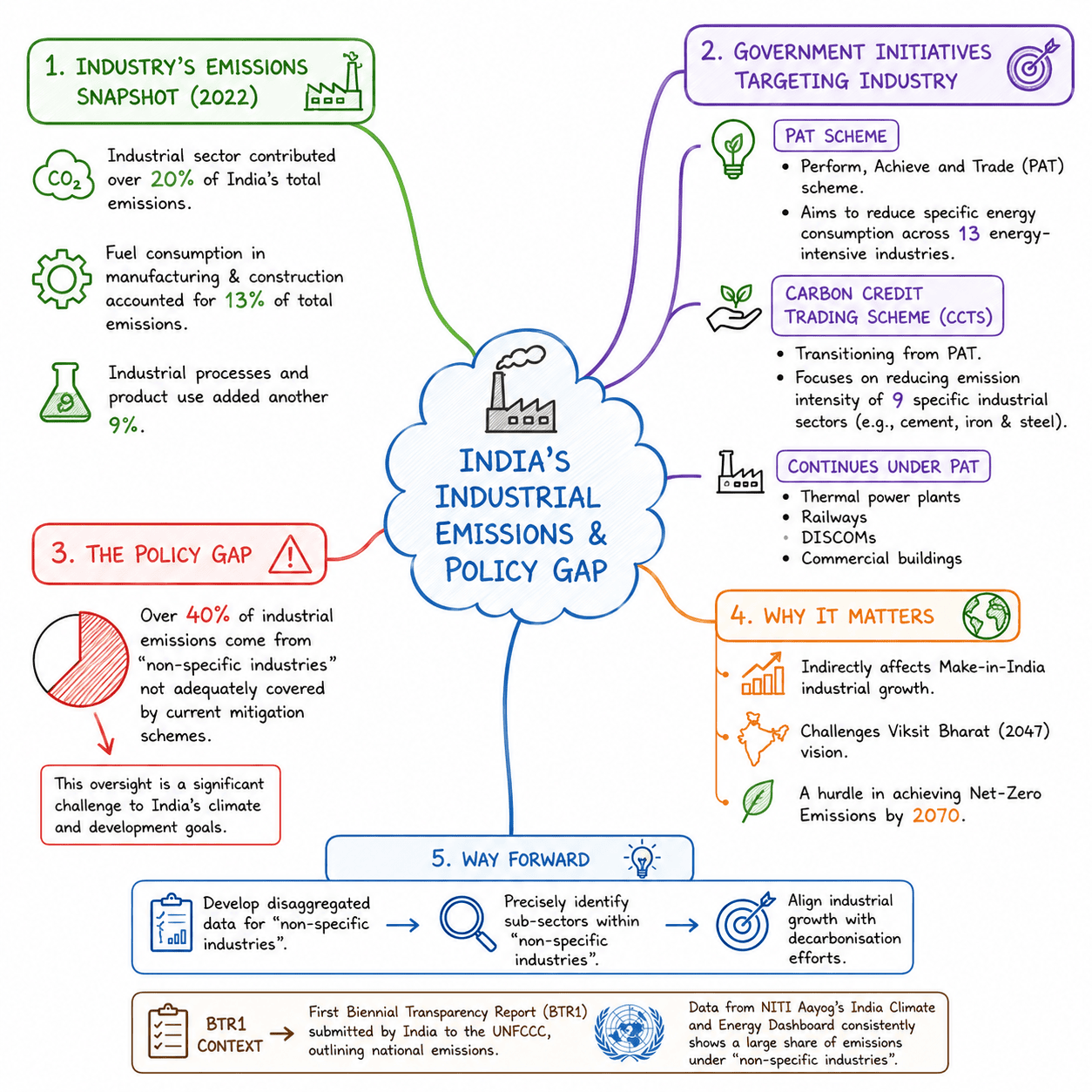
- India's industrial sector contributed over 20% of the nation's total emissions in 2022, as detailed in the First Biennial Transparency Report (BTR1).
- Fuel consumption in manufacturing and construction accounted for 13% of total emissions, with industrial processes and product use adding another 9%.
- Government initiatives like the Perform, Achieve and Trade (PAT) scheme and the Carbon Credit Trading Scheme (CCTS) target energy-intensive industries for emission reduction.
- A significant policy gap exists, as over 40% of industrial emissions originate from "non-specific industries" not adequately covered by current mitigation schemes.
- This oversight poses a challenge to India's ambitious goals of Make-in-India, Viksit Bharat (2047), and achieving net-zero emissions (2070).
Industrial emission gap.png
Detailed Insights:
- The First Biennial Transparency Report (BTR1) was submitted by India to the United Nations Framework Convention on Climate Change (UNFCCC), outlining national emissions.
- The PAT scheme aims to reduce specific energy consumption across 13 energy-intensive industries, promoting energy efficiency.
- The CCTS is transitioning from PAT, focusing on reducing the emission intensity of nine specific industrial sectors, including cement and iron & steel.
- Four sectors, namely thermal power plants, railways, DISCOMs, and commercial buildings, will continue to operate under the PAT scheme.
- Data from NITI Aayog’s India Climate and Energy Dashboard consistently shows a large portion of industrial emissions under the "non-specific industries" category.
- Addressing this policy gap requires disaggregated data and precise identification of sub-sectors within "non-specific industries" to align industrial growth with decarbonisation efforts.
Key Concepts Involved:
- Make-in-India: A government initiative launched in 2014 to encourage domestic and foreign companies to manufacture their products in India.
- Viksit Bharat (2047): India's vision to become a developed nation by 2047, marking 100 years of independence.
- Net-zero emissions: Achieving a balance between the amount of greenhouse gases emitted and the amount removed from the atmosphere.
- Perform, Achieve and Trade (PAT) scheme: A market-based mechanism under the Bureau of Energy Efficiency to improve energy efficiency in energy-intensive industries.
- Carbon Credit Trading Scheme (CCTS): A new market-based mechanism designed to reduce the emission intensity of specific industrial sectors.
- Biennial Transparency Report (BTR): A report submitted by countries to the UNFCCC detailing their climate actions, policies, and emissions.
- United Nations Framework Convention on Climate Change (UNFCCC): An international environmental treaty established in 1992 to stabilize greenhouse gas concentrations in the atmosphere.

SuperKalam is your personal mentor for UPSC preparation, guiding you at every step of the exam journey.
Download the App


STUDY RESOURCES
CONTACT US
ⓒ Snapstack Technologies Private Limited