GS 3: EconomyGS 2: GovernancePrelims
India doesn't just need start-ups, but scale-ups that become global giants, Pg12
India must foster 'scale-ups' beyond startups, creating global giants with substantial profits to boost productivity, innovation, and high-income economic transition.
Practice MCQs
753 Students attempted
Key Highlights:
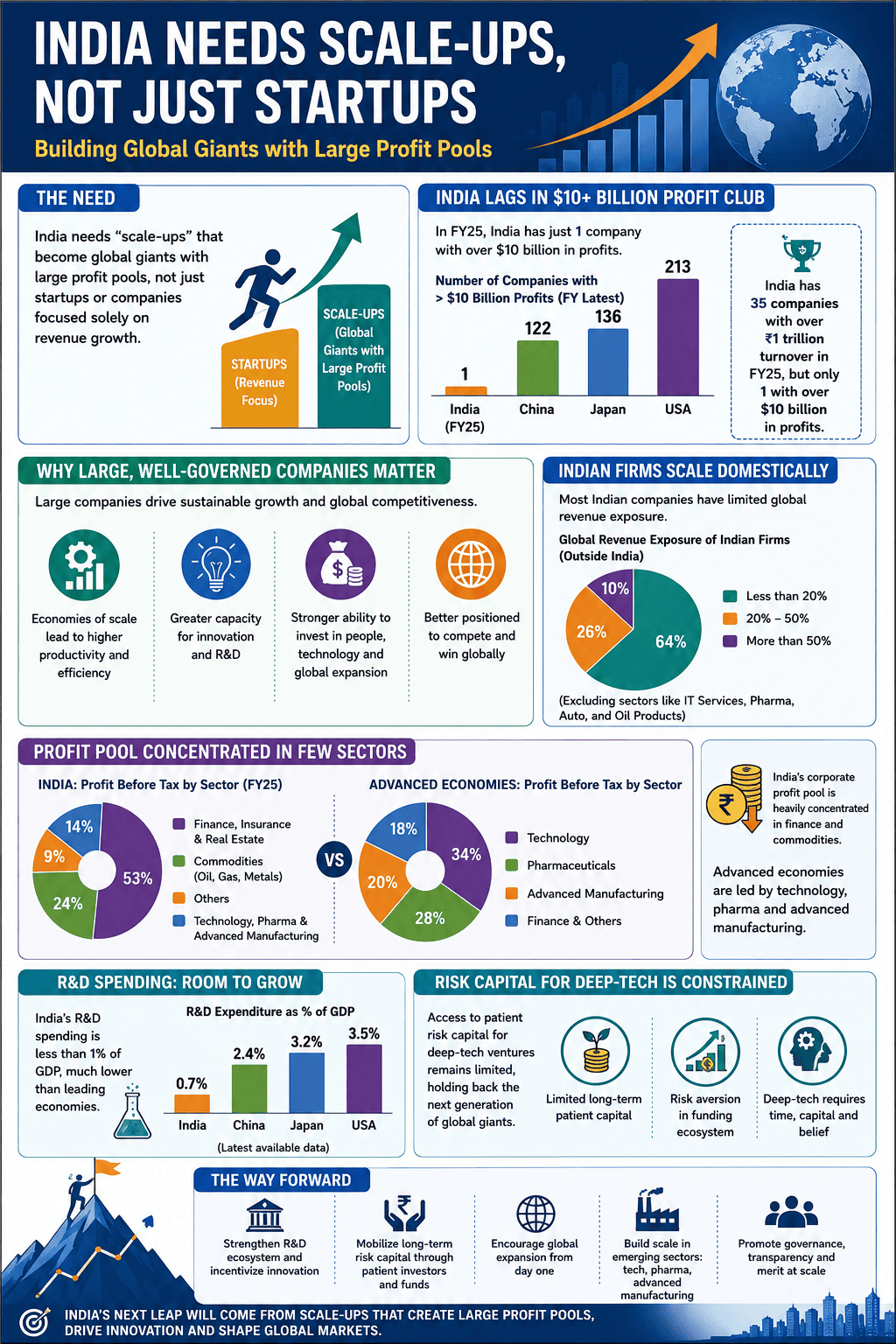
- India needs "scale-ups" that become global giants with large profit pools, not just startups or companies focused solely on revenue growth.
- While India has 35 companies with over ₹1 trillion turnover in FY25, only one has crossed $10 billion in profits, unlike the US, China, and Japan which have many such firms.
- Large, well-governed companies are crucial for productivity, innovation, and global competitiveness due to economies of scale and capacity for investment.
- Indian firms tend to scale domestically, with limited global revenue exposure outside sectors like IT services, pharma, auto, and oil products.
- India's corporate profit pool is heavily concentrated in finance and commodities, unlike advanced economies where technology, pharmaceuticals, and advanced manufacturing contribute more.
- India's R&D spending is less than 1% of GDP, and access to patient risk capital for deep-tech ventures remains constrained.
Scale ups.png
Detailed Insights:
- The article highlights that large firms spread fixed costs like R&D and digital infrastructure, driving down unit costs and increasing efficiency.
- Innovation often requires patient capital, tolerance for failure, and multidisciplinary talent, which are concentrated in large enterprises.
- Global competitiveness is built through capacity to invest, integrate, build brands, control distribution, and orchestrate cross-border supply chains.
- Indian companies often focus on export-oriented services, assembly, or re-exports rather than ownership of products, platforms, or patents.
- In advanced economies, a larger share of profits comes from sectors like technology and advanced manufacturing, which command durable margins through intellectual property.
- India's presence in high-margin, innovation-driven sectors like semiconductors and advanced industrials is currently negligible.
- Regulatory uncertainty and fragmented factor markets increase the cost of scaling businesses across different states and sectors in India.
- The article suggests moving beyond the perception of profit as a "dirty word" to foster an environment conducive to large, profitable enterprises.
Key Concepts Involved:
- Economies of Scale: Cost advantages that enterprises obtain due to their size, with unit cost decreasing as output increases.
- Patient Capital: Long-term investment capital that is willing to wait for a longer period to see returns, often crucial for innovation and deep-tech.
- Global Value Chains: The full range of activities that firms and workers perform to bring a product from its conception to end use.
- FMCG (Fast-Moving Consumer Goods): Products that are sold quickly and at a relatively low cost, such as packaged foods, toiletries, and beverages.

SuperKalam is your personal mentor for UPSC preparation, guiding you at every step of the exam journey.
Download the App


STUDY RESOURCES
CONTACT US
ⓒ Snapstack Technologies Private Limited