GS 2: PolityGS 2: GovernancePrelims
Centre tightens norms for foreign contributions, Pg1
Union Home Ministry amends FCRA rules, imposing strict activity lists, disclosure norms, and hefty fines up to 30% for NGOs receiving foreign funds.
Practice MCQs
753 Students attempted
Key Highlights:
- The Centre has tightened norms for foreign contributions to Non-Governmental Organisations (NGOs) through amendments to the Foreign Contribution Regulation Act (FCRA) Rules, 2010.
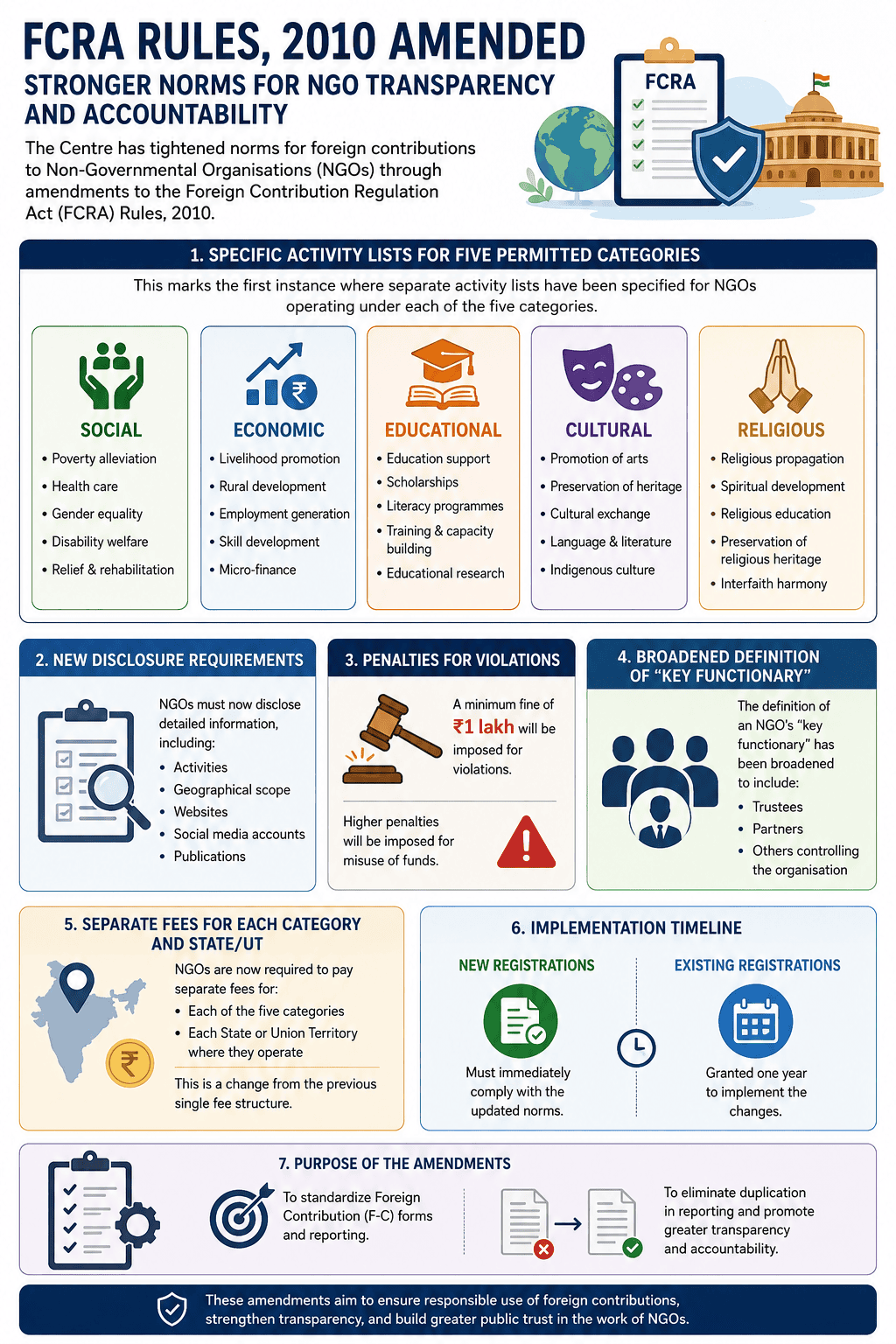
- NGOs must now adhere to specific activity lists for each of the five permitted categories: social, economic, educational, cultural, and religious.
- New disclosure requirements include details on activities, geographical scope, websites, social media accounts, and publications.
- A minimum fine of ₹1 lakh will be imposed for violations, with higher penalties for misuse of funds.
- The definition of an NGO’s "key functionary" has been broadened to include trustees, partners, and others controlling the organization.
Foreign Contribution.png
Detailed Insights:
- This marks the first instance where separate activity lists have been specified for NGOs operating under each of the five categories.
- NGOs are now required to pay separate fees for each category and State or Union Territory they operate in, departing from the previous single fee structure.
- New registrations must immediately comply with these updated norms, while existing registrations are granted one year to implement the changes.
- The amendments were introduced to standardize Foreign Contribution (F-C) forms and eliminate duplication in reporting.
- Associations with foreign nationals (excluding persons of Indian origin) as key functionaries will generally not be eligible for registration without specific permission from the Centre.
- Certain activities, such as "awareness programmes on constitutional rights" under the educational purpose, must be strictly non-political.
- Permitted religious activities include "conduct of religious education" but explicitly exclude proselytisation.
- Penalties for using foreign funds for unapproved purposes or in unauthorized areas can be up to 30% of the misused amount or ₹1 lakh, whichever is higher.
Key Concepts Involved:
- Foreign Contribution Regulation Act (FCRA), 2010: An Act by the Parliament of India regulating the acceptance and utilization of foreign contributions by individuals, associations, or companies.
- Non-Governmental Organizations (NGOs): Non-profit organizations operating independently of government, typically focused on social, economic, cultural, or environmental issues.

SuperKalam is your personal mentor for UPSC preparation, guiding you at every step of the exam journey.
Download the App


STUDY RESOURCES
CONTACT US
ⓒ Snapstack Technologies Private Limited