GS 3: Science & TechnologyPrelims
Carbon isotopes: clocks of sorts, Pg2
James Webb Space Telescope reveals interstellar comet 3I/ATLAS formed 12 billion years ago from a primordial planetary system, offering cosmic origin insights.
Practice MCQs
753 Students attempted
Key Highlights:
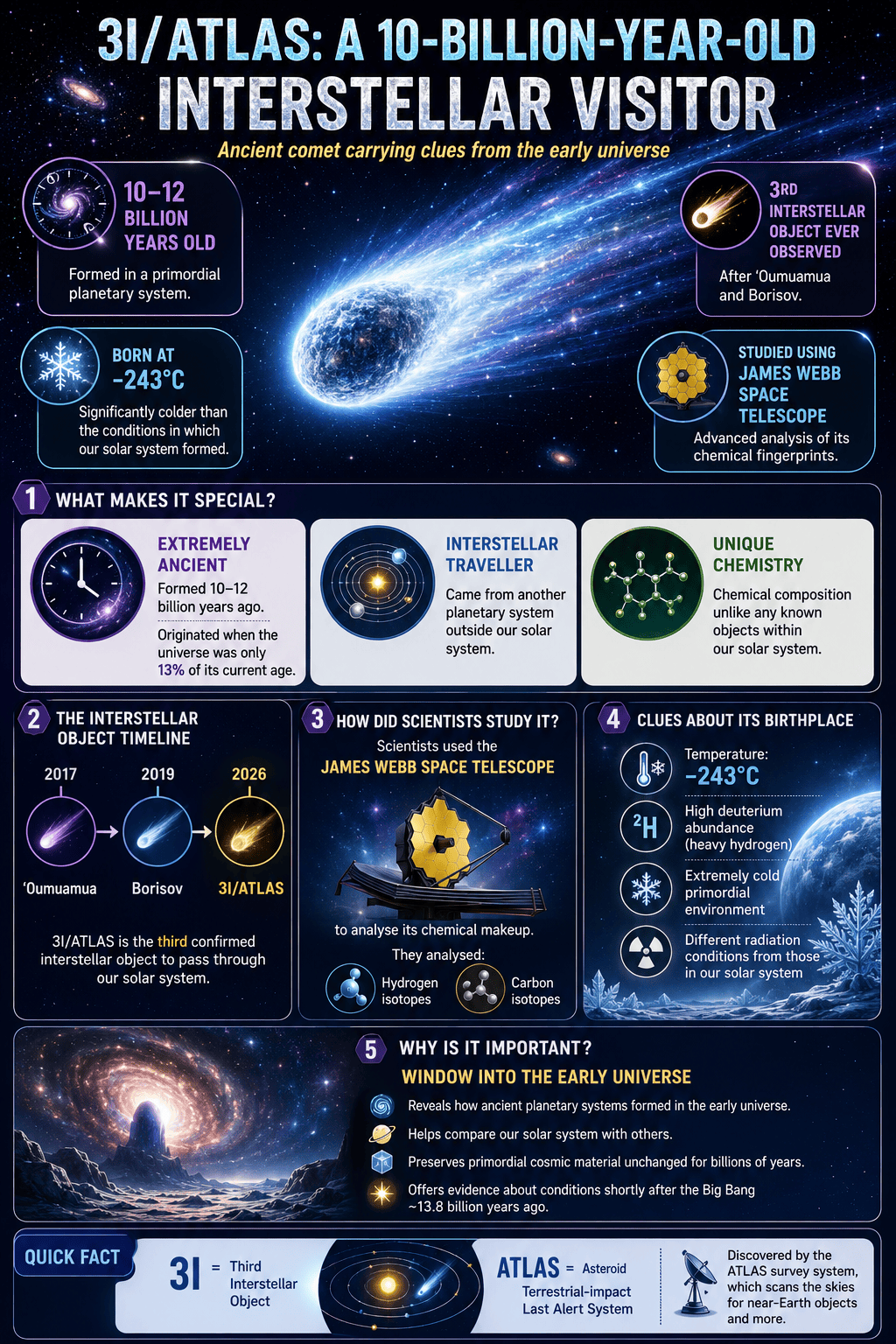
- The interstellar comet 3I/ATLAS formed an estimated 10 to 12 billion years ago in a primordial planetary system.
- It is the third interstellar object ever observed in our solar system, following 'Oumuamua and Borisov.
- Scientists utilized the James Webb Space Telescope to analyze its hydrogen and carbon isotope ratios.
- The comet's formation environment was significantly colder, around -243°C, than the conditions in which our solar system formed.
ATLAS.png
Detailed Insights:
- 3I/ATLAS originated when the universe was approximately 13% of its current age, dating back close to the Big Bang event 13.8 billion years ago.
- Its chemical composition is distinct from any known objects within our solar system, suggesting different formation processes in the early universe.
- Hydrogen isotopes, particularly a high abundance of deuterium (heavy hydrogen), provided evidence about the extremely cold temperature and radiation levels of its birth environment.
- Carbon isotope ratios offered clues about the composition of the interstellar gas cloud that gave rise to 3I/ATLAS and its home planetary system.
- The study of such ancient interstellar objects acts as a "time capsule," offering direct insights into the conditions of star and planet formation in the early universe.
- The James Webb Space Telescope's infrared capabilities were crucial for detecting and analyzing the faint, cold object and its chemical makeup through spectroscopy.
Scientific/Technical Concepts Involved:
- Interstellar Object: A celestial body that originates from outside our solar system and travels through interstellar space, not gravitationally bound to a star.
- Isotopes: Atoms of the same chemical element that have the same number of protons but different numbers of neutrons, leading to different atomic masses.
- James Webb Space Telescope (JWST): A powerful infrared space observatory designed to study the early universe, exoplanets, and distant celestial objects with high sensitivity.
- Big Bang: The leading cosmological model describing the universe's earliest known periods, starting from an extremely hot and dense state approximately 13.8 billion years ago.

SuperKalam is your personal mentor for UPSC preparation, guiding you at every step of the exam journey.
Download the App


STUDY RESOURCES
CONTACT US
ⓒ Snapstack Technologies Private Limited