GS 3: EconomyGS 2: GovernancePrelims
111 National Waterways notified, up from 5 in 2014, Pg1
India's inland water transport sector sees massive expansion with 111 National Waterways notified, a significant jump from 5 in 2014.
Practice MCQs
753 Students attempted
Key Highlights:
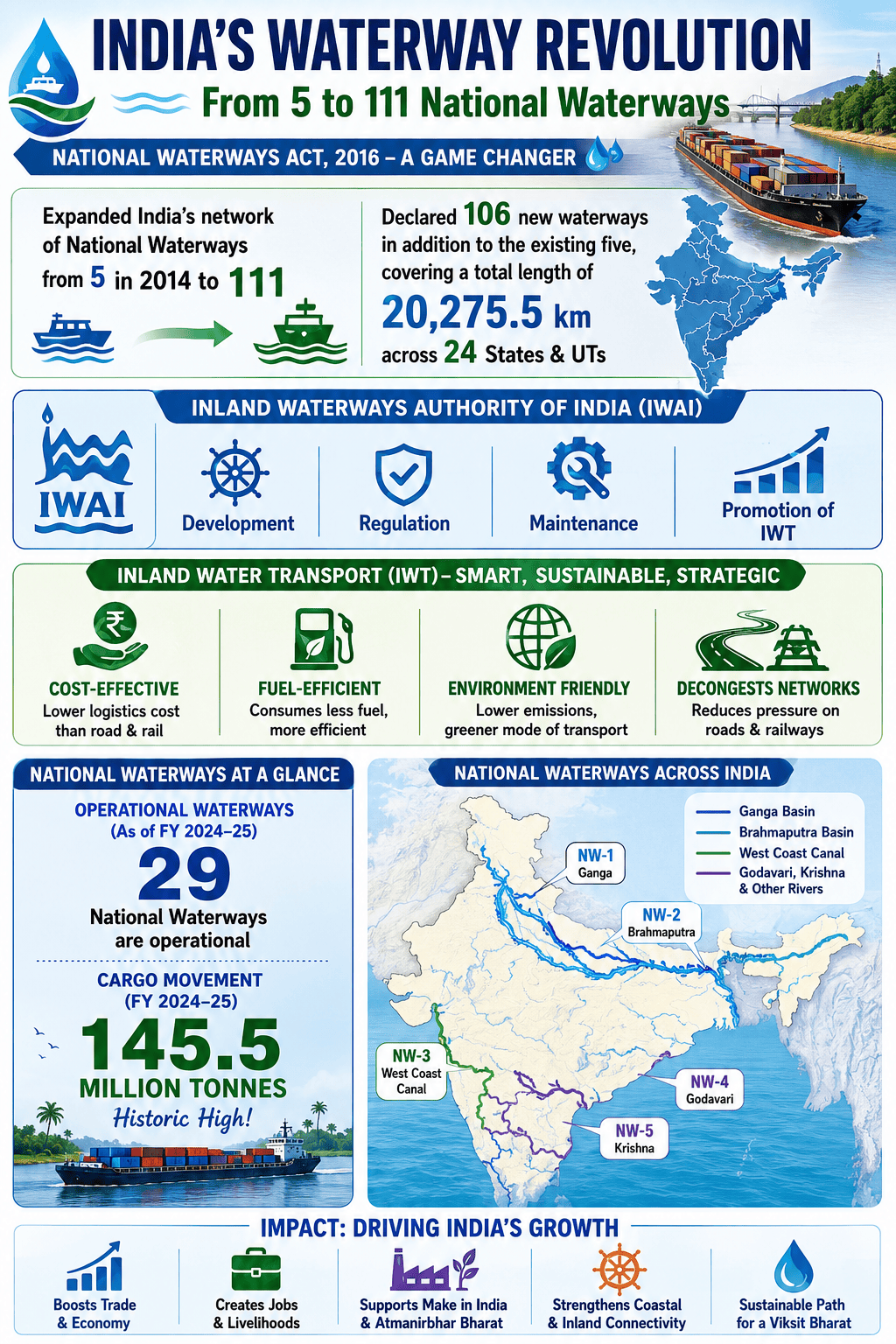
- India has significantly expanded its network of National Waterways from 5 in 2014 to 111, following the enactment of the National Waterways Act, 2016.
- The National Waterways Act, 2016, declared 106 new waterways in addition to the existing five, covering a total length of approximately 20,275.5 km across 24 states and Union Territories.
- The Inland Waterways Authority of India (IWAI), under the Ministry of Ports, Shipping and Waterways, is the nodal agency responsible for the development, regulation, and maintenance of these waterways.
- Inland Water Transport (IWT) is recognized as a cost-effective, fuel-efficient, and environmentally friendly mode of transport, aiming to reduce logistics costs and decongest road and rail networks.
- As of FY 2024–25, 29 National Waterways are operational, with cargo movement reaching a historic 145.5 million tonnes.
Waterway Revolution.png
Detailed Insights:
- The National Waterways Act, 2016, consolidated previous acts that individually declared the initial five National Waterways and provided a unified legal framework for the expanded network.
- The five original National Waterways include NW-1 (Ganga-Bhagirathi-Hooghly river system from Prayagraj to Haldia), NW-2 (Brahmaputra River from Sadiya to Dhubri), NW-3 (West Coast Canal in Kerala), NW-4 (Krishna and Godavari rivers), and NW-5 (Brahmani River, Mahanadi Delta, and East Coast Canal).
- Development efforts on these waterways include fairway maintenance, dredging, installation of navigation aids, and construction of multi-modal terminals and jetties.
- The government aims to increase the modal share of freight transport through waterways from less than 2% to 5% by 2030, and further to 500 million metric tonnes by 2047 under the Maritime India Vision 2030 and Amrit Kaal Vision 2047.
- Projects like the Jal Marg Vikas Project on NW-1 are being implemented with international support to enhance transport efficiency and reliability.
- Inland water transport offers significant benefits such as being up to 60% cheaper than road transport and having a lower carbon footprint, contributing to climate goals.
Key Concepts Involved:
- National Waterways Act, 2016: A parliamentary act that declared 111 inland waterways as National Waterways for shipping and navigation purposes.
- Inland Waterways Authority of India (IWAI): A statutory body established in 1986 under the Ministry of Ports, Shipping and Waterways for the development and regulation of inland waterways.
- National Waterways: Designated rivers, canals, and backwaters developed by the Indian government for inland water transport, serving as cost-effective and eco-friendly freight and passenger routes.

SuperKalam is your personal mentor for UPSC preparation, guiding you at every step of the exam journey.
Download the App


STUDY RESOURCES
CONTACT US
ⓒ Snapstack Technologies Private Limited