GS 2: International RelationsPrelims
Delhi plays a key role in Indo-Pacific policy of the U.S., says Rubio, Pg1
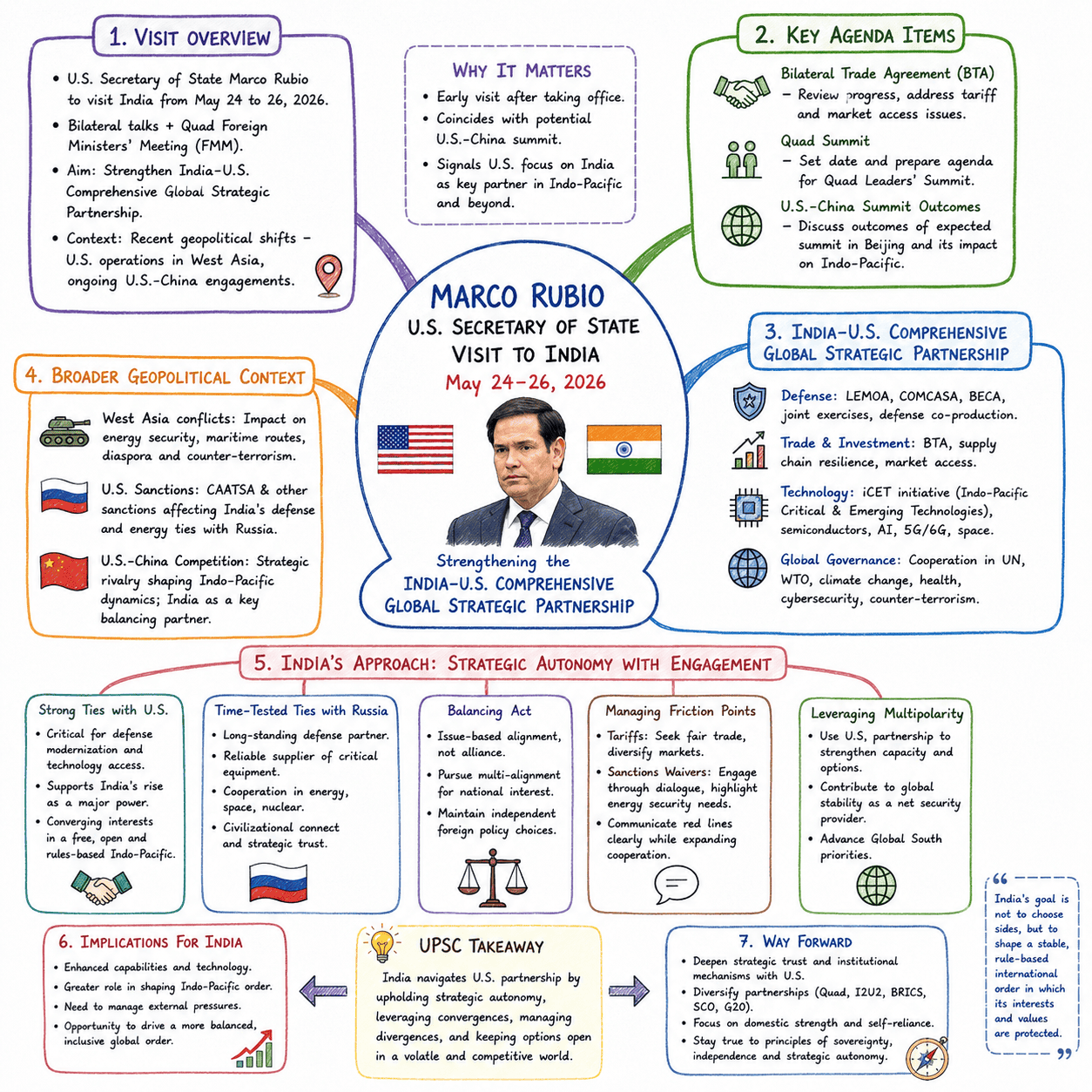
Rubio emphasizes India's pivotal role in U.S. Indo-Pacific strategy, invites PM Modi to Washington amidst Quad engagement and Iran conflict discussions.
Practice MCQs
746 Students attempted
Key Highlights:
- U.S. Secretary of State Marco Rubio affirmed India's key role in the U.S. Indo-Pacific policy during his visit.
- Rubio invited Prime Minister Narendra Modi to Washington later this year on behalf of President Donald Trump.
- The Quad Foreign Ministers’ Meeting (FMM), including ministers from Australia, India, and Japan, will be held.
- Rubio inaugurated a new ‘Support Annexe Building’ at the U.S. Embassy to expand consular and visa services.
Marco Rubio.png
Detailed Insights:
- The meeting between Rubio and Modi covered bilateral cooperation in defence, strategic technologies, trade, energy security, connectivity, education, and people-to-people ties.
- The U.S. aims to diversify India’s energy supply with U.S. energy products, ensuring Iran cannot hold the global energy market hostage.
- India reiterated its support for peaceful resolution of conflicts through dialogue, emphasizing its consistent support for peace efforts.
- Despite previous meetings, the Quad Summit, planned to be held in India for two years, has been delayed due to strains in U.S.-India relations over tariffs, sanctions, and visa restrictions.
Key Concepts Involved:
- Indo-Pacific Policy: A strategic approach focusing on the interconnectedness of the Indian and Pacific Oceans, emphasizing security and cooperation.
- Quad FMM: A strategic dialogue between Australia, India, Japan, and the United States to promote a rules-based international order.
- Bilateral Cooperation: Collaborative efforts between two countries in areas such as defense, trade, and technology.

SuperKalam is your personal mentor for UPSC preparation, guiding you at every step of the exam journey.
Download the App


STUDY RESOURCES
CONTACT US
ⓒ Snapstack Technologies Private Limited