GS 2: PolityGS 3: Internal Security
SC questions ED’s claim of rule of law breach in Bengal, Pg1
Supreme Court scrutinizes ED's claims of constitutional breakdown in West Bengal amidst coal smuggling case probe and alleged obstruction.
Practice MCQs
739 Students attempted
Key Highlights:
- The Supreme Court questioned the Enforcement Directorate (ED) on whether it was implying a "breakdown of constitutional machinery" in West Bengal during a hearing on April 23, 2026.
- The ED cited alleged violations by the Chief Minister, state police, and bureaucrats related to a coal smuggling case and raids on I-PAC premises.
- The ED argued that the "rule of law" was violated, impacting the fundamental rights of its officials due to allegedly orchestrated police FIRs.
- The West Bengal government, represented by Kapil Sibal, contended that the Centre should have filed a suit under Article 131 instead of the ED filing a writ petition.
Detailed Insights:
- The ED referred to past incidents, including the police "siege" of a CBI Joint Director's residence and the crowding of lawyers in a Calcutta High Court courtroom, to support its claim of a "non-existent" rule of law in West Bengal.
- The Solicitor-General argued that the ED had the right to approach the Supreme Court under Article 32 to enforce the fundamental rights of its officials, whose personal liberty was threatened.
- Article 131 is typically invoked when there is a dispute of a federal nature between the Centre and a State, but the ED argued that this case was a law and order issue.
- The Supreme Court questioned the ED on whether its arguments could be interpreted as calling for the imposition of President’s Rule under Article 356 of the Constitution.
Key Concepts Involved:
- Article 32: Grants the right to individuals to move the Supreme Court seeking remedies for violation of their fundamental rights.
- Article 131: Grants the Supreme Court original jurisdiction in disputes between the Government of India and one or more states.
- Article 356: Allows the President of India to impose President's Rule in a state if there is a failure of constitutional machinery.
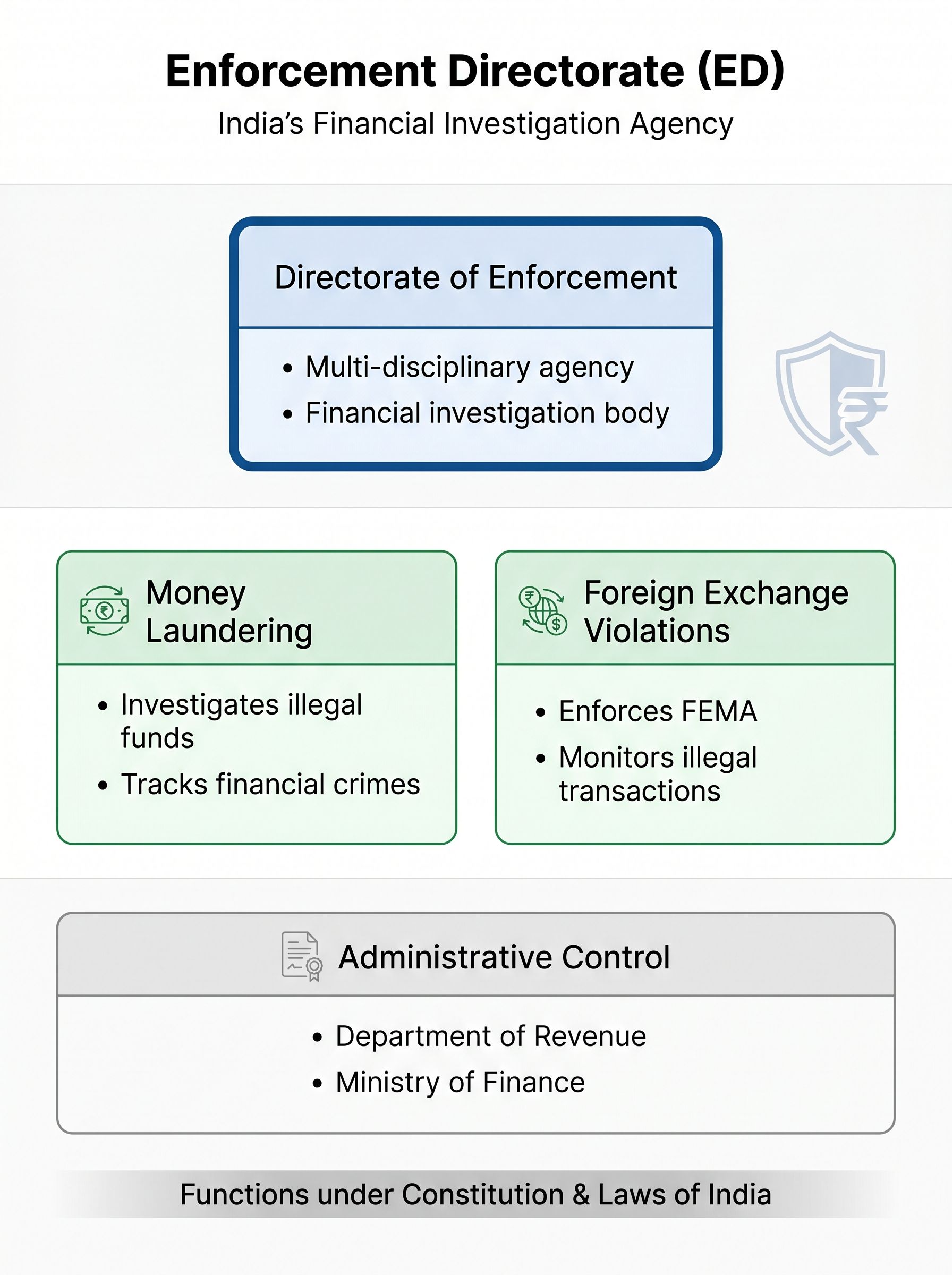
ED

SuperKalam is your personal mentor for UPSC preparation, guiding you at every step of the exam journey.
Download the App


STUDY RESOURCES
CONTACT US
ⓒ Snapstack Technologies Private Limited