GS 3: Economy
Grim future, Pg8
India's core sector growth hits three-month low amidst contracting domestic crude oil and natural gas production, raising concerns about economic resilience.
Practice MCQs
731 Students attempted
Key Highlights:
- The Index of Eight Core Industries growth dropped to a three-month low in February 2026, at half the rate of January 2026.
- The domestic crude oil industry has contracted for six consecutive months and 20 out of the last 24 months.
- The natural gas sector has contracted for the last 20 consecutive months.
- Between 2022-23 and 2025-26, contributions to GDP from private consumption, capital formation, exports, and imports have fallen.
- Oil prices are at more than $100 a barrel due to curtailed commercial fuel sources and global economic uncertainty.
- Economists and rating agencies are downgrading India’s growth outlook to about 6.5%.
Detailed Insights:
- The contraction in domestic oil and gas production was likely due to cheap imports, but increasing domestic production over the last eight months could have built reserves and reduced import dependence amidst rising tensions.
- The Pradhan Mantri Ujjwala Yojana of 2016 should have triggered policies to secure LPG supplies and reserves.
- New GDP data indicates the Indian economy is smaller than previously estimated.
- The share of ‘change in stocks’ has nearly doubled, indicating production without sufficient sales, which will eventually lead to reduced production aligning with subdued demand.
- High oil prices and global economic uncertainty are impacting India's growth, leading to a reassessment of its macroeconomic fundamentals.
Key Concepts Involved:
- Index of Eight Core Industries: A monthly production volume index that indicates the performance of core industries of the Indian economy.
- GDP (Gross Domestic Product): The monetary value of all finished goods and services made within a country during a specific period.
- Pradhan Mantri Ujjwala Yojana: A scheme launched in 2016 to provide LPG connections to women from Below Poverty Line (BPL) households.
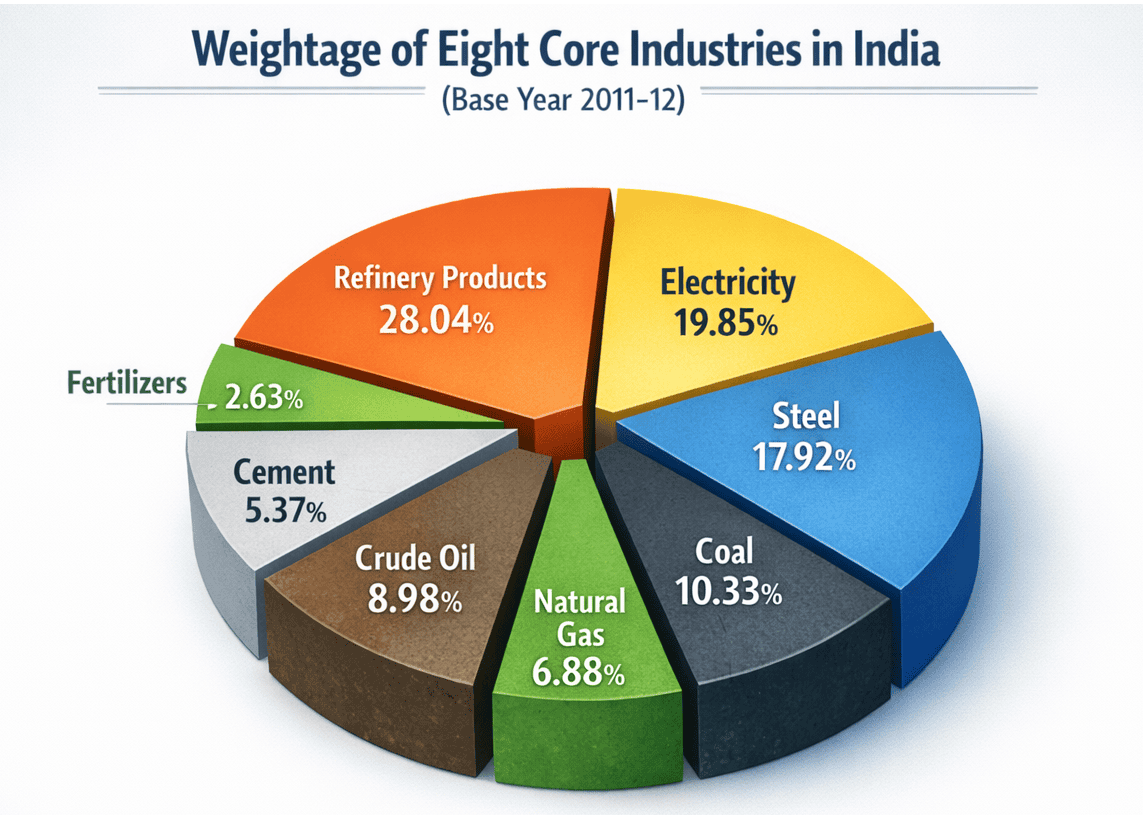
Eight Core Industries

SuperKalam is your personal mentor for UPSC preparation, guiding you at every step of the exam journey.
Download the App


STUDY RESOURCES
CONTACT US
ⓒ Snapstack Technologies Private Limited