GS 2: PolityGS 2: GovernancePrelims
Centre signals early delimitation, women’s quota for 2029 polls, Pg1
Government proposes delimitation based on 2011 Census, increasing Lok Sabha seats to 816 with 273 reserved for women before 2029 elections.
Practice MCQs
731 Students attempted
Key Highlights:
- The Union government plans to introduce an amendment Bill for delimitation based on the 2011 Census to implement the Women’s Reservation Act, 2023, before the 2029 Lok Sabha election.
- The proposed amendments suggest increasing Lok Sabha seats from 543 to 816, reserving 273 seats (33%) for women.
- The amendments may be introduced in the ongoing Budget Session or a specially convened session.
- Consultations are underway with opposition parties to ensure the passage of the Bill, which requires a two-thirds majority in both Houses.
Detailed Insights:
- The primary objective of the amendment is to advance the implementation of the Women's Reservation Act, initially contingent on the completion of the Decadal Census and subsequent delimitation.
- Concerns have been raised by states, particularly in the South, regarding the potential loss of representation due to successful population control measures; the government aims to maintain the existing proportion of seats for all states.
- As per Article 82 of the Constitution, the next delimitation exercise was scheduled post-2026, based on the census; the proposed amendments seek to utilize the 2011 Census data for constituency remaking.
- The Women’s Reservation Act, 2023 (Constitution (106th Amendment) Act, 2023) mandates 33% reservation for women in the Lok Sabha and State Assemblies.
Key Concepts Involved:
- Delimitation: The process of redrawing boundaries of parliamentary or assembly constituencies to represent changes in population.
- Women's Reservation Act: Law mandating a specific percentage of seats in legislatures to be reserved for women.
- Article 82: Constitutional provision concerning the readjustment of the allocation of seats in the Lok Sabha to the states and the division of each state into territorial constituencies after each census.
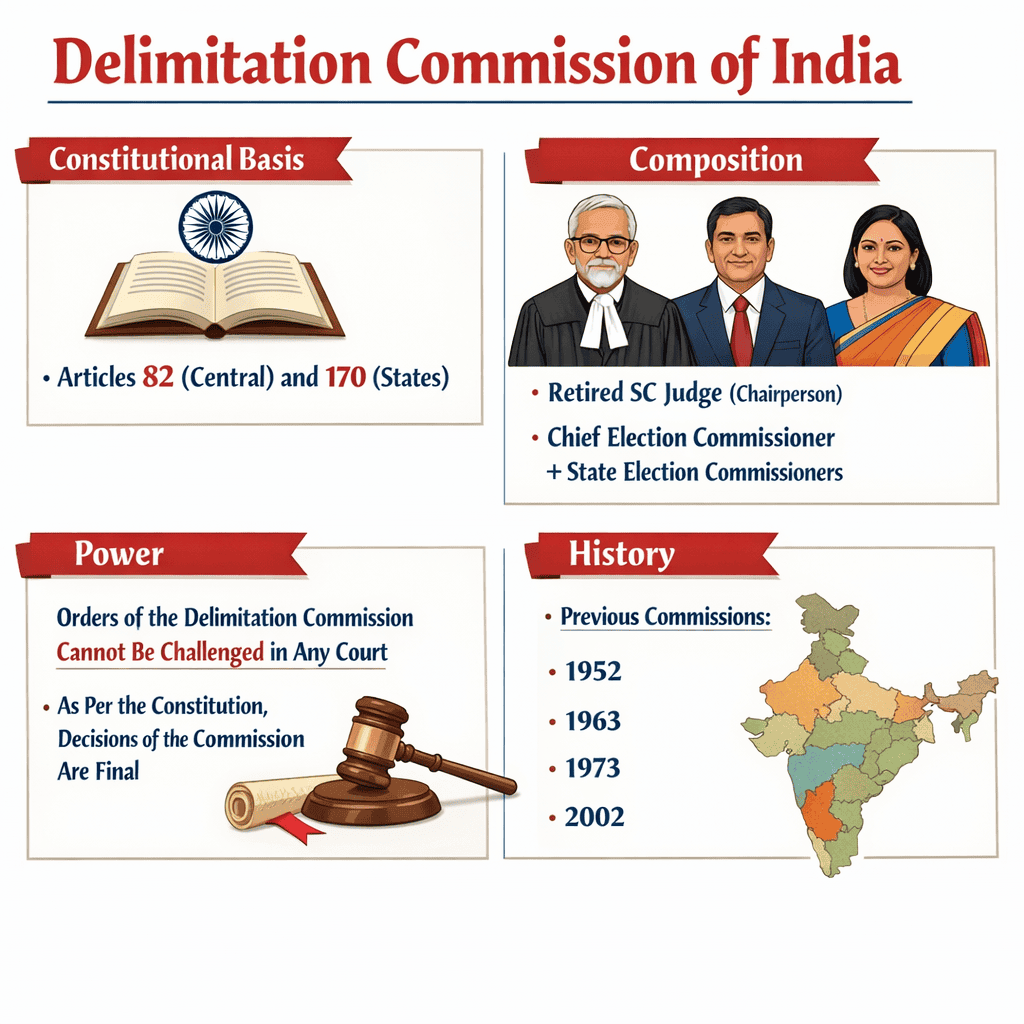
Delimitation Commission

SuperKalam is your personal mentor for UPSC preparation, guiding you at every step of the exam journey.
Download the App


STUDY RESOURCES
CONTACT US
ⓒ Snapstack Technologies Private Limited