GS 2: International RelationsGS 3: Environment & Ecology
COP backs push against trade curbs linked to climate change, silent on fossil fuel roadmap, Pg1
COP30 backs developing nations' concerns on climate finance, trade curbs, omitting fossil fuel phaseout roadmap amid US absence.
Practice MCQs
775 Students attempted
Key Highlights:
- COP30 in Belem, Brazil, adopted an agreement accommodating developing nations' concerns, omitting a fossil-fuel phaseout roadmap.
- The agreement addresses Article 9.1 of the Paris Agreement concerning financial resources from developed countries.
- A two-year work programme will discuss all issues related to climate finance, including Article 9.1.
- The agreement acknowledges concerns about unilateral trade measures like the EU's Carbon Border Adjustment Mechanism (CBAM).
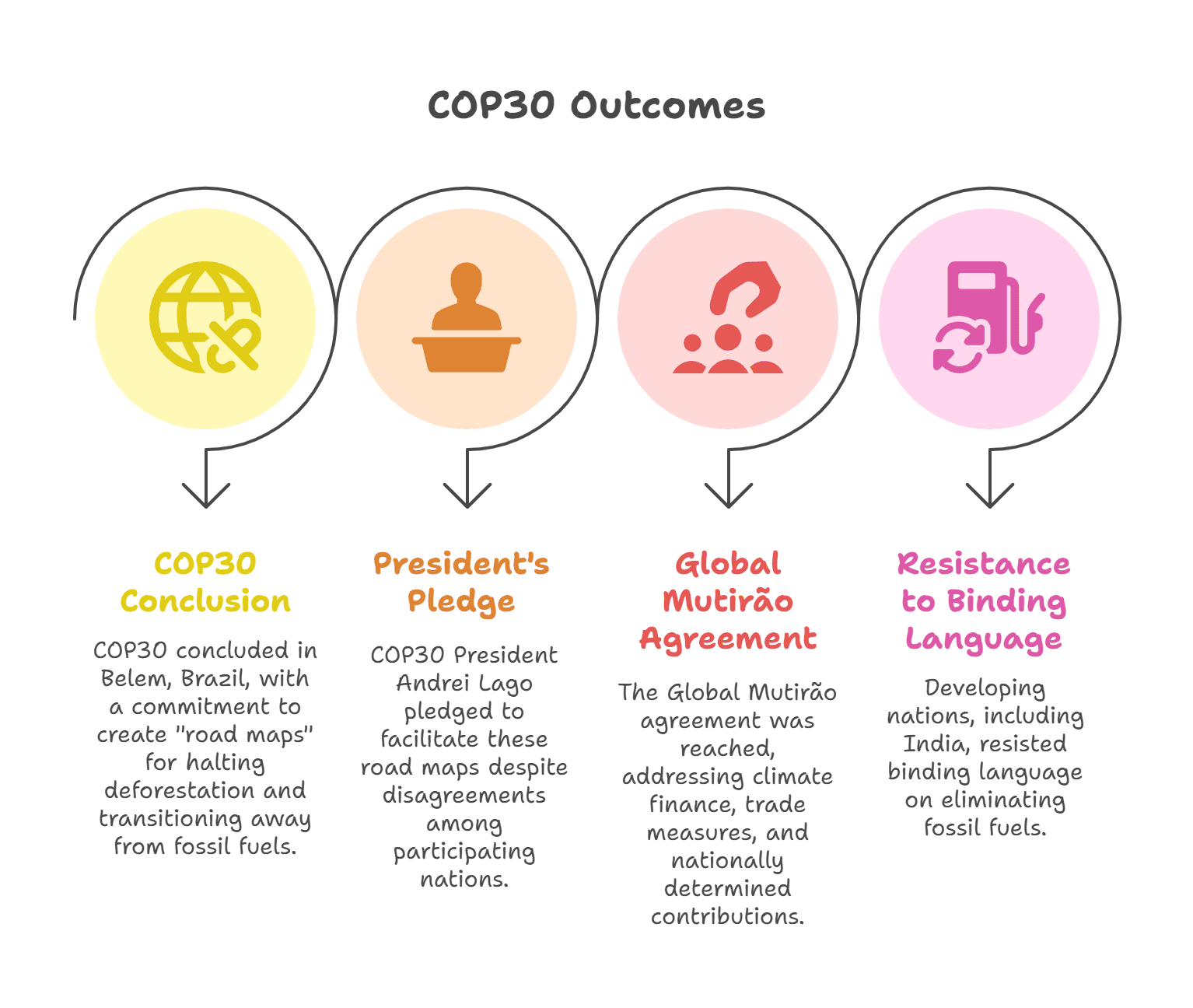
COP30 Outcomes.png
Detailed Insights:
- Developing countries, particularly India, have emphasized the neglect of Article 9.1 of the Paris Agreement, which mandates developed countries to provide financial resources.
- Previous climate finance decisions have primarily focused on Article 9.3, which pertains to developed countries mobilizing climate finance.
- The agreement recognizes the apprehension of countries like China and India, ensuring that climate change response measures do not constitute disguised trade barriers.
- The political package resulting from COP30 signifies a shift in the global power dynamic in climate negotiations, especially with reduced US influence.
- The Carbon Border Adjustment Mechanism (CBAM) is a trade measure that puts a carbon price on imports from countries with less stringent climate policies.
Key Concepts Involved:
- Article 9.1 (Paris Agreement): Requires developed countries to provide financial resources to developing countries for climate action.
- Article 9.3 (Paris Agreement): Focuses on developed countries taking the lead in mobilizing climate finance.
- Carbon Border Adjustment Mechanism (CBAM): A trade measure applying carbon pricing to imports based on their carbon content.

SuperKalam is your personal mentor for UPSC preparation, guiding you at every step of the exam journey.
Download the App


STUDY RESOURCES
CONTACT US
ⓒ Snapstack Technologies Private Limited