GS 3: Internal SecurityGS 3: Science & TechnologyGS 2: International RelationsGS 2: Governance
The challenge of India’s digital sovereignty, Pg6
Foreign tech dependence jeopardizes India's digital sovereignty, exposing critical infrastructure to external control; urgent indigenous development and strategic alliances vital.
Practice MCQs
746 Students attempted
Key Highlights:
- India's digital infrastructure faces significant threats to its sovereignty, highlighted by a CCTV network compromise in April 2026 and a service denial to Nayara Energy in July 2025.
- The CCTV breach was linked to the Chinese software platform EseeCloud, while Nayara Energy lost access to critical digital tools due to Microsoft Corporation enforcing European Union (EU) sanctions against its Russian stakeholder, Rosneft.
- These incidents underscore India's vulnerability due to reliance on foreign technology giants for authentication systems, productivity suites, and cloud platforms.
- Critical Indian businesses and government services become susceptible to decisions made by external sovereigns, potentially disrupting operations and weakening defence capabilities.
- India is actively pursuing a multi-pronged strategy involving indigenous development, private sector participation in defence, and international partnerships to enhance its technological sovereignty.
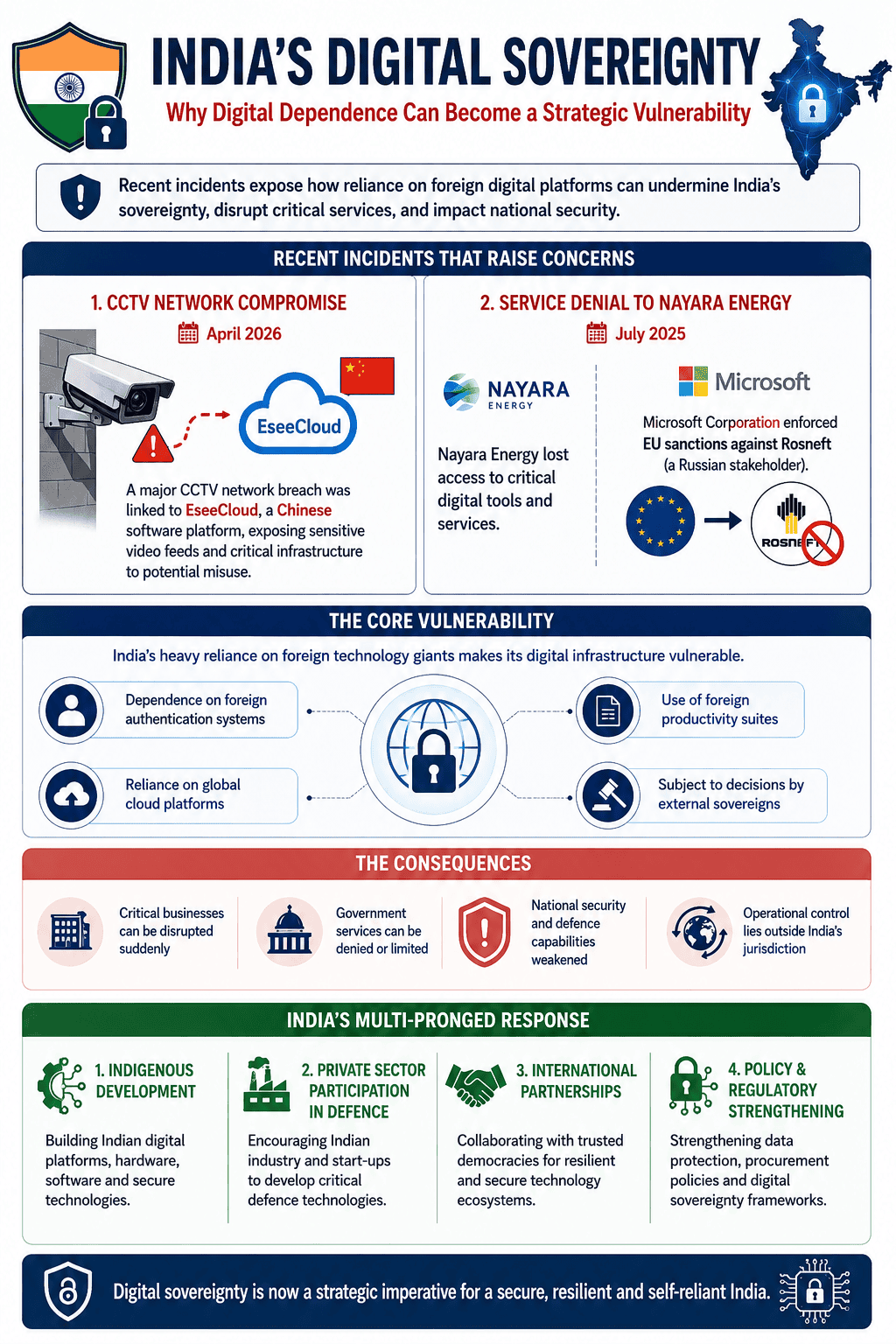
Digital Sovereignty.png
Detailed Insights:
- The compromise of CCTV networks and the Nayara Energy incident demonstrate how foreign control over digital infrastructure can lead to national security risks and economic disruptions.
- Modern warfare's software-defined nature means that intelligence in defence systems, like fighter aircraft and missile systems, can be manipulated by foreign manufacturers under external directives.
- The 1999 Kargil conflict, where India faced limitations on GPS access, serves as a historical precedent for the strategic vulnerability arising from dependence on foreign technology.
- Globally, nations like France, the Netherlands, Denmark, Germany, and the EU are also exploring domestic alternatives to reduce reliance on foreign software and cloud services.
- India's situation is uniquely precarious within the Power Transition Theory framework, as a rising power seeking strategic autonomy while approaching parity with established hegemons.
- Successful indigenous initiatives like UPI and RuPay in payments infrastructure offer a model for extending digital sovereignty to cloud, e-commerce, authentication, and defence technologies.
- Emulating the U.S. defence production model by inviting private sector participation in programs like the Advanced Medium Combat Aircraft aims to foster cutting-edge indigenous capabilities.
- International collaborations, such as the BrahMos missile programme with Russia and the Micron Technology ATMP facility in Sanand, Gujarat, established through India-U.S. technology cooperation, help build technological capabilities without isolation.
- India's decision to join Pax Silica, a U.S.-led initiative on AI and supply-chain security, further strengthens trusted technology partnerships and reduces dependence on specific foreign technologies.
- Addressing the persistent R&D spending deficit, which averaged only 0.74% of GDP between 2000 and 2020, is crucial for India's long-term technological and digital sovereignty.
Key Concepts Involved:
- Digital Sovereignty: A nation's ability to control its digital infrastructure, data, and decision-making processes within its jurisdiction, independent of external influence.
- Power Transition Theory: A theory in international relations suggesting that the likelihood of conflict increases when a rising power approaches parity with a dominant state, especially if the challenger is dissatisfied with the existing international order.
- Assembly, Test, Marking and Packaging (ATMP): The back-end process in semiconductor manufacturing where silicon wafers are processed into individual chips, tested, and packaged for final use.

SuperKalam is your personal mentor for UPSC preparation, guiding you at every step of the exam journey.
Download the App


STUDY RESOURCES
CONTACT US
ⓒ Snapstack Technologies Private Limited