GS 3: EconomyGS 3: Environment & EcologyGS 2: GovernancePrelims
Should strong hybrids be cheaper? Key question as EV policy call nears, Pg4
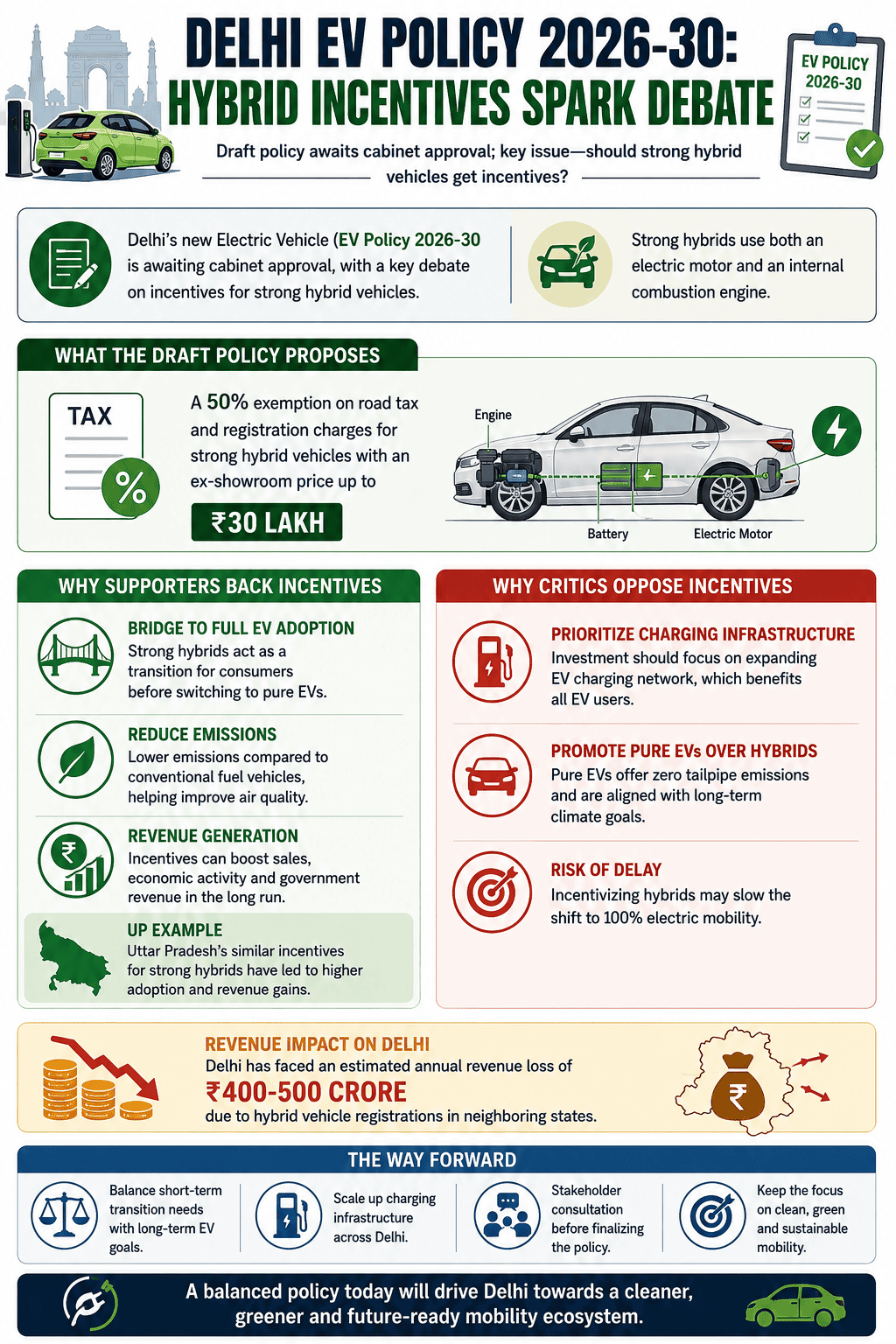
Delhi's new EV Policy 2026-30 sparks fierce debate over 50% road tax exemption for strong hybrids, balancing revenue and green transition.
Practice MCQs
746 Students attempted
Key Highlights:
- Delhi's new Electric Vehicle (EV) Policy 2026-30 is awaiting cabinet approval, with a key debate on incentives for strong hybrid vehicles.
- The draft policy proposes a 50% exemption on road tax and registration charges for strong hybrids with an ex-showroom price up to Rs 30 lakh.
- Proponents argue strong hybrids act as a bridge to full EV adoption, reduce emissions, and can generate revenue, citing Uttar Pradesh's successful implementation of similar incentives.
- Critics advocate for prioritizing investment in charging infrastructure and promoting pure EVs over hybrids.
- Delhi has faced an estimated annual revenue loss of Rs 400-500 crore due to hybrid vehicle registrations in neighboring states.
Delhi EV.png
Detailed Insights:
- The existing EV Policy has undergone multiple extensions, highlighting the urgency for a new framework.
- Over 700 public responses were received on the draft policy, indicating significant stakeholder interest and diverse opinions.
- A strong hybrid combines a traditional Internal Combustion Engine (ICE) with a powerful electric motor and larger battery, enabling electric-only operation at low speeds.
- Organizations like International Road Federation (IRF), Nat Zero Energy Transition Association (NETRA), Nomura Research Institute (NRI), and CUTS International support incentivizing strong hybrids as a transitional technology.
- Uttar Pradesh's 100% road tax exemption for strong hybrids led to a 175% increase in registrations and a 60% rise in monthly revenue.
- Strong hybrids can operate in electric mode for approximately 60% of urban driving, leading to a 25-35% reduction in CO2 emissions compared to conventional vehicles.
- Incentivizing strong hybrids is seen as a way to gradually nudge the public towards electric mobility while the charging infrastructure for pure EVs is still developing.
Key Concepts Involved:
- Strong Hybrid Electric Vehicle (SHEV): A vehicle combining a traditional engine with a powerful electric motor and battery, capable of running on electric power alone at low speeds.
- Electric Vehicle (EV) Policy: Government framework designed to promote the adoption of electric vehicles through incentives, infrastructure development, and regulations.
- Road Tax Exemption: A waiver or reduction in the tax levied on vehicles for using public roads, often used as an incentive for cleaner technologies.
- Internal Combustion Engine (ICE): A heat engine where the combustion of a fuel occurs with an oxidizer (usually air) in a combustion chamber.

SuperKalam is your personal mentor for UPSC preparation, guiding you at every step of the exam journey.
Download the App


STUDY RESOURCES
CONTACT US
ⓒ Snapstack Technologies Private Limited