GS 2: PolityGS 2: GovernanceGS 2: Social JusticePrelims
Right to walk on footpaths: Behind SC order, surge in pedestrian deaths, Pg9
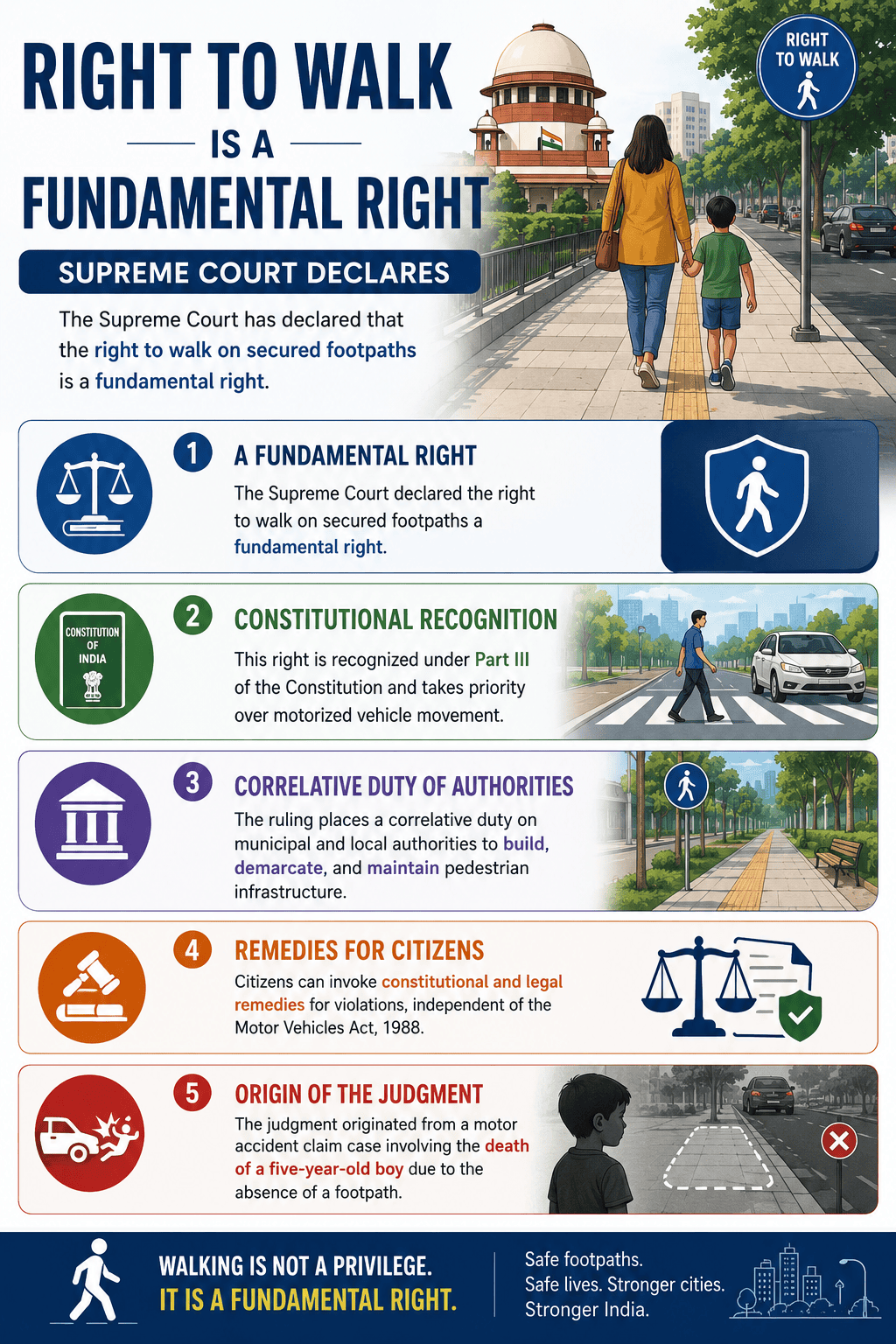
Supreme Court declares right to walk on footpaths a fundamental right, urging new law amidst 163% surge in pedestrian deaths.
Practice MCQs
746 Students attempted
Key Highlights:
- The Supreme Court of India recognized the right to walk on demarcated footpaths as a fundamental right, prioritizing it over the movement of motor vehicles.
- This landmark ruling was prompted by a significant surge in pedestrian deaths across India, which have more than doubled in the last decade.
- The Court urged the government to introduce a new law to implement this right, ensuring accountability for officials and departments regarding pedestrian safety.
- The judgment stemmed from a case involving the death of a five-year-old boy, who was struck by a tanker while walking to school.
- Pedestrian fatalities now constitute the second-highest share of road deaths in India, after two-wheeler users.
Right to Walk.png
Detailed Insights:
- Between 2015 and 2024, total road fatalities increased by 21.24%, while pedestrian deaths surged by nearly 163%, rising from 13,894 to 36,526.
- The share of pedestrian deaths in total road fatalities more than doubled from 9.5% to 20.61% during this period.
- Over 1.8 lakh pedestrians were killed in road accidents between 2019 and 2024, averaging over 30,500 deaths annually.
- National Highways accounted for nearly 31% of all pedestrian fatalities between 2019 and 2024, with Tamil Nadu, Bihar, and Maharashtra recording the highest numbers.
- The Supreme Court observed that road infrastructure is overwhelmingly designed for vehicles, undermining the rights of pedestrians despite walking being a basic human activity.
- The Court criticized the Motor Vehicles Act, 1988, stating it primarily focuses on vehicles, treating human interests as incidental.
- The right to walk is integral to Article 21 (Right to Life and Personal Liberty) and Article 19(1)(d) (Right to move freely) of the Constitution.
- The Court also linked the right to walk to Article 19(1)(a), (b), (c), encompassing expressional, congregational, and associational rights.
- Footpaths were identified as "material resources of the community" under Article 39(b), a Directive Principle of State Policy.
- The ruling places an enforceable duty on urban local bodies, including Urban Development Authorities, Municipal Corporations, Municipalities, and Panchayats, to provide and maintain safe footpaths.
- Citizens can now seek constitutional and legal remedies for violations of the right to walk on demarcated footpaths, independent of the Motor Vehicles Act, 1988.
- The Court emphasized the need for a regulatory body to ensure the effective implementation and protection of this fundamental right.
Key Concepts Involved:
- Fundamental Right: Basic human rights enshrined in Part III (Articles 12-35) of the Indian Constitution, guaranteed to all citizens, and enforceable by courts.
- Motor Vehicles Act, 1988: The primary legislation in India governing motor vehicles and regulating road traffic, often criticized for its vehicle-centric approach.
- Article 21: Guarantees the Right to Life and Personal Liberty, interpreted broadly by the Supreme Court to include various aspects of a dignified life.
- Article 19(1)(d): Enshrines the Right to move freely throughout the territory of India, a component of the broader Right to Freedom.

SuperKalam is your personal mentor for UPSC preparation, guiding you at every step of the exam journey.
Download the App


STUDY RESOURCES
CONTACT US
ⓒ Snapstack Technologies Private Limited