GS 3: Science & TechnologyPrelims
Laser strums atoms in quest for better computers, Pg2
Breakthrough: Lasers generate terahertz waves in superlattices via electron pressure, paving the way for faster spintronics and advanced computers.
Practice MCQs
746 Students attempted
Key Highlights:
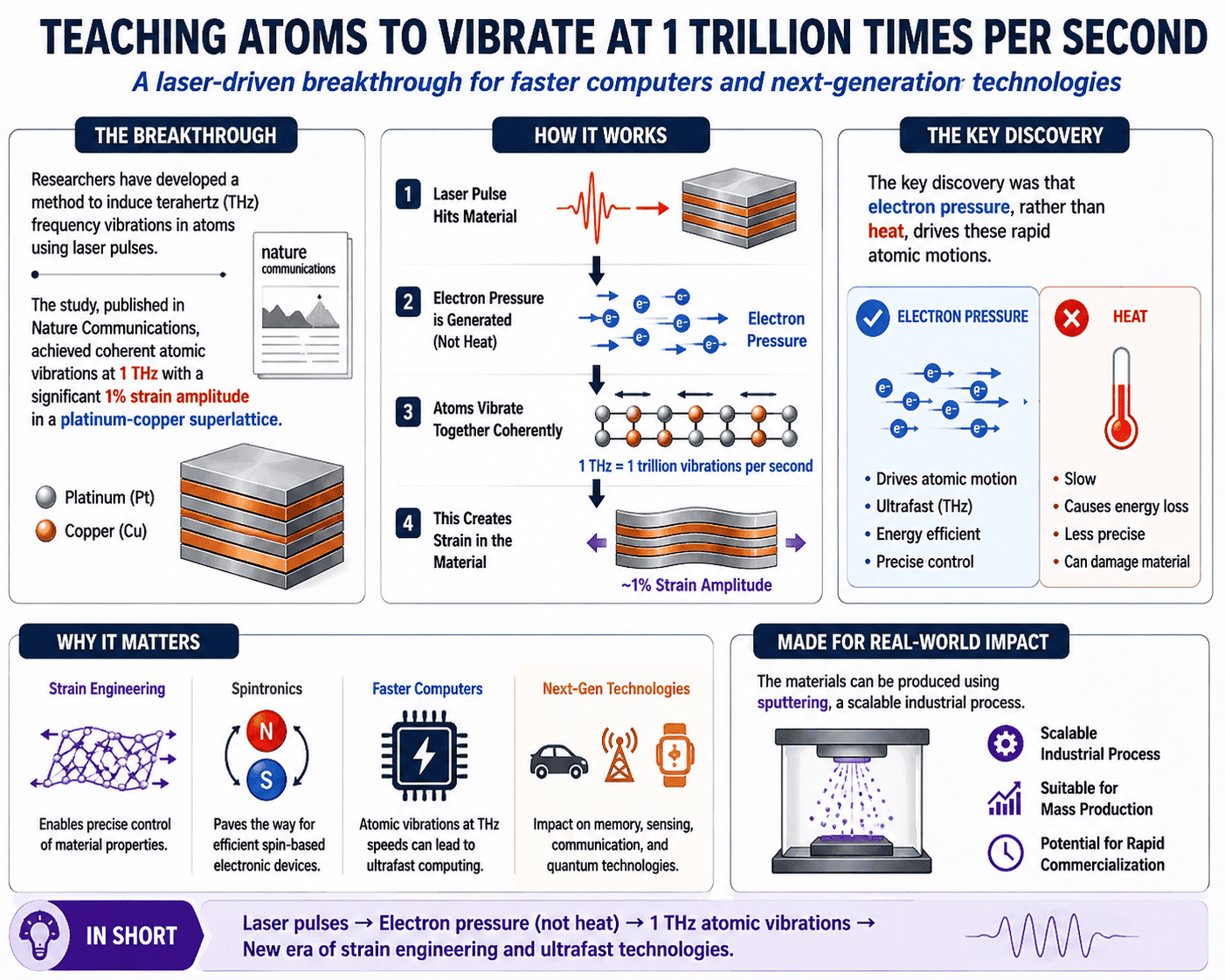
- Researchers have developed a method to induce terahertz (THz) frequency vibrations in atoms using laser pulses, aiming for faster computers.
- The study, published in Nature Communications, utilized a platinum-copper superlattice to achieve coherent atomic vibrations at 1 THz with a significant 1% strain amplitude.
- The key discovery was that electron pressure, rather than heat, drives these rapid atomic motions.
- This breakthrough is vital for advancing strain engineering and developing next-generation technologies like spintronics.
- The materials can be produced using sputtering, a scalable industrial process, suggesting potential for rapid commercialization.
Laser.png
Detailed Insights:
- Current computing technologies are nearing their limits in using electric currents, prompting a search for alternative approaches.
- Strain engineering involves applying mechanical pressure at the atomic level to alter a material's electrical or magnetic properties.
- Achieving THz frequencies for mechanical changes is crucial for the speeds required by future computing technologies.
- The challenge in metals is that electrons quickly spread energy, preventing localized mechanical force and high-frequency strain waves.
- Spintronics is an advanced application that uses the magnetic spin of electrons for data storage and movement, requiring THz vibrations.
- The platinum-copper superlattice was chosen due to platinum's ability to hold electronic energy and copper's capacity for rapid electron movement.
- Ultrafast X-ray diffraction was used to observe atomic movements in real-time following the laser pulse.
- The finding that electron pressure is the driving force was unexpected and provides a new mechanism for manipulating atoms rapidly.
- The discovery contributes to the field of thermoacoustic metamaterials, which are nanostructured materials designed to control sound and heat.
- Sputtering is a cost-effective and scalable manufacturing technique, making the technology viable for industrial application beyond the laboratory.
Scientific/Technical Concepts Involved:
- Strain Engineering: A technique that modifies a material's properties by mechanically deforming its atomic lattice.
- Terahertz (THz) Frequencies: Electromagnetic frequencies ranging from 0.1 to 10 THz, critical for high-speed data processing and communication.
- Spintronics: An emerging technology that utilizes the intrinsic spin of electrons, in addition to their charge, for data storage and processing.
- Superlattice: A synthetic periodic structure composed of alternating layers of two or more different materials, typically at the nanoscale.

SuperKalam is your personal mentor for UPSC preparation, guiding you at every step of the exam journey.
Download the App


STUDY RESOURCES
CONTACT US
ⓒ Snapstack Technologies Private Limited