GS 2: PolityGS 2: GovernancePrelims
It's time to reimagine the anti-defection law, Pg11
Expert urges reimagining or abolishing the anti-defection law, citing its failure to curb defections and stifling intra-party democracy after four decades.
Practice MCQs
746 Students attempted
Key Highlights:
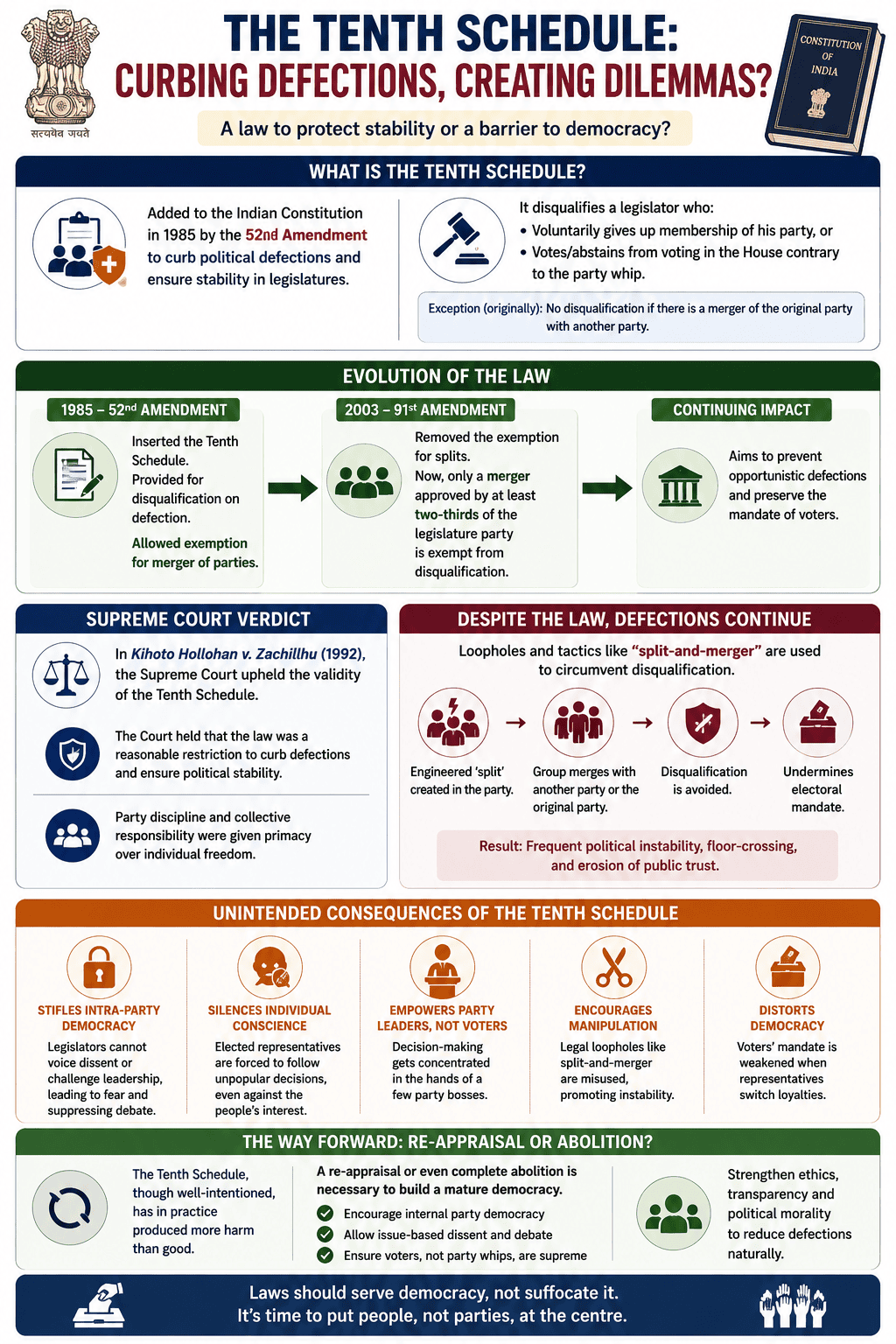
- The Tenth Schedule was added to the Indian Constitution in 1985 by the 52nd Amendment to curb political defections.
- It disqualifies legislators who defect from their party or defy its whip, with an exception for party mergers.
- The 91st Amendment in 2003 removed the exemption for splits, requiring two-thirds of members for a merger to avoid disqualification.
- The Supreme Court upheld the validity of the Tenth Schedule in the Kihoto Hollohan case, prioritizing party discipline.
- Despite the law, defections persist through tactics like "split-and-merger," often undermining electoral mandates.
- The article suggests a re-appraisal or complete abolition of the law due to its unintended consequences, such as stifling intra-party democracy.
10th Schedule.png
Detailed Insights:
- The Tenth Schedule was introduced to address the "Aaya Rams, Gaya Rams" phenomenon, where frequent party switching led to governmental instability.
- The Kihoto Hollohan case affirmed the Speaker's role as the adjudicating authority in defection cases, though this has been a point of contention.
- The 91st Amendment Act aimed to strengthen the anti-defection law by making it harder for smaller groups to split and avoid disqualification.
- Defections often occur with the implicit or explicit blessing of ruling parties, making disqualification rare and ineffective in practice.
- Unlike mature democracies such as the UK and US, where legislators can vote against their party on specific issues, India's law restricts such independent political positions.
- A significant criticism is that the Tenth Schedule has fostered a "high-command culture" and diminished intra-party democracy by making legislators overly subservient to party leadership.
- The law has not entirely eliminated horse-trading or the toppling of governments but has made such activities more complex or expensive.
Key Concepts Involved:
- Tenth Schedule: Part of the Indian Constitution outlining provisions for disqualification of Members of Parliament and State Legislatures on grounds of defection.
- Whip: A directive issued by a political party to its members in a legislature, instructing them on how to vote or behave on a particular issue.
- Defection: The act of an elected representative abandoning their original political party to join another or form a new one.
- Intra-party democracy: The extent to which democratic principles, such as open debate, elections, and accountability, are practiced within a political party.

SuperKalam is your personal mentor for UPSC preparation, guiding you at every step of the exam journey.
Download the App


STUDY RESOURCES
CONTACT US
ⓒ Snapstack Technologies Private Limited