GS 1: Art & CultureGS 3: Science & TechnologyPrelims
ASI transfers Rakhigarhi skeletons to AnSI for a scientific investigation, Pg12
ASI transfers 4,600-year-old Rakhigarhi skeletons to AnSI for advanced scientific investigation, aiming to unravel Indus-Saraswati Civilisation mysteries and inform Aryan migration debate.
Practice MCQs
746 Students attempted
Key Highlights:
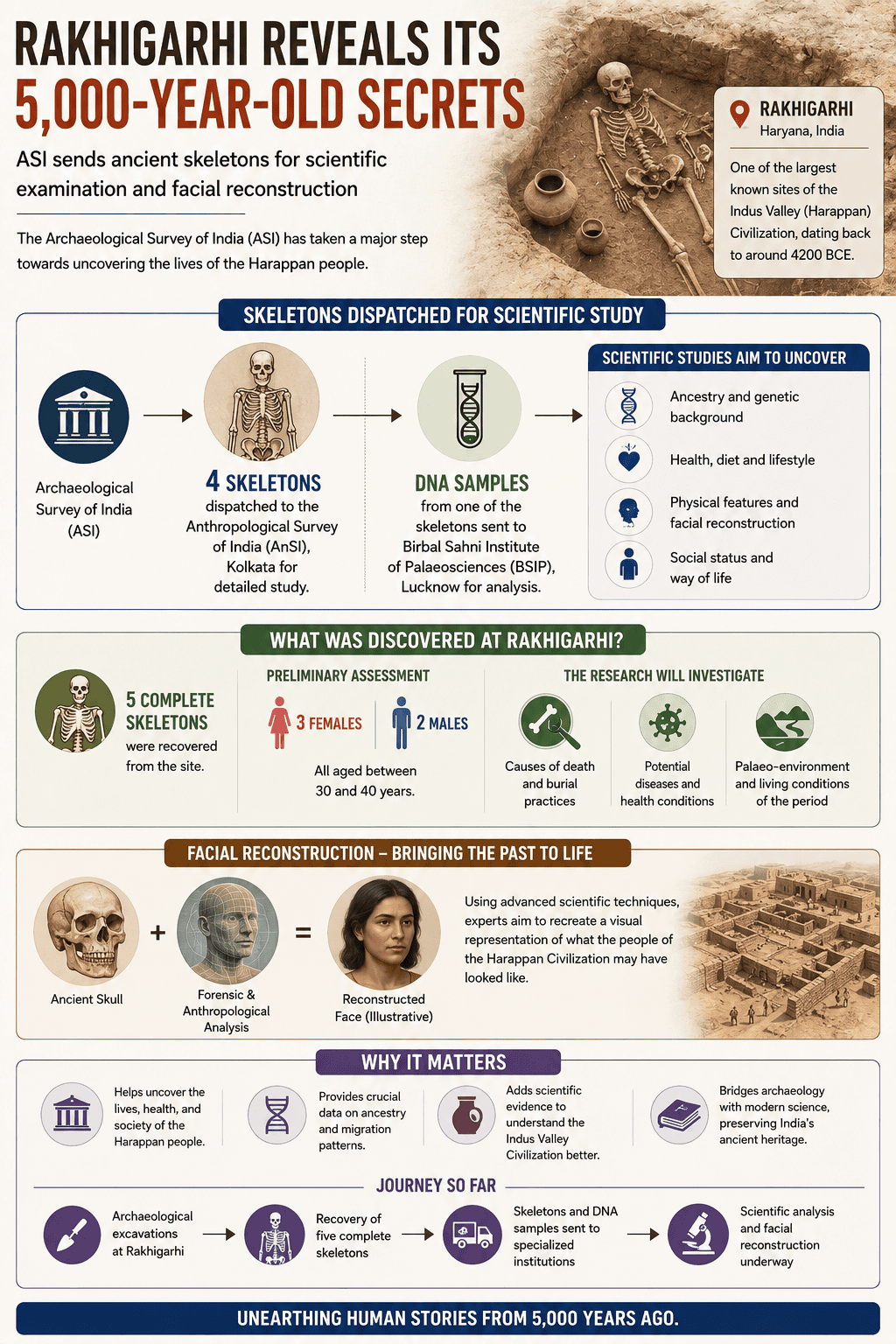
- The Archaeological Survey of India (ASI) has transferred human skeletal remains from Rakhigarhi to the Anthropological Survey of India (AnSI) for scientific investigation.
- This transfer is based on a Memorandum of Understanding (MoU) between the two institutions to advance multidisciplinary research.
- Rakhigarhi, located in Haryana, is recognized as the largest settlement of the Harappan Civilisation, spanning approximately 550 hectares.
- Three complete human skeletons and fragments from Mound 7, a burial plot, have been moved to AnSI's laboratory in Kolkata.
- A 4,600-year-old female skeleton from Rakhigarhi previously showed no steppe pastoral gene, fueling debates on Aryan migration.
Rakhigarhi.png
Detailed Insights:
- The investigation aims to apply modern scientific techniques like ancient DNA (aDNA) analysis, stable isotope studies, and palaeopathological investigations.
- This research is expected to provide crucial insights into the Indus-Saraswati Civilisation and its inhabitants.
- The collaboration involves leading institutions such as the Birbal Sahni Institute of Palaeosciences, University College London, and Banaras Hindu University.
- The findings could significantly contribute to understanding the genetic origins and population movements in ancient India, particularly regarding the Aryan migration theory.
- Rakhigarhi has yielded evidence of continuous habitation from the Early Harappan to the Mature Harappan periods, highlighting its long-term significance.
Key Concepts Involved:
- Archaeological Survey of India (ASI): A premier Indian government agency responsible for archaeological research and the conservation of cultural heritage.
- Anthropological Survey of India (AnSI): A scientific institution under the Ministry of Culture, dedicated to anthropological research and human biological studies.
- Indus-Saraswati Civilisation: Also known as the Harappan Civilisation, it was a Bronze Age civilization in the northwestern regions of South Asia.
- Ancient DNA (aDNA) analysis: The study of DNA extracted from archaeological remains, providing insights into ancient populations and their genetic history.
- Aryan migration theory: A hypothesis suggesting the arrival of Indo-Aryan-speaking people into the Indian subcontinent from Central Asia during the Bronze Age.

SuperKalam is your personal mentor for UPSC preparation, guiding you at every step of the exam journey.
Download the App


STUDY RESOURCES
CONTACT US
ⓒ Snapstack Technologies Private Limited