GS 3: Science & TechnologyPrelims
Science of induction cooktop, in demand amid LPG pinch, Pg4
Induction cooktops surge in popularity amidst LPG price hikes, utilizing electromagnetic induction for efficient, flameless heating, offering safer cooking.
Practice MCQs
724 Students attempted
Key Highlights:
- Disruption of cooking gas supply due to the West Asia conflict has increased demand for induction cooktops.
- Induction cooktops use electromagnetic heating to directly heat cookware, unlike traditional gas stoves that rely on combustion.
- These cooktops utilize alternating current (AC) to generate a fluctuating magnetic field, which induces eddy currents in ferromagnetic cookware.
- Induction cooktops are more energy-efficient, converting 85% to 90% of electrical energy into cooking heat, compared to 40% to 50% for LPG stoves.
Detailed Insights:
- Induction cooktops feature a coil of copper wire beneath a ceramic or glass surface, generating a fluctuating magnetic field when AC flows through it.
- The fluctuating magnetic field passes through the glass surface and induces eddy currents in the ferromagnetic cookware due to Faraday's Law of Induction.
- Eddy currents encounter electrical resistance in the cookware, converting kinetic energy into thermal energy (heat) according to Joule's Law of Heating.
- The heat generated is proportional to the square of the current, meaning small increases in current lead to larger increases in heat, making the process efficient.
- While energy-efficient and safer, induction cooktops have limitations, including lower durability, dependence on electricity, and incompatibility with all cooking styles.
Scientific/Technical Concepts Involved:
- Alternating Current (AC): Electric current in which the flow of electrons reverses direction at regular intervals.
- Faraday's Law of Induction: A changing magnetic field induces a voltage and electric current in nearby electrical conductors.
- Eddy Currents: Localized, swirling electrical currents generated in a conductor by a changing magnetic field.
- Joule's Law of Heating: The heat generated when current flows through a material is proportional to the current squared, resistance, and time.
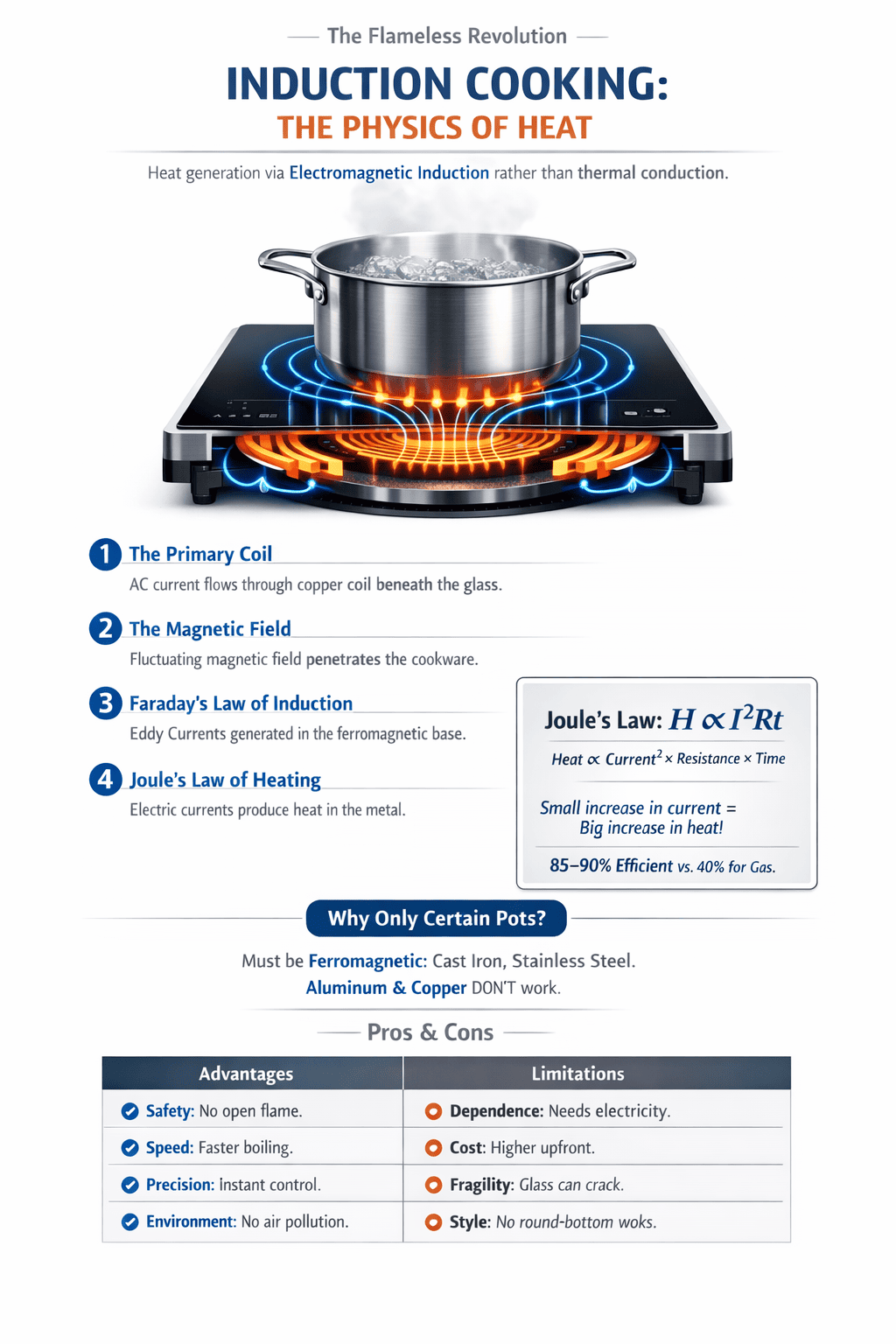
Induction Cooking

SuperKalam is your personal mentor for UPSC preparation, guiding you at every step of the exam journey.
Download the App


STUDY RESOURCES
CONTACT US
ⓒ Snapstack Technologies Private Limited